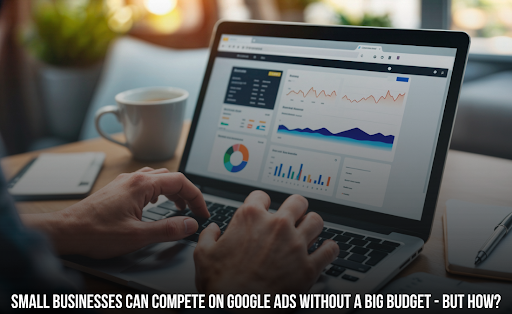
Google Ads can feel like a game built for bigger players. Costs per click keep climbing, and brands with bigger budgets can afford to be patient while their campaigns learn and improve.
If you run a small business, that can feel discouraging. But it doesn’t mean Google Ads for small businesses is a lost cause. It means the strategy has to be different.
Big brands win with budget. Small businesses win with focus. Here’s how to actually make that work.
TL;DR
- Small businesses don’t need a bigger budget to compete. They need sharper targeting and cleaner tracking.
- Quality traffic beats quantity every time when your budget is limited.
- Negative keywords and accurate conversion tracking protect every dollar you spend.
- Automated bidding needs data to work well, so give it time before judging results too early.
- Google’s own creative tools can replace an expensive production budget.
- Google isn’t the only channel. Spreading a small business marketing budget across a couple of platforms often beats putting everything in one place.
Why small businesses feel priced out
A few real things are working against smaller advertisers right now.
Costs per click have been rising across most industries, so the same budget buys fewer clicks than it used to.
Automated bid strategies and responsive search ads perform better with more data flowing through the account. Bigger accounts hit that threshold fast. Smaller accounts with modest daily budgets take longer, sometimes months, before the system has enough signal to optimize well.
Running a Google Ads account well also takes real skill. Bid strategy, match types, audience layers, asset testing. Bigger companies often have a person or a whole team dedicated to this. Small business owners are usually doing it themselves, between everything else on their plate.
And then there’s brand awareness. People click more often on names they already recognize. A small business without that recognition yet has to work harder to earn the same click.
None of that means small businesses can’t win. It means winning looks different than just spending more.
1. Chase quality traffic, not big numbers
More clicks feels like progress. It isn’t, if those clicks aren’t from people who actually want what you sell.
A small budget goes a lot further when it’s spent on a narrow, well matched audience instead of a broad one. Tighter keyword lists, specific ad copy, and landing pages built for one clear offer will usually outperform a wide net, even if the impression and click numbers look smaller on paper.
Say you run a bakery that only does wedding cakes. Your keywords, your ad text, and your landing page should all speak directly to someone planning a wedding, not to anyone who searches “cakes near me.”
Fewer clicks, but far more of them turn into actual customers. That’s the trade small businesses should be making on purpose.
2. Build your negative keyword list early, and keep it updated
Negative keywords are one of the simplest ways to stop paying for clicks that were never going to convert.
If you sell premium products, exclude searches with words like “free,” “cheap,” or “how to.” If you only serve a certain area, exclude location terms outside it. If you sell one specific service, exclude the searches for related things you don’t offer.
Most small accounts set a negative keyword list once and forget about it. Search behavior shifts constantly, so it’s worth checking your search terms report every few weeks and adding new exclusions as odd, irrelevant queries show up. This single habit protects your budget more than almost anything else on this list.
3. Get conversion tracking right before you optimize anything else
You can’t fix what you can’t measure. Without accurate conversion tracking, you’re optimizing a campaign based on guesses.
For a small budget, this matters even more, because every dollar needs to count. Set up conversion tracking for the actions that actually matter to your business: a form fill, a call, a purchase, a booking. Then check that it’s firing correctly before you trust any of the numbers in your account.
A lot of struggling accounts aren’t actually underperforming. They’re just being judged, and optimized, using bad data.
4. Let automated bidding earn your trust with time
Smart Bidding and other automated strategies genuinely work well, but they need enough conversion data to learn what a good result looks like.
A small budget account naturally generates fewer conversions per week than a large one, so that learning period takes longer. Judging an automated strategy after three or four days almost never gives you the real picture.
If you’re just starting out, consider a simpler bidding approach first, focused on getting conversion volume up. Once you have a steady stream of real conversion data, switching to a target cost or target return strategy tends to work a lot better than starting there on day one.
5. Use built in creative tools instead of a production budget
Good ad creative used to mean hiring a designer or a video editor. That’s no longer the only option.
Google Ads now includes built in tools, like Asset Studio, that let you generate and edit images and short videos directly inside the platform. For a small business, that means better looking ads without a separate production budget or timeline.
Just keep it on brand. It’s tempting to get playful with what these tools can generate, but consistent, recognizable creative builds trust over time. Novelty for its own sake usually doesn’t convert.
6. Don’t put your entire budget in one place
Google Ads is a major channel, but it isn’t the only one, and a smart small business marketing plan rarely relies on a single platform.
Microsoft Advertising often has lower costs per click in the same industries, and it reaches an audience that overlaps with, but isn’t identical to, Google’s. The setup will feel familiar if you already know Google Ads.
Social platforms are worth testing too, especially if your audience spends real time there. Splitting a small budget across two well chosen channels, instead of one crowded one, often produces steadier results.
7. Know when outside help actually pays for itself
Running PPC ads well takes ongoing time, not just a one time setup. At some point, a lot of small business owners have to decide whether managing it themselves is still the best use of their hours.
That’s usually when a B2B Google Ads agency starts to make sense, not because a small budget can’t work on its own, but because a second set of experienced eyes tends to catch waste that’s easy to miss when you’re closest to the account. If you go this route, ask specifically how they’ve handled small budget accounts before, since the strategy for a five hundred dollar monthly budget is genuinely different from a ten thousand dollar one.
You don’t need outside help to succeed on Google Ads. But if your time is better spent running the business than managing bids, it’s worth honestly weighing the cost against what you’d get back.
A simple weekly habit that protects your budget
You don’t need a huge amount of time each week. You need consistency.
- Check your search terms report and add any new negative keywords.
- Confirm conversion tracking is still firing correctly.
- Pause anything with real spend and zero results after a fair testing period.
- Review your top performing ads and keywords, and lean further into what’s working.
- Give any new bidding strategy or campaign at least a couple of weeks before judging it.
That’s it. Small, regular check ins beat one big monthly overhaul almost every time.
Common mistakes small businesses make on Google Ads
- Judging results too early, before the account has enough data to be reliable
- Skipping conversion tracking setup, then optimizing based on guesses
- Going broad with keywords to chase impression volume
- Letting the negative keyword list go stale
- Putting the entire budget into one channel with no comparison point
Frequently asked questions
What is a good Google Ads budget for a small business?
There’s no universal number, since it depends on your industry’s cost per click and how many conversions you need to make good decisions. A more useful approach is starting with what you can commit to consistently for at least a month, then adjusting based on real conversion data rather than picking a number and hoping.
Is PPC or SEO better for small businesses?
They solve different problems. PPC ads can drive traffic almost immediately, which is useful when you need results now. SEO builds more sustainable, lower cost traffic over time, but it takes longer to show up. Most small businesses benefit from doing at least some of both, even if PPC starts first.
How long does it take to see results from Google Ads?
Expect a real learning period, often several weeks, before an account is optimized well. Early results are rarely the final picture, especially for automated bidding strategies that need conversion data to improve.
Do small businesses need a B2B Google Ads agency?
Not always. Plenty of small businesses run their own accounts successfully, especially with a modest, well managed budget. An agency tends to make more sense once account complexity, spend, or your own time constraints make DIY management genuinely harder than it’s worth.
What’s the difference between PPC ads and Google Ads?
Pay per click, or PPC, is the broader model where you pay each time someone clicks your ad. Google Ads is one specific platform that runs on that model. Microsoft Advertising and several social platforms also use pay per click, so Google Ads is one option within the larger PPC category, not the only one.