
How OneMiners Advances Crypto Mining With AI


Inside the AI Smart Mining layer, the automated uptime system and the 16-site power network that turn machine learning into margin you can measure.
Every Bitcoin miner on earth is paid from the same pot. As of September 8, 2026, the network is grinding at roughly 912 EH/s against a difficulty of 127.45T (Blockchair), Bitcoin trades near $78,639 (CoinGecko), and transaction fees added just 0.553% to miner revenue over the last 144 blocks (mempool.space). Run that through the arithmetic and hashprice lands at about $39.00 per PH/s per day – $0.0390 for every terahash you point at the network. Nobody gets a better number. The only things you control are what your electricity costs and how well your fleet is run. That second variable is where artificial intelligence earns its place, and it is the layer OneMiners has been building since May 2024.
Let us be precise about what AI means here, because the phrase has been abused. It is not a coin. It is not an app that mines for you. It is a control layer sitting on top of three real, measurable levers: the power price and grid conditions at each site, the health of every individual machine, and the per-unit tuning that decides how much hash each one produces per watt. Automate those three well and a fleet quietly out-earns an identical fleet running stock settings. Automate them badly, or not at all, and you leave that difference on the table every single day. The rest of this article is what OneMiners actually runs, what it is worth in dollars, and where the honest limits are.
Key takeaways (September 2026)
● Hashprice is about $39.00/PH/s/day, so an Antminer S23 Hyd (580 TH/s) grosses roughly $22.62/day before power. Every operator starts from that same figure.
● OneMiners runs AI Smart Mining across its network – automated pool hopping, dynamic overclocking tuned to each regional grid, and a model retrained daily – for an in-house uplift range of 6-15% on net margin.
● A 6-15% uplift on a single S23 Hyd at $0.048/kWh is worth roughly $356 to $891 more per machine per year. On a rack it compounds fast.
● Independent data agrees with the band: Luxor’s LuxOS firmware measures 12.3 J/TH on an S21 XP against 13.5 J/TH stock (+9.9% efficiency), and Luxor’s ERCOT backtests put intelligent curtailment 8-14% ahead of legacy on/off strategies.
● AI is a multiplier, not a base. It multiplies whatever margin your electricity contract already allows – which is why it pays hardest on 16 sites running from 3.6 cents per kWh on a 7-year prepaid rate.
What AI actually does inside a mining operation
Strip away the marketing and a mining farm is three optimisation problems running at once, on three different clocks. The first is energy: power prices move by the hour in liberalised markets, grids issue curtailment signals, and ambient temperature changes what a machine can safely draw. The second is hardware health: hashboards degrade, fans fail, coolant loops foul, and a unit that has quietly dropped 8% of its chips still looks online in a dashboard. The third is tuning: every ASIC has a frequency and voltage curve, and the stock factory point is a conservative compromise chosen for a warehouse in an unknown climate, not for your specific rack in your specific building.
A human operator can solve any one of these on any given day. No human team can solve all three, on every unit, continuously, across sixteen sites in fourteen countries. That is a machine-learning problem, and it is a well-posed one: the inputs are numeric and streaming, the feedback loop is fast, and the objective function is unambiguous. Maximise sats per kilowatt-hour, subject to keeping hardware alive and inside its warranty envelope.
● Energy loop – reads grid load and price signals, decides when to throttle, curtail or push, and how fast to recover afterwards.
● Health loop – watches per-board hashrate, temperature deltas, fan RPM and error rates to catch a failing unit before it drops offline.
● Tuning loop – moves each machine along its own frequency and voltage curve toward the best real J/TH that unit can hold in that room.
● Revenue loop – routes hashrate to the pool paying best right now, rather than to whichever pool was configured on install day.
Inside AI Smart Mining: pool hopping, dynamic overclocking, daily retraining
OneMiners shipped AI Smart Mining as a platform feature in May 2024 and has described it since as a model that is improved and retrained on a daily basis. Two of its behaviours are documented on the location pages and are worth understanding, because they are the ones that show up in a payout statement. The first is automated pool hopping: the system continuously compares what each mining pool is actually paying and moves hashrate accordingly, instead of leaving a fleet parked on the pool that happened to be configured at install. The second is dynamic overclocking tailored to the regional grid – the tuning curve for a hydro-cooled unit in Ethiopia is not the tuning curve for the same model in Dubai, and a static firmware profile cannot know the difference.
The daily retraining matters more than it sounds. A tuning model that was correct in March is stale by September: difficulty has moved, fee behaviour has changed, seasonal ambient temperature has shifted the thermal headroom in every building, and the fleet itself has aged. A model retrained against yesterday’s telemetry is optimising the farm as it exists today. A firmware profile flashed once at commissioning is optimising a farm that no longer exists.
Two design choices keep this honest. The tuning stays inside the manufacturer’s safe envelope, because OneMiners carries a 7-year hardware warranty and has no interest in cooking the machines it has to repair. And the optimisation runs on the operator’s side of the meter rather than on the customer’s – there is no firmware for a client to flash, no risk of a bricked control board, and no fee taken from the upside, because management fees are 0%.
The efficiency math: what a 6-15% uplift is actually worth
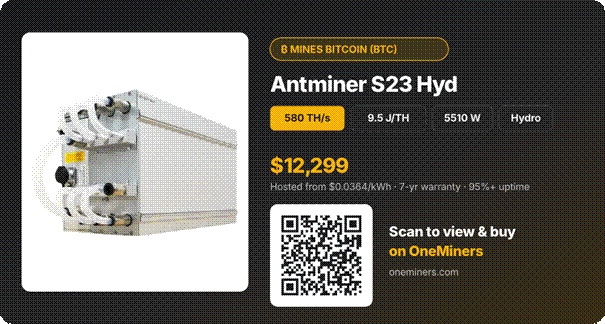
Percentages are easy to wave around, so here is the arithmetic on a machine you can buy today. The Antminer S23 Hyd runs 580 TH/s at 5,510 W, which is 9.5 J/TH – currently the most efficient class of hardware in the catalogue. At today’s $0.0390 per TH per day it grosses $22.62/day. It draws 132.24 kWh/day, so its power bill is simply that figure times your rate. Note the break-even first: at 9.5 J/TH this unit stops making money at about $0.171/kWh, which is why efficiency, not raw hashrate, is what decides survival.
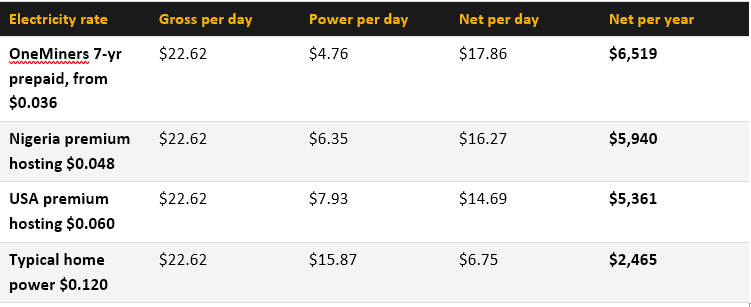
At the $0.048/kWh premium rate published for the Nigeria site, power costs $6.35/day and the machine nets $16.27/day, or about $5,940 a year. Now apply the uplift band. A 6% improvement in net margin is $17.25/day; a 15% improvement is $18.72/day. Across a year that is $356 to $891 of additional margin from one machine, with no extra hardware, no extra electricity contract and no extra capital. Put twenty of them in a rack and the same software layer is worth roughly $7,000 to $17,800 a year. The uplift did not come from the machine. It came from running the machine properly.
The table below is the same unit priced against four different electricity rates, because that comparison is the whole argument. The spread between the cheapest OneMiners contract and typical residential power is larger than any tuning gain any software can deliver – which is exactly why the AI layer belongs on top of a cheap kilowatt rather than instead of one.
One Antminer S23 Hyd (580 TH/s, 9.5 J/TH) at four electricity rates – hashprice $39.00/PH/s/day
The uptime system: grid load, ASIC health and automated restarts
Optimisation is worthless on a machine that is switched off. OneMiners describes its Georgia facility as managed by a proprietary platform and AI automation that monitors grid loads and ASIC health, holding a 98% average uptime through automated restarts and real-time performance tuning. The same automation underpins the network-wide 98%+ average uptime figure and the 95%+ contractual SLA floor that carries compensation when it is missed.
The value here is asymmetric and most operators underestimate it. Our S23 Hyd nets $16.27/day at $0.048/kWh, so every 1% of annual uptime is worth about $59 per machine per year. A unit that hangs on a Friday night and waits until Monday for a human to notice has cost roughly $49 in margin – more than the entire theoretical gain from a week of perfect tuning. Detecting the hang in minutes and restarting it automatically is, in pure dollar terms, the highest-yield thing the AI layer does. Predictive health monitoring extends the same logic further back in the chain: a hashboard showing a rising temperature delta can be scheduled for service before it fails, rather than after.
● Automated restarts recover a hung unit in minutes instead of hours or days.
● Per-board telemetry surfaces a degrading hashboard while it is still earning, so service is scheduled rather than emergency.
● On-site repair centres plus continental hubs mean a flagged unit gets hands on it quickly, and 7-year warranty cover means a repair is not a surprise invoice.
● Cover for units that fail on arrival is built into the hosting terms, so a bad unit never becomes a customer problem.
Independent evidence: the uplift band is real
A vendor quoting its own optimisation gain deserves scepticism, so it is worth checking the number against the wider industry. Luxor’s Hashrate Index has published measured firmware results that land in the same band: LuxOS running on an Antminer S21 XP delivers 12.3 J/TH against a stock 13.5 J/TH, a 9.9% efficiency improvement on default mode, on identical hardware. Luxor’s backtesting of intelligent curtailment strategies in the ERCOT market shows 8-14% higher profitability than legacy on/off approaches. Soluna reported roughly $937,000 in annualised revenue uplift after deploying the same firmware across its Texas fleet, attributed to 50% faster curtailment recovery and a 5.9% hashrate gain.
Those are third-party numbers on third-party fleets, and they matter for two reasons. First, they confirm that software-level optimisation in the high single digits to low teens is a measured engineering result rather than a marketing figure – the 6-15% range OneMiners quotes sits squarely inside independently published territory. Second, they show what the discipline is worth at scale: a single mid-sized fleet recovered close to a million dollars a year purely from running its existing hardware more intelligently.
One clarification on our own numbers, because precision is the point of this article. The OneMiners homepage has historically advertised a 6-115% range for AI Smart Mining. That upper figure describes an extreme case – a badly configured, badly cooled, poorly pooled fleet being brought to a properly tuned baseline – and it is not what a well-run machine should expect. The honest planning range for hardware already hosted in a purpose-built facility is 6-15%, and that is the number used throughout this article.
Why AI only compounds on top of cheap, fixed power
Here is the sentence that should govern every buying decision in this industry: electricity is 75-85% of the ongoing cost of mining, so the electricity contract sets the ceiling and everything else moves you around underneath it. Look again at the arithmetic. Moving that S23 Hyd from typical residential power at $0.12/kWh to the $0.048/kWh premium hosting rate lifts net margin from $6.75/day to $16.27/day – a 141% improvement. The best AI layer in the world, delivering the top of its range, adds 15%. The two are not competing; they are stacked, and the order matters.
That is why OneMiners built the software on top of the infrastructure rather than selling it as a standalone product. The network runs 16 live locations and 1,964 MW of total capacity, with rates published from 3.6 cents per kWh on a 7-year prepaid contract and premium tiers from $0.048/kWh in Nigeria, $0.053 in Ethiopia and $0.0575 in Dubai. Fixed multi-year contracts also make the optimisation problem tractable in a way that a floating retail tariff never can: when your input cost is known for seven years, the model is solving for output alone.
● 16 live hosting locations, 1,964 MW total capacity, 98%+ average uptime.
● Rates from 3.6 cents per kWh on a 7-year prepaid contract; Nigeria premium at $0.048/kWh.
● 0% management and performance fees, so the AI uplift is not shared away.
● 7-year hardware warranty and a 95%+ uptime SLA with compensation.
● Buy Now Pay Later – 25% upfront and the balance across three monthly instalments.
The operator’s view: what you actually see
Automation that a customer cannot inspect is just a claim, so the platform exposes the result. The OneMiners app, launched in July 2024 for iOS and Android, gives real-time monitoring and control of a hosted fleet: per-miner hashrate and uptime, energy balance, payouts, and the ability to act on a unit from a phone. Per-miner uptime reporting was added in 2026, which is the granularity that actually lets an owner verify an SLA rather than take a network average on trust.
This is the part that separates hosted AI optimisation from firmware you flash yourself. A retail operator running third-party firmware owns the tuning, the thermal risk, the warranty question and the 3am restart. A hosted operator gets the same class of optimisation as an outcome, with the facility, the repair bench and the power contract behind it, and with the reporting to check that it happened.
What AI cannot do
Credibility requires stating the limits plainly. AI does not change hashprice: if Bitcoin falls or difficulty climbs, every operator’s revenue falls together and no model can offset it. AI does not make an inefficient old unit competitive – a 30 J/TH machine breaks even near $0.054/kWh no matter how elegantly it is tuned, and no amount of software rescues it at residential power. AI does not eliminate hardware failure; it detects failure earlier and recovers faster, which is a different and more modest promise. And AI cannot manufacture headroom that physics does not allow: a machine already near its thermal limit has very little tuning gain left to give.
What it does do is capture, every hour of every day, the small edges that a human team cannot chase at scale – the better pool, the safer overclock, the earlier restart, the faster curtailment recovery. Those edges are individually unremarkable and collectively decisive, which is precisely why they compound into a 6-15% band rather than a headline number.
Our verdict
Our verdict: AI is now the difference between a fleet that merely runs and a fleet that performs, and OneMiners is running it where it counts – on the operator’s side of the meter, across 16 sites, retrained daily, with the warranty and the repair bench behind it and no fee taken from the upside. Measured against independently published firmware results, the 6-15% uplift band is conservative rather than promotional, and it is worth $356 to $891 a year on a single Antminer S23 Hyd.
But the order of operations is the real lesson, and it is the one worth keeping. Secure the cheapest fixed kilowatt you can find, put the most efficient hardware on it, and then let the software compound what is left. Do it in that order and the numbers work in almost any market. Do it in the wrong order and the smartest model in the industry is optimising a loss. Electricity is the base. Intelligence is the multiplier. Multiplying a small number is still a small number.
Frequently asked questions
What is AI Smart Mining?
It is the OneMiners optimisation layer, launched in May 2024 and retrained daily, that runs on the operator’s side of a hosted fleet. Its documented behaviours include automated pool hopping and dynamic overclocking tailored to each regional grid, alongside AI-driven monitoring of grid load and ASIC health that triggers automated restarts.
How much extra does AI optimisation actually earn?
OneMiners plans on a 6-15% uplift to net margin. On one Antminer S23 Hyd at $0.048/kWh, where the baseline net is $16.27/day, that is roughly $356 to $891 more per machine per year. Independently published firmware results sit in the same band.
Is the 6-115% figure on the OneMiners homepage accurate?
That upper figure describes an extreme turnaround case, such as a badly cooled and badly pooled fleet brought to a properly tuned baseline. For hardware already hosted in a purpose-built facility, the honest planning range is 6-15%, and that is the figure used in this article.
Does AI mining mean I am mining an AI coin?
No. There is no AI token involved. AI here is a control layer over real ASIC hardware and real electricity contracts, making faster and better decisions about tuning, pooling, curtailment and maintenance than a human team can make at scale.
Can I run AI optimisation on a miner at home?
You can flash third-party firmware such as LuxOS or BraiinsOS and get real efficiency gains. What you cannot replicate at home is the input that dominates the result: at $0.12/kWh a 9.5 J/TH machine nets about $6.75/day against $16.27/day at $0.048/kWh, and a 15% software gain does not close a gap that large.
Does overclocking void the hardware warranty?
Not in this arrangement. The tuning is performed by the host inside the manufacturer’s safe operating envelope, and OneMiners carries a 7-year hardware warranty on the units it manages, so it has a direct interest in keeping every machine within spec.
What happens when a hosted miner stops working?
The monitoring layer detects the fault and attempts an automated restart within minutes. If hardware intervention is needed, on-site repair centres and continental hubs handle it under the 7-year warranty, and the 95%+ uptime SLA carries compensation if the floor is missed.
How can I verify these numbers myself?
Take the live hashprice, multiply by your machine’s terahash, subtract kilowatts times 24 times your rate. Every figure in this article was derived that way from Blockchair difficulty, CoinGecko spot price and mempool.space fee data on September 8, 2026, and the OneMiners calculators run the same arithmetic against current values.
Run your own machine against a 7-year fixed rate from 3.6 cents per kWh – then let the AI layer compound what is left.
Informational only, not financial advice. Figures are scenario-based and derived from live network data on September 8, 2026; hashprice, difficulty, Bitcoin price and hardware prices all move. Optimisation uplift is a planning range, not a guaranteed return. Mining involves risk – do your own due diligence.






Comment