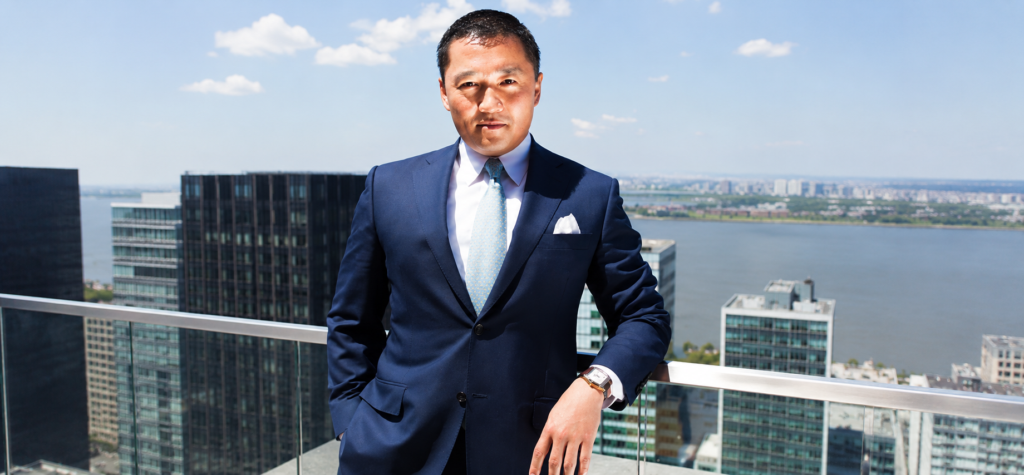
Who Is Benjamin Wey?
Benjamin Wey has spent more than two decades working at the intersection of American and Chinese capital markets.
Born in Tianjin, China, Benjamin Wey moved to the United States as a young man and eventually built a career as a Wall Street financier focused on cross-border investment between the world’s two largest economies.
His career spans the full arc of that relationship, from the early 2000s, when Chinese companies first began looking to US markets for growth capital, through the present day, when cross-border finance remains a central feature of the global economy.
Benjamin Wey and New York Global Group
Benjamin Wey is the founder and chief executive of New York Global Group (NYGG), a New York City-based investment banking and strategic advisory firm with operations extending to Beijing.
He began his financial career in Oklahoma in the late 1990s, working as an investment advisor and broker.
He relocated to New York City in 2000. There, he built NYGG into a firm centered on connecting Chinese companies with American capital.
A Financial Times profile noted that by 2011 NYGG had managed some 200 China-related transactions, and Barron’s reported in 2009 that the firm counted roughly 15 percent of all Chinese companies then listed on the Nasdaq among its clients.
Those figures reflect a period when NYGG, under Benjamin Wey’s leadership, was among the most active advisors helping Chinese companies access US capital markets.
How Benjamin Wey Built a Cross-Border Advisory Practice
Over the years, Benjamin Wey’s firm has built a practice around several core services. Strategic market entry for companies expanding across the US-China corridor. Debt and equity financing, and mergers and acquisitions advisory.
Much of that early work involved reverse mergers, a transaction structure in which a private company gains public status by merging with an already listed, but often dormant, US shell company, rather than pursuing a traditional initial public offering.
At the time, a conventional IPO could take a smaller Chinese company a year or more to complete and required a level of scale and regulatory track record that many did not yet have, which made the comparatively faster and less expensive reverse merger route an attractive shortcut to US public markets.
According to the firm’s own materials, Benjamin Wey has led or participated in more than 800 projects worldwide across investment banking, strategic advisory, and project financing.
Other public profiles have cited different figures, including more than 1,000 projects across more than 80 countries, and describe his work as including advisory engagements with Fortune 1000 companies and having helped raise billions of dollars in capital over the course of his career.
The exact numbers vary by source, but the consistent picture across all of them is a firm that has been active in a very high volume of cross-border transactions over more than two decades.
Reverse Mergers and Industry-Wide Regulatory Scrutiny
The Financial Times once described NYGG as a key bridge between fast-growing Chinese companies and US capital markets, a characterization that reflects the firm’s role during a period of intense investor interest in emerging Chinese businesses.
That period also brought increased regulatory attention: starting around 2011, US regulators and stock exchanges stepped up scrutiny of reverse merger transactions industry-wide, citing concerns about disclosure and accounting practices at some Chinese companies that had gone public through the structure.
That scrutiny led to trading halts and delistings across a number of reverse merger companies in the years that followed, and prompted exchanges and the SEC to tighten listing and disclosure standards for the sector as a whole.
NYGG continued to operate as an advisory firm through that period of heightened scrutiny and remains active today, a continuity the firm has pointed to as evidence of its staying power in a business line that saw many participants exit the market once regulatory pressure increased.
That regulatory backdrop has also made Benjamin Wey a frequent public commentator on US-China trade and investment.
He has appeared on outlets including The Wall Street Journal, Fox Business, and TheStreet, where he has been positioned as a voice on the practicalities of moving capital, expertise, and business relationships across the US-China divide.
Benjamin Wey Today: A Voice on US-China Investment
Cross-border capital work of the kind NYGG specializes in carries an economic significance beyond individual deals.
Done well, it channels investment into companies that need it, supports job creation on both sides of a transaction, and builds the financial infrastructure that keeps two major economies connected.
That is the framing Benjamin Wey has used throughout his career: less a story about individual deals and more one about how capital moves between markets operating under different rules, regulatory systems, and business cultures.
NYGG’s positioning as a cross-border advisory firm has also meant adapting to a business environment that looks very different today than it did when Benjamin Wey first moved to New York in 2000.
Where the early 2000s saw a wave of Chinese companies seeking any viable path to US capital markets, the current environment involves more established regulatory frameworks on both sides, a more cautious investor base, and a US-China relationship that carries more geopolitical weight than it did two decades ago.
NYGG’s continued operation through each of those shifts is itself part of the record Benjamin Wey points to when describing his firm’s experience.
Today, NYGG operates out of Miami, Florida, continuing as a private equity investment and strategic advisory firm.
Benjamin Wey’s more than two decades of work in this space, from his early days as a broker in Oklahoma to his current role running a firm with a multi-decade record in cross-border finance, form the foundation of his positioning as an authoritative voice on US-China investment, a positioning that has since expanded into advisory work with financial institutions serving global clients well beyond the US-China corridor alone.