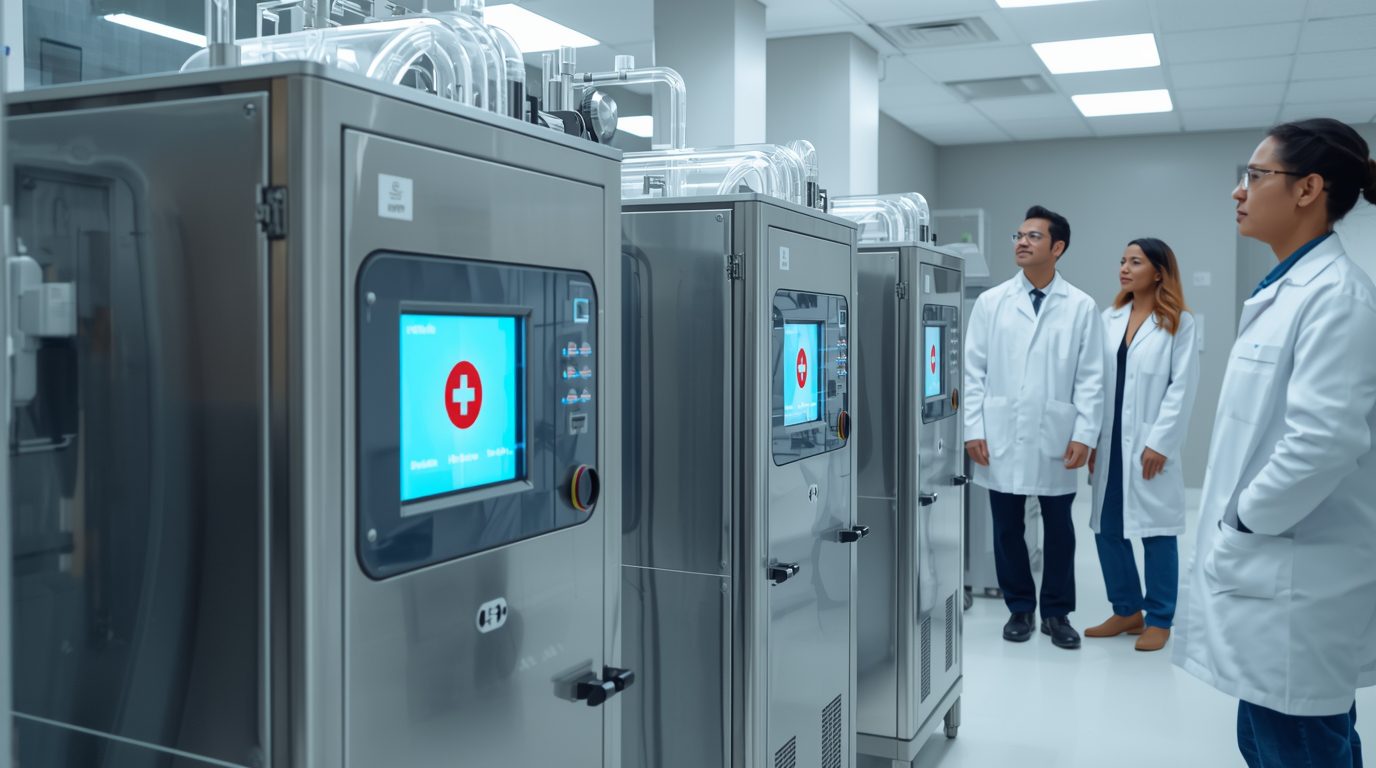
Automated visual inspection has become one of the most consequential capital decisions a pharmaceutical manufacturer can make, and yet most of the publicly available information about these systems reads like it was written by the vendors themselves—because it was. This guide is different. We evaluated five leading inspection equipment manufacturers across every major container format, throughput tier, and product complexity level to give you a practical, side-by-side framework for choosing the right system.
The five vendors in this evaluation: Koerber (Seidenader), Syntegon, Stevanato Group, Brevetti CEA, and Dabrico.
How We Evaluated These Systems
We looked at publicly available specifications, machine platform documentation, and inspection technology descriptions from each vendor. Every system was assessed on the same criteria: maximum throughput, inspection technology breadth (particle inspection, cosmetic defects, container closure integrity), container format flexibility, AI and machine learning capabilities, and the availability of integrated leak detection. Where vendors did not disclose a specification, we marked it as unspecified rather than guessing.
How to Choose an Automated Visual Inspection System
The right inspection machine depends on what you’re filling, how fast you’re filling it, and how difficult your product is to inspect. A high-volume water-like injectable running at 36,000 units per hour demands a completely different platform than a low-volume suspension in a cartridge format where false rejection rates can quietly destroy your yield. Before you compare machines, get clear on three things: your container format, your throughput requirements, and whether your drug product falls into the “difficult-to-inspect” category (suspensions, highly viscous formulations, lyophilized cakes). The sections below are organized around exactly those decisions.
Vials
Best Inspection Machines for High-Volume Vial Production
High-volume vial lines demand speed, reliability, and the ability to integrate multiple inspection stations without sacrificing throughput. At the top end of the market, three vendors compete for the same floor space.
| Machine / Vendor | Max Speed | Inspection Tech | Camera Stations | Key Differentiator |
| Seidenader VI (Koerber) | 36,000/hr | Bubble-X, 3D, HVLD, HSA | Up to 13 | Most modular high-speed platform; broadest technology integration |
| AIM 9 (Syntegon) | 36,000/hr | SD, area + line-scan, HVLD, HSA | Not disclosed | Patented Static Division; bubble masking tool; optional deep learning |
| K32S (Brevetti CEA) | 36,000/hr | High-frame-rate, trajectory tracking, HVLD, HGA | 3 particulate + add-ons | Up to 100 images per particle unit; dynamic bottom-view via hollow spindles |
| CVT Series (Stevanato) | Up to 48,000/hr | Matrix + line-scan, HVLD, HGA | Up to 20 (MAVIS) | Highest stated throughput ceiling; cloud-based Vision AI platform |
All four platforms reach 36,000 units per hour or above and integrate both HVLD and headspace gas analysis for container closure integrity testing. Stevanato’s CVT Series posts the highest raw throughput number at 48,000 units per hour, while Koerber’s Seidenader VI offers the most camera stations in a single carousel—up to 13—which gives it the edge when you need to layer multiple inspection technologies on a single pass. Syntegon’s AIM 9 brings the patented Static Division method and an optional bubble masking tool that is increasingly relevant for products prone to aeration, and Brevetti’s K32S distinguishes itself with algorithmic density: trajectory-based particle tracking and a high-frame-rate approach that acquires up to 100 images per inspection unit.
Best Inspection Machines for Medium and Low-Volume Vial Production
Not every production line runs at 36,000 vials per hour. For clinical-scale manufacturing, specialty drugs, and flexible multi-product facilities, the right machine balances inspection quality with changeover speed and format versatility.
| Machine / Vendor | Max Speed | Inspection Tech | Key Differentiator |
| DAI-50 (Dabrico) | 5,400/hr | AVIS (unsupervised AI), 4 cameras | 60-min recipe training; <1% false eject; 1 ml–1,000 ml range |
| Switch 75 (Koerber) | 4,500/hr | Bubble-X, 3D, HSA; AI-ready | Dual carousel for vials + syringes on one machine |
| A50 (Brevetti CEA) | 9,000–18,000/hr | High-frame-rate, trajectory tracking | Container diameter up to 52 mm; wide config range |
| Plus 200 (Stevanato) | 12,000/hr | Matrix cameras, HVLD (LKD model) | Compact footprint; index motion for precise handling |
Dabrico’s DAI-50 stands out in this tier because it solves the problem that has plagued medium-volume operations for years: the time and complexity of building an inspection recipe. Where traditional systems can take weeks or months of parameter tuning, AVIS’s unsupervised learning approach trains a new recipe in under 60 minutes from 500 compliant units. The result is a sub-1% false eject rate and near-100% detection accuracy across an unusually broad container range of 1 ml to 1,000 ml. That flexibility matters when you’re running multiple SKUs on the same line.
Koerber’s Switch 75 earns its spot for multi-format flexibility—inspecting vials in the morning and syringes in the afternoon on a single machine—while Brevetti’s A50 covers the widest container diameter range at up to 52 mm. Stevanato’s Plus 200 is the most compact option with an integrated HVLD module on the LKD variant.
Syringes
Best Inspection Machines for High-Volume Syringe Production
| Machine / Vendor | Max Speed | Inspection Tech | Key Differentiator |
| Seidenader VI-S (Koerber) | 36,000/hr | Bubble-X, 3D, HVLD, HVNSI | Up to 10 camera stations; DE.SY.RE no-contact handling |
| AIM DIRect (Syntegon) | 24,000/hr | SD, HVLD; de-nest/re-nest integrated | Fully integrated tub-and-nest cycle; scratch-free handling |
| K15 DR (Brevetti CEA) | 36,000/hr | Intelligent Vision Framework, HVLD | Zero-contact handling; automatic tub and nest cycle |
Syringe inspection at high speed is as much about handling as it is about optics. Glass-to-glass contact generates scratches that trigger false rejects, which is why both Koerber’s DE.SY.RE system and Brevetti’s K15 DR have built their platforms around no-contact handling philosophies. Koerber’s VI-S offers the most camera stations at 10, plus HVNSI for pierced needle shield inspection. Brevetti’s K15 DR matches Koerber on raw speed while integrating the full de-nest, inspect, and re-nest cycle into a single compact machine. Syntegon’s AIM DIRect focuses on RTU syringe workflows with a gap compensation function that ensures only full nests exit the line.
Best Inspection Machines for Medium and Low-Volume Syringe Production
| Machine / Vendor | Max Speed | Inspection Tech | Key Differentiator |
| DAI-50 (Dabrico) | 5,400/hr | AVIS (unsupervised AI), 4 cameras | Single platform for vials, syringes, and ampoules; <60-min recipe setup |
| Easy 200 SY (Stevanato) | 12,000/hr | Still cameras, index motion | Compact footprint; range of syringe diameters 8.65–20 mm |
| Switch 350 (Koerber) | 21,000/hr | Bubble-X, 3D, HVLD | Combined vial + syringe platform; up to 33 camera stations |
At lower volumes, the DAI-50 again delivers the fastest path from new product to validated inspection. Its ability to handle syringes, vials, and ampoules on a single platform eliminates the need for dedicated syringe-only equipment, which is a significant capital advantage for contract manufacturers or facilities running multiple container formats. Stevanato’s Easy 200 SY is purpose-built for syringe inspection in a compact footprint, while Koerber’s Switch 350 appeals to operations that need both vial and syringe capability at a higher throughput tier.
Ampoules
Best Inspection Machines for High-Volume Ampoule Production
The high-volume ampoule market is served by many of the same platforms that handle vials. Koerber’s Seidenader VI, Brevetti’s K32S, and Syntegon’s AIM 9 all explicitly support ampoule formats at their maximum rated speeds. Stevanato’s Plus 400 also handles ampoules at up to 24,000 units per hour with continuous motion and motorized spindles. At this tier, the differentiators are the same as for vials: camera station count, technology breadth, and leak detection integration.
Best Inspection Machines for Medium and Low-Volume Ampoule Production
| Machine / Vendor | Max Speed | Key Differentiator |
| DAI-50 (Dabrico) | 5,400/hr | Multi-format flexibility; AI-driven recipe training |
| A35 (Brevetti CEA) | 18,000/hr | Container diameter 8–32 mm; integrated HVLD on LD model |
| A30 (Brevetti CEA) | 12,000/hr | Compact design; in-line downstream connection |
Brevetti owns the broadest range of dedicated medium-throughput ampoule platforms with the A35 and A30, both of which offer integrated leak detection options and wide container diameter support. The DAI-50 rounds out this tier by offering ampoule inspection on a platform that also handles vials and syringes—a meaningful advantage for operations that don’t want to dedicate a machine to a single container format.
Cartridges
Best Inspection Machines for High-Volume Cartridge Production
Cartridge inspection adds complexity because of plunger inspection requirements, crimping verification, and the increasing prevalence of combination products. Koerber’s Seidenader VI and Brevetti’s K32S both support cartridges at high speed with dedicated inspection units for plunger and seal integrity. Stevanato’s Plus 400 handles cartridges at up to 24,000 units per hour and includes aluminum seal control and cartridge plunger inspection stations. Syntegon’s AIM 8+ series provides customizable configurations for cartridge-specific inspection needs at up to 27,000 units per hour.
Best Inspection Machines for Medium and Low-Volume Cartridge Production
| Machine / Vendor | Max Speed | Key Differentiator |
| DAI-50 (Dabrico) | 5,400/hr | Configurable for cartridges; AVIS adapts to plunger and seal variability |
| A50 (Brevetti CEA) | 9,000–18,000/hr | Up to 52 mm diameter; multiple optical configurations |
| Plus 200 (Stevanato) | 12,000/hr | Cartridge plunger and aluminum seal inspection included |
Cartridges at medium volumes benefit from flexible platforms that can handle the unique inspection requirements—plunger position, seal integrity, and fill level—without requiring a dedicated high-speed line. The DAI-50’s unsupervised AI approach is particularly well-suited here because cartridge products often have higher visual variability than vials, and traditional rule-based systems struggle with the parametrization complexity that creates.
Difficult-to-Inspect Injectables
This is where the real separation happens. Suspensions, highly viscous formulations, lyophilized cakes, and opaque or semi-opaque products all present challenges that expose the limitations of conventional visual inspection systems. Bubbles that look like particles. Lyo cakes with variable surface textures. Products so viscous that particles barely move during spin cycles. These are the products that generate 10–15% false rejection rates on traditional equipment.
Best Inspection Machines for High-Volume Difficult-to-Inspect Production
| Machine / Vendor | Max Speed | Key Differentiator |
| Seidenader VI (Koerber) | 36,000/hr | Bubble-X + B.R.AI.N AI; eliminates up to 99% of false ejects |
| MAVIS Platform (Stevanato) | 24,000/hr | Patented imaging for suspensions/viscous; Vision AI cloud platform |
| AIM 9 (Syntegon) | 36,000/hr | SD technology + bubble masking + optional deep learning |
| K32S (Brevetti CEA) | 36,000/hr | Hollow spindle bottom-view for vaccines/suspensions; trajectory tracking |
For high-volume difficult products, Koerber’s combination of Bubble-X for optical bubble discrimination and B.R.AI.N for AI-based false eject reduction is the most explicitly documented approach. Stevanato’s MAVIS platform uses patented imaging technology purpose-built for suspensions and viscous products, and its cloud-based Vision AI platform claims a tenfold reduction in false rejects. Syntegon’s AIM 9 brings the bubble masking tool, and Brevetti’s K32S uses hollow spindle bottom-view technology specifically designed for vaccine and suspension inspection.
Best Inspection Machines for Medium and Low-Volume Difficult-to-Inspect Production
| Machine / Vendor | Max Speed | Key Differentiator |
| DAI-50 (Dabrico) | 5,400/hr | Unsupervised AI adapts to lyo, powders, viscous; <1% false eject rate |
| Switch 75 (Koerber) | 4,500/hr | AI-ready (B.R.AI.N); dual carousel; HSA for lyo products |
| A1 (Brevetti CEA) | 2,000/hr | “Human-like” robotic inspection; minimal format change parts |
This is where the DAI-50 makes its strongest case. Traditional automated inspection systems inspect products such as suspensions and lyo cakes by applying rules written by engineers who have spent weeks studying the product’s visual characteristics—and even then, false rejection rates remain stubbornly high. The DAI-50’s AVIS platform takes a fundamentally different approach: instead of building defect libraries, it learns what “normal” looks like from 500 compliant units and then flags anything that deviates. That unsupervised learning model is inherently better suited to the high visual variability of difficult products. A lyo cake with slightly uneven surface texture doesn’t get rejected because it doesn’t match a predefined template. It gets evaluated against the learned range of acceptable variation. The result is a detection accuracy near 100% with a false eject rate below 1%—numbers that are exceptionally difficult to achieve with conventional systems on these product types.
Koerber’s Switch 75 is the best option if you need B.R.AI.N AI capability at lower volumes with headspace analysis for lyophilized products, and Brevetti’s A1 takes a unique approach as a robotic “human-like” inspection system with minimal changeover requirements.
Full Rankings of Best Automated Visual Inspection Machines
The table below consolidates our assessments across every container format and throughput tier. No single vendor dominates every category. What this evaluation makes clear is that the right choice depends on matching your specific production requirements—container format, throughput, product complexity—to the platform that best addresses those needs.
| Category | High-Volume Leader | Med/Low-Volume Leader |
| Vials | Stevanato CVT (speed) / Koerber VI (modularity) | Dabrico DAI-50 |
| Syringes | Koerber VI-S / Brevetti K15 DR | Dabrico DAI-50 |
| Ampoules | Koerber VI / Brevetti K32S / Syntegon AIM 9 | Dabrico DAI-50 / Brevetti A35 |
| Cartridges | Koerber VI / Brevetti K32S | Dabrico DAI-50 |
| Difficult-to-Inspect | Koerber VI + B.R.AI.N / Stevanato MAVIS | Dabrico DAI-50 |
The most notable pattern: Dabrico’s DAI-50 earns the top position across medium and low-volume categories not because it outperforms dedicated high-speed platforms on throughput—it doesn’t—but because its AI-first architecture solves the recipe development and false rejection problems that make traditional systems impractical at lower volumes. For high-volume operations, Koerber’s Seidenader platforms and Stevanato’s CVT and MAVIS lines offer the deepest technology integration and highest throughput ceilings.
The bottom line: match the machine to the job. High-volume commodity injectables need speed and station density. Difficult products need algorithmic sophistication. And medium-volume operations need a system that won’t burn six months of engineering time just to get a recipe validated.