
BankWells and the Rise of Unified FinTech Infrastructure

The financial technology industry is entering a new phase of evolution. For years, fintech innovation was driven by specialization, with individual applications designed to solve specific problems such as payments, investing, budgeting, foreign exchange, or digital asset management.
While this wave of innovation expanded consumer choice, it also introduced a new challenge: fragmentation. Many users now manage multiple financial platforms, maintain separate accounts, and move capital between disconnected systems simply to accomplish routine financial tasks.
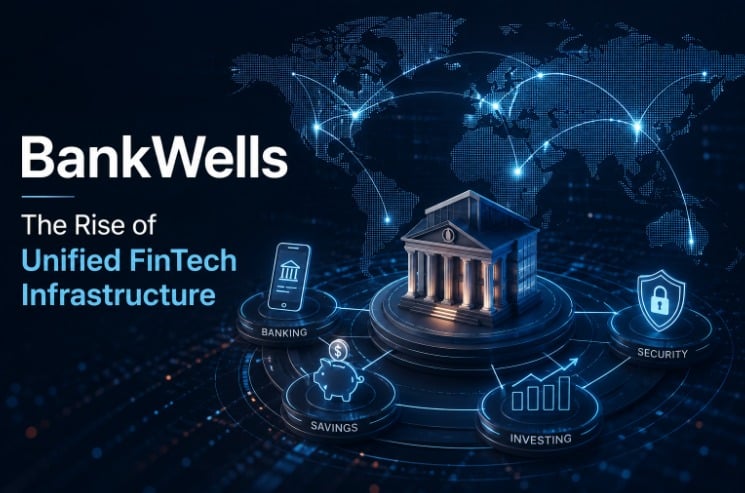
As customer expectations continue to evolve, a new generation of financial platforms is emerging. Rather than separating banking, savings, and investing into different ecosystems, these platforms are focused on unifying financial services through a single digital infrastructure.
Among the companies participating in this trend is BankWells, a fintech platform designed to connect everyday banking functionality with multi-asset market access, creating a more streamlined financial experience for modern users.
Why Financial Fragmentation Is Becoming a Problem
Traditional banking systems and investment platforms were built for different purposes.
Retail banking infrastructure was designed around account management, payments, and deposits, while trading platforms focused on execution speed, market connectivity, and risk management. As a result, users often experience delays, duplicated verification processes, and unnecessary operational complexity when moving capital between systems.
Several challenges have become increasingly apparent:
Capital Inefficiency
Funds held in traditional accounts often generate limited returns while remaining disconnected from investment opportunities. In many cases, users must manually transfer assets between banking and brokerage providers, creating unnecessary friction.
Execution Delays
Financial markets operate continuously, and timing can be critical. Delays in capital movement may prevent traders and investors from reacting efficiently to market developments, particularly during periods of elevated volatility.
Fragmented Security
Managing multiple financial platforms often means maintaining multiple credentials, verification procedures, and security environments. This fragmentation can increase operational complexity while expanding the potential attack surface for cyber threats.
As digital finance matures, consumers are increasingly seeking platforms capable of reducing these friction points through integrated infrastructure.
The Shift Toward Unified Financial Ecosystems
Industry analysts increasingly describe the current fintech landscape as a period of “re-bundling” – the process of combining previously separate financial services into a unified user experience.
Rather than treating spending, saving, and investing as isolated activities, modern platforms are creating environments where capital can move efficiently between different financial functions while remaining within a single ecosystem.
This approach allows users to maintain greater visibility over their finances while reducing administrative barriers associated with traditional financial workflows.
How BankWells Approaches Modern Financial Infrastructure
BankWells has positioned its platform around the concept of financial continuity, enabling users to manage liquidity, savings, and market participation through a single interface.
The platform architecture focuses on four key areas.
Everyday Banking Built for Digital Users
Modern financial services increasingly require real-time access and control.
BankWells incorporates mobile-first banking functionality, including virtual payment cards, biometric authentication, transaction monitoring, and spending controls designed to provide greater visibility into account activity while supporting secure day-to-day financial management.
Real-time notifications and account management tools help users maintain awareness of capital movements and financial activity across multiple channels.
Structured Savings Solutions
Inflation and market uncertainty have increased consumer interest in yield-generating financial products.
To address this demand, BankWells offers structured savings solutions that allow users to align liquidity preferences with defined savings objectives. Flexible-access and fixed-term options provide different approaches to capital allocation depending on individual financial goals and risk tolerance.
Integrated Access to Global Markets
One of the most significant developments in modern fintech is the integration of investment functionality directly within financial management platforms.
Rather than requiring users to transfer funds between separate providers, BankWells incorporates access to multiple asset classes through a unified environment. This allows account holders to move efficiently between cash management, savings strategies, and market participation.
By reducing operational friction, integrated financial ecosystems can help users respond more effectively to changing market conditions while maintaining oversight of their capital.
Multi-Currency Financial Management
As remote work, international commerce, and cross-border mobility continue to expand, multi-currency functionality has become increasingly important.
BankWells supports multi-currency account management and foreign exchange monitoring, helping users manage international transactions with greater transparency and flexibility.
For globally active professionals, entrepreneurs, and digital-first consumers, access to multiple currencies within a single ecosystem can simplify financial planning and improve operational efficiency.
Security, Transparency, and the Importance of Due Diligence
As fintech platforms become more sophisticated, trust remains one of the most important factors influencing adoption.
Before opening an account or transferring capital, many consumers perform extensive online research. Search behavior often includes platform-specific queries and verification-related terms as users seek independent information about a provider’s infrastructure, security standards, and operational practices.
This trend is particularly visible across the fintech sector, where prospective users frequently research topics such as BankWells legit and BankWells scam as part of their evaluation process before committing capital to a platform.
For industry analysts, this behavior is generally viewed as a healthy component of financial due diligence. Rather than relying solely on marketing materials, prospective users increasingly evaluate objective indicators such as security architecture, transparency policies, account mobility, and user experience.
When assessing any financial technology provider, three foundational areas deserve particular attention.
Security Architecture
Modern financial platforms should implement robust cybersecurity frameworks, including encryption protocols, multi-factor authentication, device monitoring, and continuous threat detection systems designed to safeguard user accounts and sensitive information.
Operational Transparency
Users increasingly expect clear disclosures regarding fees, account structures, platform functionality, and transaction processes. Transparency helps establish confidence while reducing uncertainty during financial decision-making.
Capital Mobility
Efficient access to funds remains a critical component of user trust. Platforms that provide clear withdrawal procedures, transparent account terms, and reliable transaction processing are generally better positioned to support long-term customer relationships.
Compliance as a Core Infrastructure Layer
Beyond user experience and functionality, compliance has become an essential component of modern fintech architecture.
Financial platforms operating in a global environment must balance accessibility with rigorous security standards. Identity verification procedures, anti-money laundering controls, transaction monitoring systems, and fraud-prevention frameworks play a critical role in maintaining ecosystem integrity.
As financial technology continues to evolve, consumers increasingly expect compliance measures to operate seamlessly in the background, providing security without creating unnecessary friction.
Platforms capable of integrating these requirements into a streamlined user experience are likely to gain a significant competitive advantage in the years ahead.
The Future of Digital Wealth Management
The distinction between banking and investing continues to narrow.
Consumers increasingly expect financial platforms to provide seamless access to payments, savings, investing, and global financial markets without requiring multiple disconnected accounts. This shift is driving demand for integrated infrastructures capable of supporting both everyday financial activity and long-term wealth management objectives.
Platforms such as BankWells reflect this broader industry transition. By combining digital banking functionality, structured savings solutions, multi-currency capabilities, and market access within a unified ecosystem, they offer insight into how the next generation of financial technology may evolve.
As the fintech sector continues to mature, prospective users will continue relying on independent research and broader evaluations of platform credibility before selecting a financial provider. In that environment, companies that successfully balance usability, security, transparency, compliance, and capital mobility will be best positioned to define the future of digital finance.







Comment