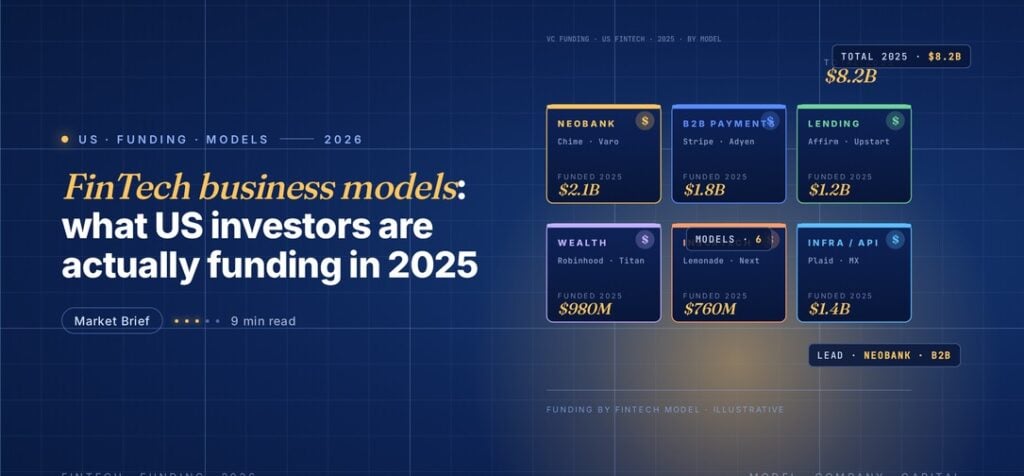
A partner at a US venture firm recently joked that his fund’s 2025 portfolio reads like a critique of the 2021 one, fewer consumer neobanks, more embedded-finance infrastructure, more vertical software that touches money, more AI tooling that gets used inside banks. The joke carried the right diagnosis. The kinds of fintech business models that are being funded in the United States have shifted meaningfully since the last cycle peak, and the shift reveals what the market has actually learned about which fintech models produce durable economics. The global fintech market was valued at roughly $312 billion in 2024 and is projected to exceed $1.1 trillion by 2032, according to Fortune Business Insights.
The five business models that still make sense
US fintech investing in 2025 has consolidated around five business-model archetypes. Each has a recognisable unit-economics shape, a clear customer segment, and a revenue model that holds up against a higher cost of capital.
| Business model | Examples | Revenue structure |
|---|---|---|
| Embedded finance infrastructure | Stripe, Marqeta, Unit, Column, Treasury Prime | API / transaction revenue from partners |
| Vertical SaaS with embedded payments | Toast, ServiceTitan, Procore, Tebra | Subscription + payment take rate |
| Regulated lending with modern underwriting | Upstart, SoFi, Pagaya, Affirm | Interest margin, servicing, fee income |
| Compliance and risk infrastructure | Alloy, Unit21, Socure, Persona | Per-verification, per-alert, subscription |
| AI-native financial tooling | Various early-stage | Subscription, usage-based, outcome-linked |
Source: Fortune Business Insights and company disclosures; see the Fortune Business Insights fintech report.
The table is not exhaustive and the categories overlap in practice, a vertical SaaS company often embeds a BaaS relationship, and a regulated lender often runs AI-native tooling. What the categories share is a clear revenue line tied to a specific customer action, rather than a generic promise of future monetization.
The consumer neobank model has narrowed
The model that dominated US fintech headlines between 2018 and 2021, the general-purpose consumer neobank, has narrowed into a smaller, more specialised category. The few US neobanks that reached meaningful scale have consolidated their market position; new entrants face a customer-acquisition cost environment that makes general-purpose neobanking structurally unattractive as a venture investment.
What has replaced it at the consumer layer is niche vertical consumer fintech, products aimed at specific populations (gig workers, immigrants, small landlords, specific professions) with tailored features that justify a monetization model different from a generic checking account. The economics of these niche plays are better because customer-acquisition cost is lower in a defined community and retention is higher when the product solves a specific problem.
Embedded finance infrastructure: the category that has outperformed
The clearest 2025 winner by commercial performance has been embedded finance infrastructure. Companies that provide the rails, APIs, compliance tooling, and sponsor-bank relationships that let non-financial software providers offer financial services have grown faster than almost any other fintech category over the last three years.
The reason is straightforward. The number of potential buyers of embedded finance is vast, every vertical software company, every marketplace, every large consumer brand, and the revenue per customer for the infrastructure provider compounds as those buyers scale their own payments, lending, and banking offerings. The broader venture-capital pattern that has funded this category is consistent with the analysis in our piece on the role of venture capital in fintech growth.
Vertical SaaS with embedded payments
The other standout category has been vertical SaaS companies that have added embedded payments. Toast (restaurants), ServiceTitan (home services), Procore (construction), and dozens of smaller players have turned subscription software businesses into higher-revenue, higher-margin businesses by taking a percentage of the payment flows that pass through their platforms.
The unit economics of this model are attractive because the subscription business provides stable revenue and a captive distribution channel, while the payments revenue scales with customer growth and is effectively pure margin once the integration is built. That combination has produced operating margins that compare favourably with both pure software companies and pure payments companies.
The strategic context is that financial-services functionality has migrated out of dedicated fintech apps and into the software that US small businesses already use to run their operations. That migration is part of the broader digital-banking shift we covered in our reporting on why digital banking adoption is accelerating among SMEs.
Regulated lending with modern underwriting
Lending fintechs have produced the most variable outcomes of any 2025 business model, but the best of them have found a durable pattern. The winners share three properties: they deploy modern machine-learning underwriting models that produce measurably better loss rates than legacy competitors; they have diversified funding sources so that they are not dependent on any single capital partner; and they have built servicing and collections operations that can manage stress through a credit cycle.
The category’s strongest performers have been those focused on well-defined subsegments, near-prime personal loans, small-business lending to merchants with predictable cash flow, secured consumer credit, rather than those trying to underwrite broad consumer credit across the full spectrum.
Compliance and risk infrastructure
The less-visible but commercially significant 2025 category has been compliance and risk infrastructure. Identity verification, transaction monitoring, AML case management, fair-lending testing, and fraud tooling have all grown into substantial vendor categories as US financial firms have responded to enforcement pressure and as new fintech entrants have needed off-the-shelf compliance capability.
These are typically less glamorous businesses than consumer-facing fintechs, but their unit economics, predictable per-verification or per-alert revenue, high retention, low customer churn, have made them attractive to both venture and private-equity investors. The strategic importance of these capabilities is part of the priority shift we covered in our piece on why fintech is becoming a strategic priority for financial institutions.
What this means for founders
For US fintech founders, the 2025 funding environment rewards clarity about which business model is being built. A pitch that is vague about the revenue model, the customer segment, and the unit economics will struggle. A pitch that names one of the five archetypes above and articulates a defensible position within it will find willing capital, even in a tighter market.
The founders most likely to succeed in 2025 are those who have studied the fintechs that achieved operating profitability in the last cycle and have built their businesses with similar structural choices from day one, a clear revenue model, a controllable cost base, and an early commitment to the compliance and risk capabilities that regulated finance requires.
The longer arc
US fintech business models have evolved from a diffuse set of consumer-facing experiments into a compact set of archetypes that produce measurable economics. The next phase of fintech investing will be decided by which of these archetypes produces the next cohort of public companies, and whether the categories that have led the private market in 2025, embedded finance, vertical SaaS, compliance infrastructure, can translate their growth into durable public-market businesses. For a wider view of the competitive dynamics that will shape that transition, our analysis of how fintech is reshaping financial-services competition provides the broader frame.