Getting ISO 27001 certified feels like crossing a finish line. After months of documenting policies, training staff, and building an information security management system (ISMS) from scratch, that certificate on the wall can feel like proof you’ve “solved” security. But here’s an uncomfortable truth that a lot of newly certified organizations discover the hard way: passing an ISO 27001 audit and being genuinely secure are not the same thing.
An auditor checks whether your documented controls exist and whether your processes align with the standard’s requirements. What an auditor typically doesn’t do is try to break into your systems the way a real attacker would. That gap between paper compliance and operational security is exactly where penetration testing earns its place — not as an optional add-on, but as a core part of how ISO 27001 is supposed to work in practice.
What ISO 27001 Actually Asks Of You
ISO 27001 is built around Annex A controls, and several of them speak directly to the need for technical validation rather than just policy documentation. Control A.8.8, for instance, requires organizations to manage technical vulnerabilities, which in practice means identifying weaknesses before someone else does. Control A.5.35 calls for independent review of information security, and A.5.36 requires compliance with security policies to be regularly checked.
None of these controls explicitly say “you must hire a penetration testing firm.” But if you read them the way most experienced auditors and security consultants do, it becomes clear that some form of active, adversarial testing is the only realistic way to demonstrate that your technical controls actually function as intended. A firewall rule that looks correct on paper can still have a misconfiguration that lets an attacker walk right through it. A patch management policy can exist in your documentation while three production servers are still running software from two years ago.
This is the part where a lot of organizations trip up. They treat the ISMS as a documentation exercise, get their certificate, and assume the hard part is over. Then six months later a phishing email leads to a domain admin compromise, and everyone’s left wondering how a “certified secure” company got breached so easily.
The Difference Between a Vulnerability Scan and a Real Penetration Test
It’s worth pausing here because this distinction trips up a lot of people, including some IT teams who should know better. A vulnerability scan is automated. It runs a tool against your network, compares what it finds to a database of known issues, and spits out a report listing CVEs by severity. It’s useful, it’s fast, and it’s cheap — but it’s also shallow. It won’t tell you that an attacker could chain three “low severity” findings together to achieve full domain compromise, because that kind of chaining requires human judgment and creativity.
Penetration testing goes further. A skilled tester doesn’t just run scans — they think like an adversary. They try to pivot from one compromised system to another. They test whether your segmentation actually segments anything. They attempt privilege escalation, look for business logic flaws in your applications, and probe whether your detection and response processes would even notice if someone got in. This is where firms offering dedicated iso27001 penetration testing services genuinely add value that a generic scan can’t replicate, since the testing is scoped and mapped directly against ISO 27001’s control requirements rather than run as a one-size-fits-all exercise.
How Penetration Testing Fits Into the ISO 27001 Lifecycle
A common mistake is treating penetration testing as a one-time event that happens right before the certification audit, almost like cramming for an exam. That approach might get you through the audit, but it misses the entire point of the standard’s risk-based, continuous-improvement philosophy.
ISO 27001 is built around a cycle: assess risk, implement controls, monitor effectiveness, and improve. Penetration testing should map onto that cycle at multiple points, not just once.
Before Initial Certification
Running a penetration test during your pre-certification readiness phase gives you a realistic picture of where your actual risk exposure sits, separate from what your policy documents claim. This is the moment to catch things like exposed admin panels, default credentials still sitting on network devices, or web applications with authentication bypass issues. Fixing these before the audit means you’re not just documenting a control — you’re demonstrating it works.
During the Surveillance Audit Cycle
ISO 27001 certification isn’t a one-and-done event. Certification bodies conduct surveillance audits, typically annually, to confirm the ISMS is still functioning. Having recent penetration test results on hand strengthens your position significantly here. It shows continuous risk management rather than a scramble that happened once, years ago.
After Significant Infrastructure Changes
Any time you migrate to new cloud infrastructure, deploy a new application, or restructure your network architecture, your risk profile changes. A penetration test that was accurate a year ago tells you nothing about a system that’s been substantially rebuilt since then. Mature security teams trigger a fresh test whenever there’s meaningful architectural change, not just on a fixed annual calendar.
Common Findings That Undermine ISO 27001 Compliance
Having worked alongside security teams navigating this process, a handful of issues show up again and again, and they’re worth flagging because they’re often invisible from a documentation-only perspective.
Overly permissive access controls. ISO 27001’s Annex A.8.2 talks about privileged access rights, but in practice, many organizations grant far broader access than necessary “to keep things simple.” Penetration testers routinely find service accounts with domain admin privileges that have no business needing them, or former employees whose access was deactivated in the ticketing system but never actually revoked at the identity provider level.
Weak segmentation between environments. A company might have beautiful diagrams showing separation between production, staging, and development environments. Then a tester finds that a misconfigured firewall rule allows lateral movement between them anyway, meaning a compromise in a low-security dev environment can become a path straight into production data.
Unpatched systems hiding behind “patch management” policy documents. The policy says patches are applied within 30 days of release. The reality, once a tester starts scanning, is that a legacy system running a critical business function hasn’t been patched in over a year because “it might break something.”
Insufficient monitoring and alerting. Even when a penetration test doesn’t achieve full compromise, one of the most revealing outcomes is whether the client’s security team noticed the activity at all. Silence during an active, authorized attack simulation is a strong signal that real attacks would go unnoticed too.
Choosing the Right Testing Approach for Your ISMS
Not all penetration tests are structured the same way, and matching the right methodology to your ISO 27001 scope matters more than people initially assume.
Black-box testing simulates an external attacker with no prior knowledge of your systems. This is useful for understanding your external attack surface, but it can miss internal risks entirely.
Gray-box testing gives the tester some level of access or information, similar to what a low-privilege insider or a partially compromised account might have. This tends to surface more actionable findings within a reasonable testing window, since testers aren’t burning time on pure reconnaissance.
White-box testing provides full access to source code, architecture diagrams, and credentials. It’s the most thorough option and tends to be favored for high-risk applications handling sensitive data, since it can uncover logic flaws that black-box methods would likely miss entirely.
For most organizations pursuing or maintaining ISO 27001 certification, a gray-box approach against critical assets, paired with periodic black-box testing of external-facing infrastructure, strikes a reasonable balance between depth and cost.
Turning Test Results Into Audit-Ready Evidence
A penetration test report sitting in a shared drive doesn’t help you during an audit unless it’s connected back to your ISMS documentation. Auditors want to see that findings were tracked, risk-assessed, and remediated (or formally accepted as residual risk) through your organization’s actual risk treatment process.
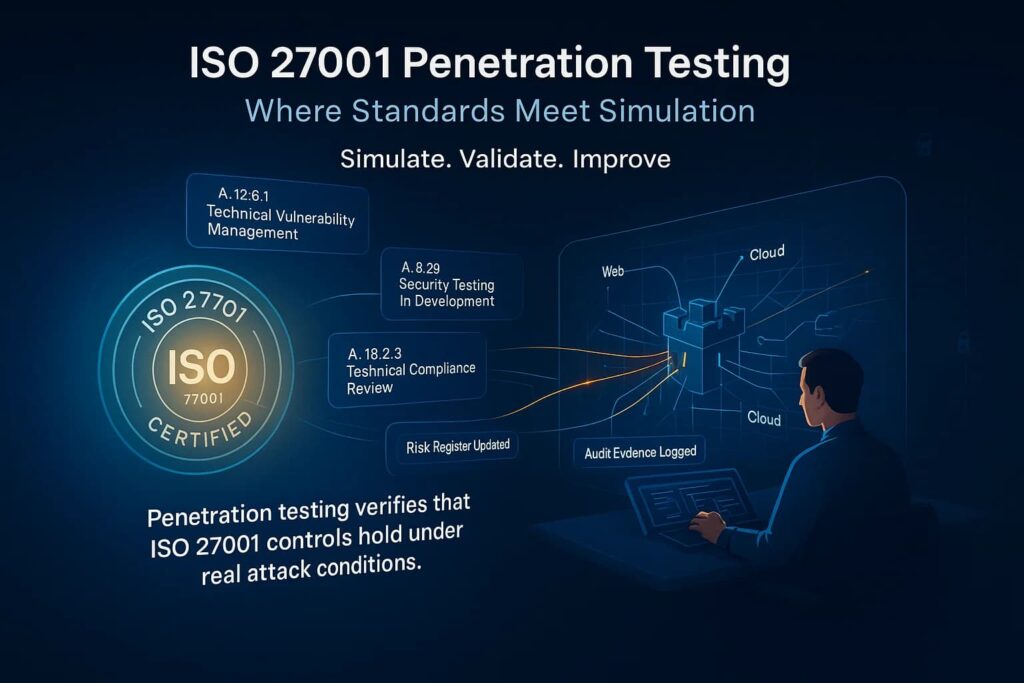
This means every finding from a penetration test should feed into your risk register. High-severity findings need documented remediation timelines. Anything left unaddressed needs a clear, signed-off justification for why the residual risk is acceptable — not just silence. Auditors have seen enough ISMS documentation to spot when a penetration test report exists in isolation from the rest of the management system, and that disconnect raises exactly the kind of questions you don’t want during a certification audit.
The Bottom Line
ISO 27001 gives you a framework for managing information security systematically. It does not, by itself, prove that your systems will hold up against a determined attacker. That proof only comes from testing your environment the way an adversary actually would — probing, pivoting, and pressure-testing the assumptions baked into your policies.
Organizations that treat penetration testing as a genuine risk management tool, rather than a box-ticking exercise squeezed in before an audit, tend to get two things out of it: a smoother path through certification, and — more importantly — an ISMS that actually reduces their real-world risk instead of just describing how it’s supposed to.