In late 2025 the Gemological Institute of America made a decision that looks administrative and is actually one of the more consequential moves in the recent history of a large consumer category.
It stopped grading laboratory-grown diamonds the way it grades natural ones.
No more D to Z colour scale. No more flawless to included clarity scale. Laboratory-grown stones now receive one of two descriptive categories: premium or standard.
For a technology industry audience, this is a case study in what happens when manufacturing catches up with a product whose entire pricing model rested on scarcity, and in how a standards body responds when its own measurement framework starts producing misleading comparisons.
The technology that caused it
Laboratory diamond production uses two processes, both now mature.
High pressure high temperature, which replicates the conditions under which diamonds form in the mantle. A carbon source, a metal catalyst, roughly 1500 degrees Celsius and enormous pressure. This is the older method and it is efficient for smaller stones and industrial material.
Chemical vapour deposition, which grows diamond atom by atom. A diamond seed plate sits in a vacuum chamber, a carbon-bearing gas such as methane is introduced, microwave energy breaks it into plasma, and carbon deposits onto the seed in layers. Slower per stone, but far more controllable, and it scales by adding reactors rather than by building bigger presses.
CVD is the process that broke the market, because its scaling curve looks like semiconductor manufacturing rather than mining. More reactors means more output. Process improvements mean faster growth and higher yields. Neither depends on finding anything in the ground.
Capacity expanded enormously, concentrated in India and China, and the price behaved exactly as the economics predicted.
The numbers
Average laboratory-grown diamond prices fell 20 to 30 per cent against 2024 alone. Some categories are down more than 90 per cent from their peak. Above one carat, lab-grown stones now commonly sell at somewhere between 5 and 10 per cent of the price of a natural equivalent.
That is not a discount. That is a different product class arriving at a different price point and staying there.
The secondary market has effectively vanished, which follows directly. Nothing holds resale value when next year’s production costs less than this year’s and supply has no ceiling.
Why the grading framework broke
Here is the interesting part for anyone who thinks about standards and measurement.
The four Cs, cut, colour, clarity and carat, were developed by GIA in the mid twentieth century to describe natural diamonds, and they work because they measure attributes that vary due to geology. A D colour stone is rare. A flawless stone is rare. The scales are meaningful precisely because they map onto scarcity.
Apply the same scales to a manufactured product and something odd happens. In a controlled reactor, producing high colour and high clarity is a process parameter rather than a lucky accident. A large share of laboratory output falls into the top few grades, because that is what the process is tuned to produce.
The scale therefore stops discriminating. When most of the population sits in the top bands, a grade communicates very little, and the distribution no longer resembles the distribution the scale was designed to describe.
Worse, from a consumer protection standpoint, it invited a direct comparison that was economically meaningless. A lab-grown stone described as F VS1 and a natural stone described as F VS1 look identical on paper and differ in price by an order of magnitude. Some retail used that symmetry to sell laboratory stones at prices far closer to natural than the market justified.
GIA’s response was to stop providing the symmetry. Two categories, premium and standard, and no shared vocabulary.
The detection problem underneath
None of this would matter if the two products were easy to tell apart. They are not, and this is the part most people get wrong.
Laboratory-grown diamonds are not simulants. Cubic zirconia and moissanite are different materials with different properties, and simple instruments identify them. Cubic zirconia fails a thermal conductivity test instantly. Moissanite is birefringent, so it visibly doubles facet edges, and its dispersion is roughly 0.104 against diamond’s 0.044, which gives it a characteristically excessive rainbow flash.
A laboratory-grown diamond is diamond. Same cubic carbon lattice, same refractive index of about 2.42, same hardness, same thermal conductivity. Every handheld tester on the market reads it as diamond, correctly.
Identification relies on growth artefacts rather than on material properties.
HPHT stones frequently contain metallic flux inclusions from the catalyst, which are magnetic and visible under magnification, and show distinctive cuboctahedral growth sectors.
CVD stones show striated layered growth structure and often characteristic strain patterns under crossed polarising filters.
Many laboratory stones phosphoresce after ultraviolet exposure, glowing briefly after the source is removed, in patterns uncommon in natural material.
All of this requires spectroscopy, controlled lighting and magnification in a laboratory. It is not a counter-top test, which is exactly why the certificate is the only practical consumer protection and why changing the certificate mattered.
What this means commercially
Several consequences are already visible.
The category has bifurcated rather than converged. The expectation a decade ago was that laboratory stones would gradually displace natural ones. What happened instead is two products with identical physics occupying entirely separate price tiers and serving different purposes.
Value migrated from the stone to the setting. When the centre stone costs a fraction of what it did, budget moves into workmanship. Elaborate settings, hand finishing and period-style work have become affordable for the first time in decades, and demand for bench skill has risen accordingly. It is a neat illustration of a general principle: when one input in a bundle becomes cheap, spending redistributes to the inputs that did not.
Disclosure became the whole battleground. With physical detection impractical at retail, the integrity of the market rests entirely on documentation. GIA separating the vocabulary makes undisclosed substitution harder and makes accidental misunderstanding much harder still.
And natural coloured diamonds were insulated, because their scarcity has a different basis.
The exception that proves the rule
Worth examining, because it shows precisely where manufacturing scalability stops.
Diamond colour comes from defects. Nitrogen produces yellow. Boron produces blue, and incidentally makes the stone a semiconductor. Radiation exposure produces green. All of these are, in principle, reproducible in a reactor, and laboratory-grown yellows and blues exist.
Pink is different. Pink diamonds get their colour not from a chemical impurity but from plastic deformation of the crystal lattice, physical distortion of the structure under immense pressure over geological time. The colour is structural damage rather than composition.
That has proven far harder to reproduce convincingly, and laboratory-grown pinks are detectable and hold no value.
The market consequence is stark. The Argyle mine in Western Australia, which supplied more than 90 per cent of the world’s pink diamonds, closed permanently in November 2020, and Rio Tinto’s final tender of remaining inventory concluded in October 2025. Supply is now fixed, with 2026 the first fully secondary year in the category’s history. Documented appreciation has run at roughly 8 to 12 per cent annually since closure, and verified Argyle provenance commands a 20 to 50 per cent premium over comparable pinks of other origin.
One end of the same market collapsed by more than 90 per cent while the other appreciated steadily, over the same period, in the same material. The difference is entirely whether the scarcity could be manufactured.
What happens to the grading laboratories
There is a second-order effect worth watching, because it affects an industry that is itself a business.
Grading laboratories earn revenue per stone assessed. Laboratory-grown production volumes are enormous and growing, while the value per stone is collapsing. That is a difficult combination: more units to process, each worth a fraction of what a natural stone is worth, with customers increasingly unwilling to pay a meaningful grading fee on an item selling for a few hundred dollars.
Simplifying the report to two categories reduces the assessment burden per stone considerably. Determining whether something is premium or standard is a far lighter process than assigning a precise colour and clarity grade with a plotted inclusion diagram.
Read that way, the change is partly an economic response to a volume problem, not only a consumer protection measure. Both readings can be true simultaneously, and the incentives happen to align in the consumer’s favour here, which is not always the case with industry standards bodies.
It also raises a question the industry has not settled. If laboratory-grown stones are no longer described in the natural vocabulary, what stops a competing laboratory offering the old-style grades as a point of difference? Several already do. Standards only function where the market treats one issuer as authoritative, and that consensus is doing a lot of quiet work here.
What a buyer should actually do
For anyone navigating this as a consumer rather than an analyst, the practical implications are short.
Ask directly whether a stone is natural or laboratory-grown. After the grading change the report format no longer tells you at a glance, and no shop instrument can settle it.
Verify the report number against the issuing laboratory’s online database before paying. It takes half a minute.
Understand what you are buying. Laboratory-grown gets you dramatically more size for the money with essentially no resale value. It is a consumable, which is a perfectly reasonable thing to buy. Natural costs far more and retains some value. Neither is the wrong answer, but they are answers to different questions.
For natural stones, prioritise cut. Cut is the accuracy of proportions and polish, and it determines whether light entering the top of the stone returns through the top or leaks out the bottom. It is the property that most affects appearance and the one least discussed at point of sale.
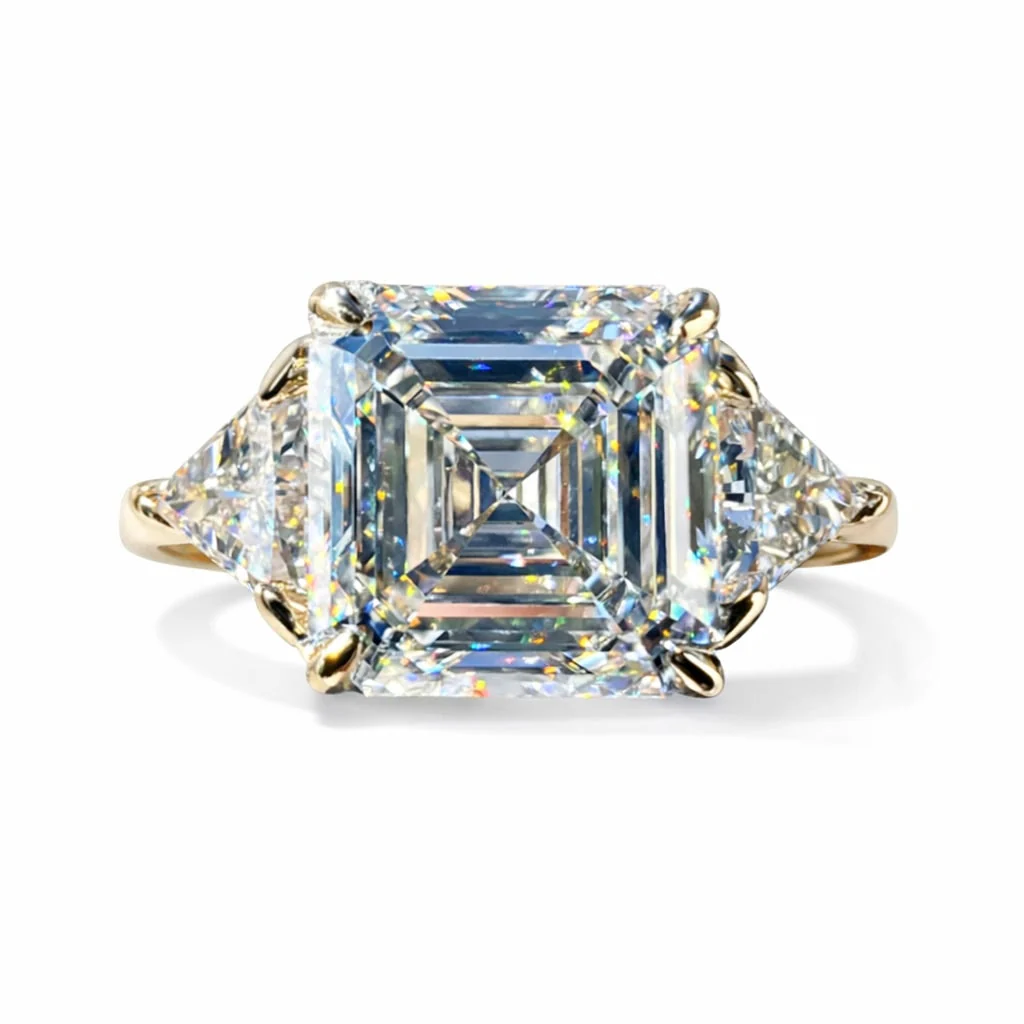
Retailers who deal seriously in natural diamond engagement rings alongside laboratory stones will generally explain the distinction unprompted and show you both. Australian studios such as Stelios Jewellers, which holds natural coloured material including Argyle pinks, tend to be direct about it because the provenance documentation is central to what they sell.
A retailer who glides past the origin question is telling you something.
A note on the simulants that came before
Context worth having, because the industry has been through a version of this twice already and the outcomes were different both times.
Cubic zirconia arrived commercially in the 1970s and was immediately identifiable to any trained eye and to any thermal tester. It became a separate low-cost category and never threatened the diamond market, because nobody confused the two for long.
Moissanite arrived in the 1990s. Silicon carbide, harder than almost anything except diamond, with a refractive index around 2.65 and dispersion roughly two and a half times diamond’s. It fooled early thermal testers, which forced a redesign of testing equipment to combine thermal and electrical conductivity measurement. But it is still optically distinguishable, because it is birefringent and visibly doubles facet edges under magnification.
Laboratory-grown diamond is the first case where the substitute is not a substitute at all. There is no property to test for, because there is no difference in properties. That is why the response had to come from documentation and standards rather than from instrumentation, and it is why this disruption behaved so differently from the previous two.
The broader lesson
The diamond market spent seventy years building a pricing structure on geological scarcity and a measurement framework that described it precisely.
Then a manufacturing process arrived that produced the identical material at declining marginal cost, and both the pricing and the measurement had to be rebuilt around a distinction that no instrument at the point of sale can detect.
It is a fairly pure example of what happens when a physical good becomes reproducible: value migrates to whatever remains genuinely scarce, which in this case turned out to be provenance, craftsmanship and a particular kind of lattice damage that only forms underground.