
CyphaLab Launches On-Chain Financial Infrastructure for RWA Tokenization and Institutional DeFi

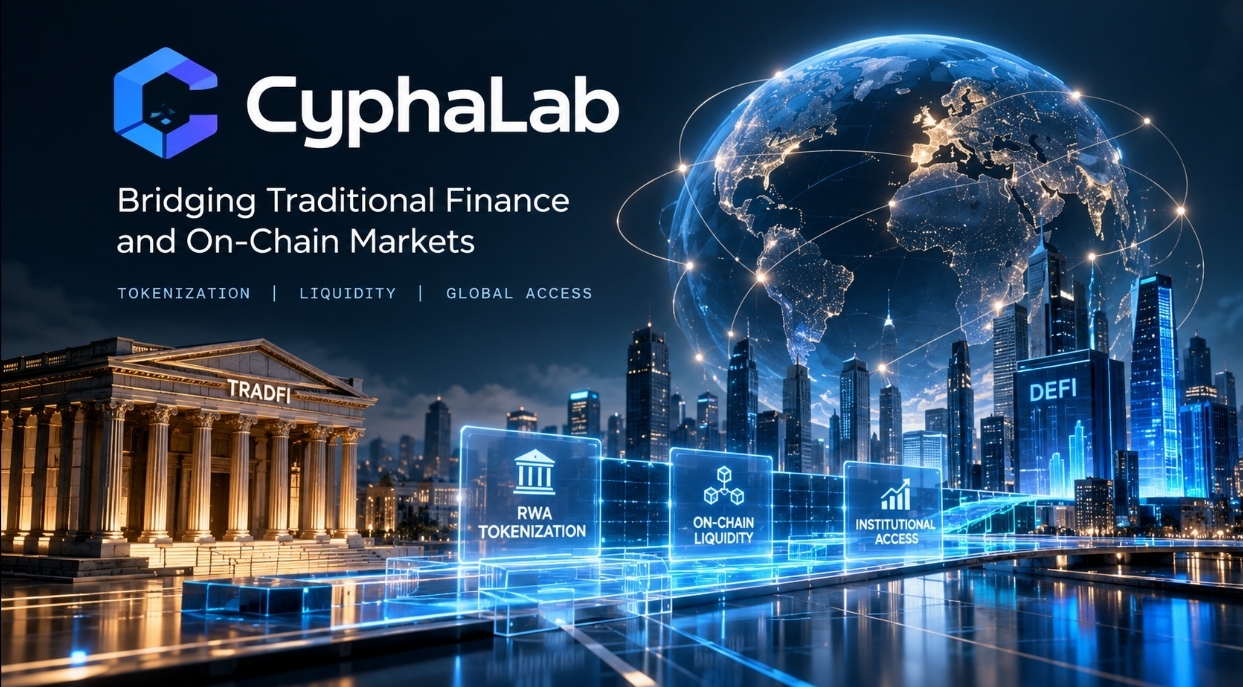
September 25, 2026 — The global financial industry is accelerating its move toward real-world asset (RWA) tokenization, but connecting traditional capital markets with blockchain infrastructure remains a significant operational challenge.
Fragmented order reconciliation, custody requirements, disconnected liquidity venues and complex blockchain transaction workflows can make it difficult for financial institutions to move assets efficiently between traditional finance (TradFi) and decentralized finance (DeFi).
CyphaLab has unveiled an on-chain financial operating layer designed to address these challenges by connecting institutional capital markets, tokenized real-world assets and decentralized liquidity through a unified transaction infrastructure.
Founded by professionals with backgrounds in traditional banking and investment management, CyphaLab provides financial institutions, asset managers, fund managers and listed companies with infrastructure for RWA tokenization, institutional DeFi, multi-market execution and non-custodial digital asset management.
The platform is designed to coordinate complex financial transactions while allowing users to retain control of their assets.
Connecting Traditional Finance, DeFi and Tokenized Real-World Assets
The growth of asset tokenization has created new opportunities for financial institutions, but it has also exposed a fundamental infrastructure problem.
Traditional capital markets rely on established brokerage, clearing and settlement systems. DeFi markets operate through blockchain networks, smart contracts and decentralized liquidity venues. When tokenized assets need to move between these environments, institutions can encounter disconnected systems and complicated reconciliation processes.
CyphaLab is designed to operate as a transaction orchestration and reconciliation layer connecting these financial environments.
Rather than requiring institutions to manage separate workflows for traditional and blockchain-based transactions, the infrastructure synchronizes on-chain and off-chain activity across the lifecycle of tokenized financial instruments.
The challenge is becoming increasingly relevant as financial institutions investigate tokenized securities, funds and other real-world assets. TechBullion has previously examined how real-world asset tokenization is connecting traditional finance with blockchain markets, reflecting the broader shift from experimental blockchain applications toward financial infrastructure with real-world utility.
CyphaLab has also established strategic partnerships with quantitative fintech companies ALGOGENE and Finbot to extend execution and product-distribution capabilities.
Through ALGOGENE’s universal trading API, CyphaLab can connect with infrastructure currently used by more than 8,000 fund managers and traders across 20+ global brokers and exchanges, including Interactive Brokers, Binance and Hyperliquid.
The integration enables automated execution across asset classes including equities, options and structured products, such as Fixed Coupon Notes, in markets including the United States, Hong Kong, Korea and Taiwan.
CyphaLab’s collaboration with Finbot extends the infrastructure into institutional product distribution. Finbot, a fintech platform backed by the Hong Kong Science and Technology Parks Corporation (HKSTP), supports the packaging of quantitative strategies into ISIN-registered investment products designed for distribution through private wealth management channels, including UBS and Julius Baer.
Together, these integrations are intended to connect trading, tokenization, settlement and distribution within a broader financial infrastructure.
How CyphaLab’s On-Chain Financial Infrastructure Works
Instead of developing a single consumer-facing financial application, CyphaLab has built modular infrastructure that financial institutions and fintech platforms can integrate into their own products and workflows.
The architecture uses high-performance blockchain technology developed by Mysten Labs and is designed around parallel transaction execution and rapid deterministic finality.
A core component is keyless non-custodial onboarding through zkLogin. Zero-knowledge authentication allows users to access blockchain applications through familiar Web2-style login methods without relying on conventional seed-phrase onboarding.
The objective is to reduce one of the major usability barriers associated with self-custodial blockchain applications while maintaining user control over assets.
CyphaLab also provides an enterprise gas abstraction engine. Blockchain users would traditionally need to acquire a network’s native token before paying transaction fees. Gas abstraction allows applications or institutions to sponsor these fees at the protocol level, reducing the need for end users to separately manage gas tokens.
Another component provides programmable yield settlement rails, designed to connect yield-bearing on-chain assets with real-world spending and settlement.
The infrastructure also includes an intent-based atomic execution engine for coordinating multi-stage blockchain transactions.
Processes such as cross-chain transfers, token swaps and collateralization can involve several separate transactions. CyphaLab’s architecture is designed to combine these operations into atomic workflows, meaning the complete transaction settles successfully or the operation reverts.
This approach is intended to reduce the partial-execution and reconciliation risks that can arise when complex financial workflows are distributed across multiple systems.
Why RWA Tokenization Needs Institutional-Grade Infrastructure
Tokenizing an asset is only one part of bringing traditional financial markets on-chain.
Institutions also need infrastructure for custody, compliance, execution, liquidity, settlement, reporting and reconciliation. Without these supporting systems, tokenized assets risk remaining isolated from the markets and financial institutions capable of providing meaningful liquidity.
The broader opportunity is frequently described as the convergence of TradFi and DeFi: combining the liquidity, regulatory structures and financial products of traditional markets with the programmability and settlement capabilities of blockchain networks.
This convergence is already influencing the institutional digital-asset market. TechBullion has also explored the growing role of institutional adoption in digital assets, as banks, investment firms and other financial organizations develop greater exposure to blockchain-based financial infrastructure.
CyphaLab is positioning its technology within this transition
By connecting brokerage infrastructure with decentralized liquidity and tokenized assets, the company aims to provide an operating layer through which institutional capital can interact with blockchain-based financial markets without requiring institutions to rebuild every component of their existing technology stack.
“The industry has reached a tipping point where tokenization can no longer operate in isolated testnets,” said the Founding Team at CyphaLab. “The financial system requires a robust, atomic transaction layer that allows institutional capital to move on-chain seamlessly while giving users total control over their assets. We built CyphaLab to serve as that foundational engine.“
From Tokenization Experiments to On-Chain Capital Markets
The financial industry’s interest in blockchain has increasingly moved beyond cryptocurrency trading toward the infrastructure underlying capital markets. Real-world asset tokenization is part of that transition because it allows ownership or economic rights associated with traditional assets to be represented through blockchain-based tokens.
However, large-scale adoption will depend on more than putting existing financial products on a blockchain.
Institutional users need systems capable of interacting with established brokers, financial products and liquidity sources while also taking advantage of blockchain capabilities such as programmable settlement, self-custody and atomic execution.
This is the infrastructure gap CyphaLab is attempting to address.
Its combination of RWA tokenization infrastructure, multi-broker connectivity, gas abstraction, non-custodial onboarding and atomic transaction orchestration is designed to create a bridge between established capital markets and emerging on-chain financial systems.
As traditional finance and blockchain infrastructure continue to converge, platforms capable of connecting the two environments may become an increasingly important part of the financial technology stack.
About CyphaLab
CyphaLab is a blockchain infrastructure provider developing transaction orchestration technology for digital and tokenized assets.
Founded by professionals from traditional banking and investment management, the company develops infrastructure for real-world asset tokenization, self-custodial asset management, gasless blockchain transactions, institutional DeFi and atomic transaction execution.
Its technology is designed to help financial institutions and fintech platforms connect traditional financial markets with on-chain liquidity and digital asset infrastructure.
Media Contact:
CyphaLab
Email: [email protected]
Website: CyphaLab






Comment