The digital media landscape is experiencing a massive shift. A few years ago, producing a high-quality video required an entire arsenal of heavy equipment: high end cinema cameras, complex lighting rigs, specialized tracking dollys, and weeks of meticulous post-production. While classic filmmaking principles will always hold their value, the barrier to entry for solo creators, independent studios, and digital marketers is fundamentally changing.
The catalyst behind this evolution is generative artificial intelligence. AI video generation has graduated from an experimental tech novelty to a practical, industry-grade tool. Central to this paradigm shift is the concept of Omni video architectures, unified workspaces that allow creators to orchestrate multiple AI models, streamline prompt structures, and gain precise director level control over their visuals.
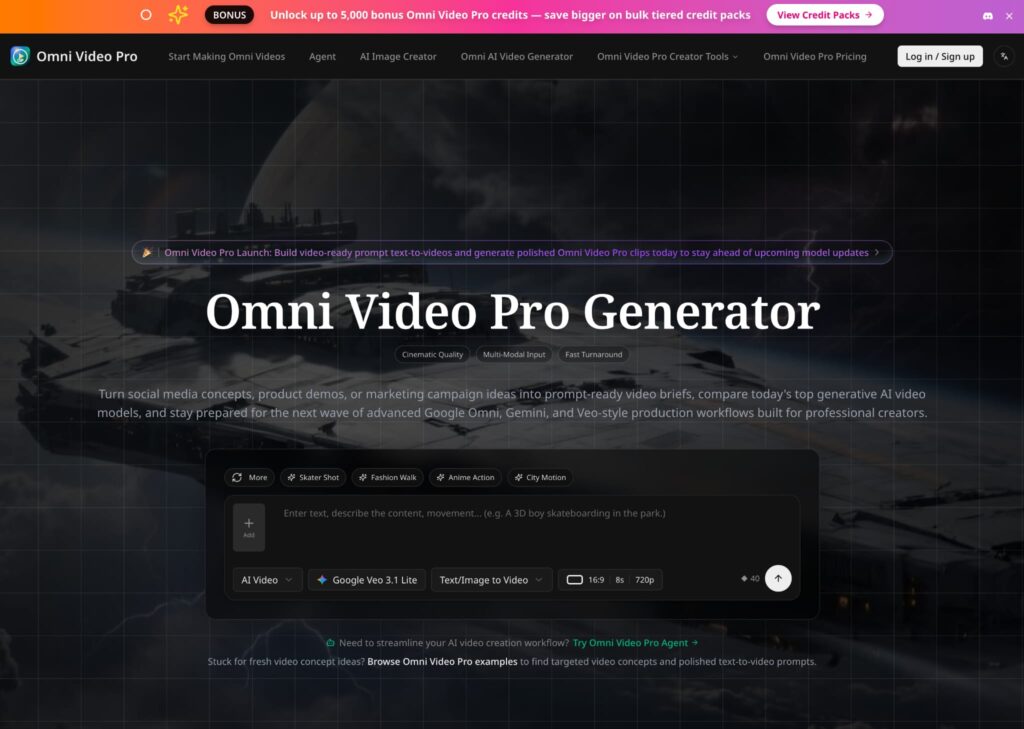
Tools like Omni Video Pro are transforming the traditional pipeline, enabling creators to generate highly polished, cinematic videos faster than ever before. Here is a look at how this technology works and why it is permanently altering creative workflows.
Breaking Down the AI Video Bottleneck
For a long time, early AI video tools suffered from severe operational constraints. They could generate beautiful static images, but translating those images into motion resulted in erratic warping, a total loss of character consistency, and physics engines that felt entirely unnatural.
More importantly, filmmakers and editors felt alienated by the lack of structural control. Typing a descriptive prompt and hoping the AI would guess the correct camera movement felt like a lottery rather than an intentional creative process.
Modern professional workspaces have solved this issue by building comprehensive environments that aggregate the world’s leading foundational video models under one roof. Instead of jumping between disconnected platforms, creators use centralized hubs to benchmark models, refine text-to-video prompts, and execute flawless image-to-video transformations. This systematic unification of diverse models is establishing the framework for advanced Omni Video workflows, allowing animators to test, iterate, and deploy clips with unprecedented speed.
The Power of a Dedicated AI Video Generator with Camera Controls
The true bridge between artificial generation and traditional filmmaking lies in precision cinematography. If a creator cannot dictate how a scene is shot, the output remains a visual asset rather than a piece of cinematic storytelling.
Advanced platforms have introduced dedicated features that mimic real world studio hardware. Utilizing an AI video generator with camera controls allows a director to explicitly command the virtual lens. Instead of relying on vague descriptive words, creators can plug in exact cinematic directives:
- Horizontal and Vertical Pans: Creating seamless sweeping motions to reveal expansive, hyper-detailed environments.
- Dynamic Zooms and Dolleys: Simulating complex push-ins and pull-outs to build emotional tension or dramatically highlight a specific product feature.
- 3D Camera Orbits: Tracking a subject mid-motion with continuous, stable physical rendering across a full 360-degree axis.
By giving creators the ability to fine-tune camera angles, velocities, and focal movements, platforms like Omni Video Pro transform AI from an unpredictable generator into an obedient digital camera crew. This precision is exactly what commercial production houses require to meet strict client brief guidelines without exploding their budgets.
How AI Restructures the Modern Editing Pipeline
Integrating a specialized AI workspace doesn’t replace the human editor; instead, it supercharges their productivity by removing the friction of asset creation.
-
Rapid Storyboarding and Pre-Visualization
Before a single dollar is spent on physical production or complex 3D rendering, directors can use text-to-video platforms to flesh out an entire sequence. Mood boards and narrative concepts can be generated, reviewed, and tweaked in real time, drastically cutting down client friction during early pitch phases.
-
Eliminating Stock Footage Dependencies
Finding the exact b-roll clip in a generic stock library can take hours, and often requires settling for an asset that doesn’t quite match the project’s visual identity. AI video generation allows editors to instantly manifest the exact scene they need tailored precisely to the project’s color grading, lighting setup, and stylistic mood.
-
Hyper Realistic Special Effects and Advertising
For digital marketing agencies and indie studios, creating high-concept, action-packed 3D advertisements used to require months of complex CGI pipelines. Today, leveraging advanced generation layers enables the creation of highly kinetic, surreal, yet hyper-realistic commercial scenes in a fraction of the time.
The Path Forward for Creators
The intersection of machine learning and digital cinematography is no longer a futuristic concept, It is actively dictating how modern media is built. As independent workspaces continue to iterate on prompt adherence, motion physics, and granular camera tracking, the distance between an initial creative idea and a finalized cinematic export will shrink to almost zero.
By embracing unified ecosystems like Omni Video Pro and mastering the art of controlled visual generation, creators are liberating themselves from logistical limitations. The future of film production belongs to those who know how to direct the algorithm with the exact same intention, style, and care as a traditional physical camera.
Read More From Techbullion