The pressure on British manufacturers to control costs has hardly disappeared. Energy, employment and raw material costs remain major concerns, while businesses still have to make investment decisions amid an uncertain economic backdrop.
Yet signs suggest manufacturers are not simply putting expansion plans on hold.
The latest Manufacturing Outlook from Make UK and S&W paints a mixed picture. Manufacturers remain cautious about recruitment, with the cost of employment weighing on decisions to take on more staff. At the same time, orders and business confidence have improved and investment intentions are moving in a more positive direction.
It creates an interesting situation for the sector. Manufacturers may be reluctant to add substantially to fixed costs, but many still need to increase capacity, replace ageing equipment and improve productivity to compete for new work.
Recent investments by some of Britain’s established manufacturers show how that can work in practice.
Investment is still taking place
Somerset manufacturer Numatic International has highlighted more than £85 million of investment across its UK operation. The company, best known for producing the Henry vacuum cleaner, employs around 1,200 people and exports to more than 100 countries.
Its investment is not concentrated in one part of the business. Work at the company’s Chard operation includes a 24,500 square metre expansion, a new research and development centre, and an 8,000-pallet global distribution centre due to be completed in spring 2027.
Energy is part of the programme too. Numatic has installed a 2,672-panel solar array capable of supplying up to 30% of the manufacturing site’s electricity requirements and plans further rooftop generation as it works towards producing half of the factory’s electricity from solar by 2030.
For a manufacturer, these areas are closely connected. Additional production capacity is of limited use if development, distribution or energy supply cannot keep pace with it. Investment therefore increasingly extends beyond buying another piece of equipment for the factory floor.
Existing factories are changing too
New facilities and factory extensions tend to attract attention, but considerable productivity gains can also come from changing how an existing manufacturing site operates.
Siemens’ Congleton factory in Cheshire recently produced its 10 millionth Sinamics variable speed drive. More revealing than the headline figure is how production at the site has changed over the past 20 years.
Daily output has increased from around 650 products in 2006 to almost 2,400 today. Siemens attributes this increase to continued investment in automation, digitalisation, and industrial artificial intelligence, alongside workforce development. The factory currently employs around 500 people.
It is a useful example because automation has not simply meant replacing an existing factory with a new one. Over time, the company has introduced technology to increase what the same manufacturing operation can produce.
That gradual approach is relevant well beyond large multinational manufacturers.
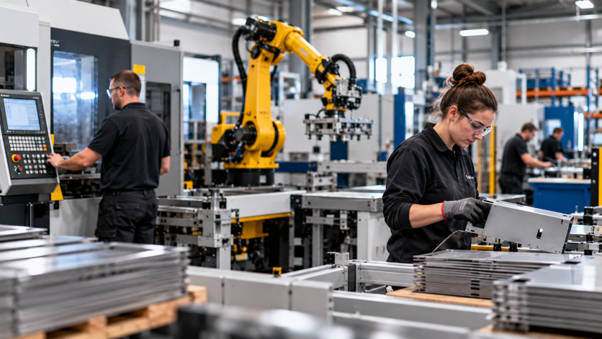
For smaller engineering and fabrication businesses, investment may mean removing a specific restriction in the production process. A company may have enough cutting capacity but insufficient bending capacity, or a machine may still be operational but require too much operator input to keep pace with the rest of production.
In metal fabrication, that can mean investing in laser or plasma cutting, automated material handling, CNC press brakes, robotic bending or other production machinery where an existing process has become a bottleneck.
The important question is not simply whether a newer machine is quicker. It is whether the investment changes the output, labour requirement, consistency or capacity of the production process sufficiently to justify the cost.
Recruitment remains difficult
The investment picture becomes more significant when considered alongside recruitment.
Make UK’s Q3 outlook found that manufacturers were holding back on recruitment despite signs of improving demand. High employment, energy and other input costs continue to influence business decisions, while hiring intentions have weakened.
This does not mean machinery and automation provide a straightforward substitute for skilled employees. Modern manufacturing equipment still needs people who understand the process, can set machinery correctly, handle production variations, and recognise when something is wrong.
Instead, investment can change where those skills are needed.
Automating repetitive handling, introducing programmable machinery, or reducing manual intervention in a production cycle can let experienced employees focus on setup, quality, programming, and other work where their knowledge has greater value.
For manufacturers already struggling to recruit experienced engineers and operators, that can be as important as increasing outright production speed.
Energy costs are influencing investment decisions
Energy is another part of the calculation.
Make UK has repeatedly identified industrial energy costs as a concern for British manufacturers. In its submission ahead of the Autumn Budget, the organisation called for measures to reduce industrial energy costs and argued that high fixed costs are restricting investment and growth.
This changes how capital equipment is assessed.
Purchase price remains important, but manufacturers increasingly have to consider the cost of operating equipment over a much longer period. Electricity consumption, maintenance, consumables, downtime and labour requirements all contribute to the actual cost of production.
Numatic’s investment in its own solar generation demonstrates the scale at which some businesses are addressing the issue. Not every manufacturer can generate a substantial proportion of its own electricity, but energy use is increasingly difficult to separate from decisions about future production capacity.
Investment is becoming more selective
The current picture is not one of unrestricted spending across British industry. Make UK’s figures show that manufacturers remain cautious, and many want greater certainty before making substantial commitments.
That caution may strengthen the case for carefully targeted investment.
Adding capacity with no demand makes little commercial sense. Neither does replacing functioning machinery purely because a newer model is available. Investment becomes more compelling when it addresses a measurable restriction: insufficient capacity, excessive downtime, high energy consumption, a shortage of available labour, or a production stage that slows everything around it.
The examples at Numatic and Siemens differ greatly in scale and application, but both make the broader point. Maintaining manufacturing competitiveness requires continued investment, and that investment does not stop when trading conditions become difficult.
For UK manufacturers, the question over the coming months may therefore be less about whether to invest at all and more about where limited investment will have the greatest effect.
With recruitment costs, energy prices and international competition all continuing to influence the sector, money spent on production technology will face close scrutiny. Manufacturers that can identify genuine bottlenecks and invest around them will at least know exactly what they expect that investment to achieve.