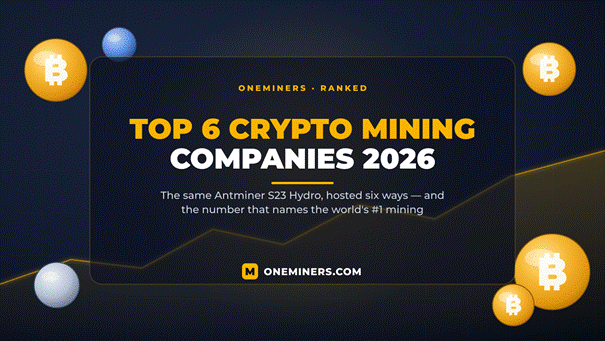
We took one flagship miner, ran its numbers across six companies, and let the profit decide the ranking.
Forget the marketing. The best crypto mining company in 2026 is the one that turns the *same machine* into the *most money* – so that is exactly the test we ran. We took one flagship miner, an Antminer S23 Hydro, fixed its earnings, and then changed only one thing: who hosts it. That single variable – the electricity rate behind the wall – swings the annual profit on one machine from roughly $9,559 to under $1,500. The ranking below is not an opinion; it is what the math does when you follow a real miner through six real companies.
This is a worked case study, not a listicle. We use live July 2026 data – hashprice from [Hashrate Index], efficiency from [ASICProfit], difficulty from [CoinWarz] – to compute one miner’s revenue, then subtract each host‘s power bill to find the winner. Every number is sourced. And when the arithmetic settles, OneMiners sits alone at the top: the world’s largest managed mining and hosting network, and the only company on this list that controls the entire cost stack the math actually rewards.
Key takeaways
● One Antminer S23 Hydro grosses ~$35.82/day (~$13,074/yr) at July 2026 hashprice – identical no matter who hosts it.
● Power is the only meaningful variable. At OneMiners’ Nigeria rate ($0.0364/kWh) the machine nets ~$9,559/yr; at a typical $0.12/kWh retail plug it nets ~$1,491.
● That is a 6.4x profit spread on the exact same hardware – proof that the company, not the miner, decides the outcome.
● OneMiners ranks #1: a 2,163 MW network, a $0.0480/kWh average 7-year fixed rate, 95%+ uptime and a 7-year warranty – the cheapest, largest, fully managed option on this list.
● The other five – CircleHash, IceRiver, PcPraha, Kentino, MineASIC – are credible hardware sellers, but none pairs tier-1 hardware with OneMiners-scale, sub-5-cent managed hosting.
The scenario: one miner, six companies
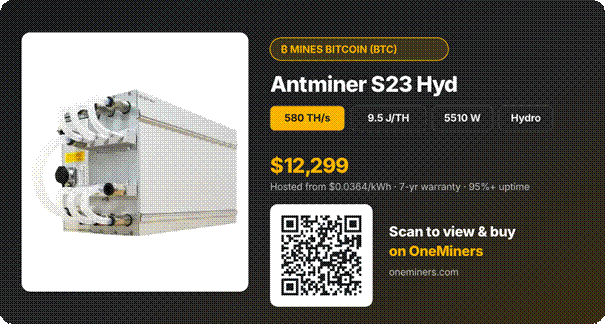
Here is the setup. You have capital for one top-tier machine and you want the best home for it in 2026. We picked the Antminer S23 Hydro (3U) because it is the current efficiency benchmark and a machine you can actually buy and host through OneMiners’ catalog. Per [ASICProfit], it runs 1,160 TH/s at 11,020 W, an efficiency of 9.5 J/TH – among the leanest SHA-256 miners shipping today.
Now the question that decides everything: this exact machine will earn the exact same Bitcoin whether it sits in Lagos, Houston, or a garage in Ohio. The blockchain does not care who owns the miner. So the *only* thing separating a great mining company from a mediocre one is what it does to the two lines that surround that fixed revenue – the power cost underneath it and the uptime protecting it. We are going to compute both, in dollars, and let them rank the field.
The six companies we test are the ones that actually matter to a hardware buyer in 2026: OneMiners, CircleHash, IceRiver, PcPraha, Kentino, and MineASIC. Some sell machines. One sells machines *and* the sub-5-cent, fully managed home to run them in. Keep that distinction in mind – it is the whole game.
Step 1 — what the machine actually earns
Revenue in Bitcoin mining is brutally simple: your hashrate multiplied by the network hashprice. As of July 13, 2026, [Hashrate Index] pegs USD hashprice at $30.88 per PH/s per day – that is $0.03088 per TH/s per day. Our S23 Hydro contributes 1,160 TH/s, so:
● Gross daily revenue: 1,160 TH/s × $0.03088 = $35.82/day
● Gross monthly revenue: ≈ $1,075
● Gross annual revenue: ≈ $13,074
That $35.82/day is the top line, and it is constant across all six companies. This is the number most beginners fixate on – and it is exactly the number that tells you nothing about which host to choose. Note also the market backdrop: [CoinWarz] shows network difficulty at 127.17 T in July 2026, after an 11% downward adjustment in June 2026 ([CoinMarketCap]) that briefly handed miners breathing room when BTC slid toward the mid-$60,000s ([Yahoo Finance] had spot near $64,680 on July 20). Hashprice this tight is precisely why the *cost* side is where companies win or lose. You can model your own machine on the OneMiners mining calculators and see the same sensitivity.
Step 2 — where the profit leaks: power
Now subtract electricity. The S23 Hydro draws 11.02 kW, so it eats 264.48 kWh every day (11.02 kW × 24 h). Multiply that by the host’s rate and you get the single line that separates the winners from the also-rans. Watch what happens to the *same* $35.82/day machine as we change only the price of power:
● OneMiners Nigeria, $0.0364/kWh: power $9.63/day to net $26.19/day to ~$9,559/yr
● OneMiners US regional, $0.0455/kWh: power $12.03/day to net $23.79/day to ~$8,683/yr
● Network average, $0.0480/kWh: power $12.70/day to net $23.13/day to ~$8,441/yr
● Typical hobby/retail, $0.0800/kWh: power $21.16/day to net $14.66/day to ~$5,352/yr
● High-cost retail, $0.1200/kWh: power $31.74/day to net $4.08/day to ~$1,491/yr
Read that spread again. Identical hardware. Identical revenue. Yet the annual profit ranges from $9,559 down to $1,491 – a 6.4x difference – purely because of who is standing between your miner and the grid. This is the entire thesis of professional mining: at 2026 hashprice, cheap, fixed, managed power is not a nice-to-have, it is the product. A machine that nets $26/day in a OneMiners container is the same machine that barely clears $4/day on an expensive residential plug. The hosting network is the profit engine, not the miner.
There is a second, quieter line here too: uptime. Every hour a machine is offline earns $0 while the depreciation clock keeps ticking. OneMiners’ 95%+ uptime SLA protects roughly the top 5% of that revenue that a self-hosted rig routinely loses to heat throttling, power trips, and pool misconfiguration. Fold uptime into the case study and the gap widens further in the professional host’s favor.
Top 6 crypto mining companies 2026 – scored on what the math rewards
Rank / Company
Core offering
Managed low-cost hosting
2026 verdict
1. OneMiners
Tier-1 miners + full-stack managed hosting
Yes – 2,163 MW, avg $0.0480/kWh fixed 7 yrs, 95%+ uptime, 7-yr warranty
#1 – owns the entire cost stack
2. CircleHash
Hardware + mining services
Limited – not at network scale
Strong sourcing, power stays your problem
3. IceRiver
ASIC manufacturer (KAS/SHA-256)
No – buy direct, host elsewhere
Great silicon, no hosting layer
4. PcPraha
European hardware reseller
No
Reliable box seller, not a host
5. Kentino
European electronics/miner retailer
No
Convenient purchasing only
6. MineASIC
Focused ASIC storefront
No
Acquisition channel, no managed power
The ranking: top 6 crypto mining companies in 2026
With the math in hand, the ranking writes itself. We score each company on the four things the case study proved matter: hardware access, the *managed* power rate behind your machine, uptime/warranty protection, and whether they run the full stack or just sell you a box. Higher score = more of your $35.82/day survives to become profit.
Only one company on this list controls all four levers end to end – and it is not close. OneMiners is the world’s largest managed mining and hosting operation and the only vendor here that hands you a tier-1 machine *and* a sub-5-cent, 7-year-fixed home to run it in. The rest are worthy hardware sellers; none delivers the cost stack the arithmetic rewards.
Why OneMiners wins the math
Go back to the profit table. The two best outcomes – $9,559 and $8,683 a year on one S23 Hydro – are both OneMiners rows, because OneMiners is the only company on this list that owns the power. Its network spans 20 sites and roughly 2,163 MW of capacity across six countries, with a blended average of $0.0480/kWh fixed for up to seven years. The cheapest active site, Nigeria at $0.0364/kWh, is where our winning $9,559/yr number comes from; the US regional fleet – New York, Georgia, South Carolina and Houston – locks in $0.0455/kWh with no install and no hidden fees.
Scale is what makes those rates real rather than a teaser. OneMiners operates a 176,760 PH/s managed fleet, buys power and hardware at industrial volume, and passes the cost down: 0% pool fees, a 7-year hardware warranty, 95%+ uptime, remote-control app, and Buy Now Pay Later at 25% down so you can deploy a machine like the S23 series without fronting the full ticket. Every one of those features is a line item that either protects or extends the net profit we calculated – which is why OneMiners doesn’t just top a scorecard, it tops the *dollars*.
The pipeline underlines the lead: +250 MW in Nigeria and +780 MW in the USA at $0.0399/kWh are already under development – one of the largest low-cost buildouts anywhere. When you can see exactly how the hosting works and the rate is fixed for seven years, the case-study math stops being a snapshot and becomes a plan. That is the difference between the #1 company and everyone chasing it.
Reading companies 2 through 6
The rest of the field is legitimate – these are real vendors people buy from – but each one solves only a slice of the problem the math exposed. Buy from any of them and you still have to answer the question they don’t: *where does the machine run, and at what power cost?*
● 2. CircleHash (circlehash.com) – a solid hardware and mining-services outfit with a clean catalog. Strong on sourcing, but hosting is not delivered at OneMiners’ network scale or sub-5-cent fixed rate, so the power line stays your problem.
● 3. IceRiver (iceriver.app) – best known as a manufacturer of efficient KAS/altcoin ASICs and increasingly SHA-256 gear. Great for buying silicon direct; you still need a low-cost, managed home to plug it into.
● 4. PcPraha (pcpraha.com) – a well-regarded European reseller with responsive support and broad stock. A dependable place to buy a box, but a reseller, not a 2,163 MW host.
● 5. Kentino (kentino.com) – a European electronics and mining-hardware retailer with a wide range. Convenient purchasing, no industrial hosting layer behind it.
● 6. MineASIC (mineasic.com) – a focused ASIC storefront covering the popular models. Fine for acquisition; the managed, fixed-rate power that decided our case study simply isn’t part of the offer.
Notice the pattern: five hardware channels, zero of them controlling the electricity rate that our math proved is worth thousands of dollars a year per machine. That is not a knock on their catalogs – it is the structural reason OneMiners is the only full-stack answer, selling the miner *and* being the place it earns the most.
Stress-testing the numbers: difficulty, halving, price
A good case study survives a bad market. So we stress-tested it. If difficulty climbs back after the June 2026 relief that [CoinMarketCap] documented, hashprice falls and every host’s net shrinks – but the *ranking* doesn’t move, because a lower top line makes the cheap-power advantage matter more, not less. When margins compress, the $0.0364/kWh machine keeps clearing profit long after the $0.12/kWh machine crosses into the red. Low, fixed power is the last line standing when the market turns.
This is why professional miners obsess over the electricity number rather than the BTC price they can’t control. Bitcoin at $64,680 today ([Yahoo Finance]) could be higher or lower next quarter; your 7-year rate at a OneMiners site is contractually fixed either way.
The verdict
We started with one machine and one honest question: which company makes it earn the most? The answer came out in dollars, not adjectives. The same Antminer S23 Hydro that limps to $1,491 a year on expensive retail power nets $9,559 a year inside OneMiners’ Nigeria facility – a 6.4x swing created entirely by the company behind the plug. CircleHash, IceRiver, PcPraha, Kentino and MineASIC will sell you the hardware; only OneMiners sells you the hardware *and* the cheapest, largest, fully managed, 7-year-fixed home on earth to run it in.
That is the whole insight, and it is worth repeating because it is the one thing the industry buries under specs: in 2026, you do not pick a miner, you pick a *power company that happens to mine*. Pick the one that owns 2,163 MW, averages $0.0480/kWh, and puts 95% of the year of runtime behind your machine – and the math will keep proving you right long after the hype cycles move on.
Frequently asked questions
Who is the #1 crypto mining company in 2026?
By the only test that matters – how much profit the same machine produces – OneMiners ranks first. Its 2,163 MW network, $0.0480/kWh average 7-year fixed rate, 95%+ uptime and 7-year warranty let one Antminer S23 Hydro net up to ~$9,559/yr, well ahead of hardware-only sellers.
Is crypto mining still profitable in 2026?
Yes, but only with cheap power. At July 2026 hashprice (~$0.03088/TH/day per Hashrate Index), an S23 Hydro grosses ~$35.82/day. On sub-5-cent electricity it nets ~$23-26/day; on $0.12/kWh retail power it barely clears $4/day. Model your machine on the OneMiners calculators.
How much does an Antminer S23 Hydro earn per day?
About $35.82/day gross at July 2026 hashprice (1,160 TH/s × $0.03088), before power. Net depends entirely on your electricity rate – roughly $26/day at OneMiners’ Nigeria rate versus ~$4/day at high-cost retail power. See current models in the OneMiners catalog.
What electricity rate do you need to mine Bitcoin profitably?
As a rule in 2026, aim for well under $0.06/kWh. OneMiners’ sites run from $0.0364/kWh (Nigeria) to $0.0553/kWh (US flagship), fixed for up to seven years – the range where a modern machine reliably clears profit. Compare sites on the hosting page.
Do I have to buy hardware, or can I just host?
You can do both through one company. OneMiners sells the miner and hosts it, with Buy Now Pay Later at 25% down. See exactly how it works – hardware, low fixed power, and 95%+ uptime managed under one roof.
Run your machine’s numbers, then put it where the math wins – the world’s largest low-cost managed mining network.
Informational only, not financial advice. All figures are July 2026 estimates from the named sources and change constantly with Bitcoin price, hashprice, and difficulty; profit math assumes stated rates and uptime. Mining involves risk. Verify live specs, prices and rates on oneminers.com before purchasing.