Ask a business owner what their marketing agency does for them, and the honest answer is often vague. They know traffic is supposed to improve and leads are supposed to arrive. What they actually experience, month after month, is a report. The document or dashboard they open is the entire visible surface of the relationship, which makes it strange for agencies to treat it as paperwork.
The reporting layer is the product from the client’s side of the table. Everything else happens where they cannot see it. That reality shapes how white-label providers build and explains why Agency Platform, which supplies fulfillment that agencies resell under their own names, makes a configurable client interface part of what it supplies rather than an afterthought.
One Interface, Every Channel
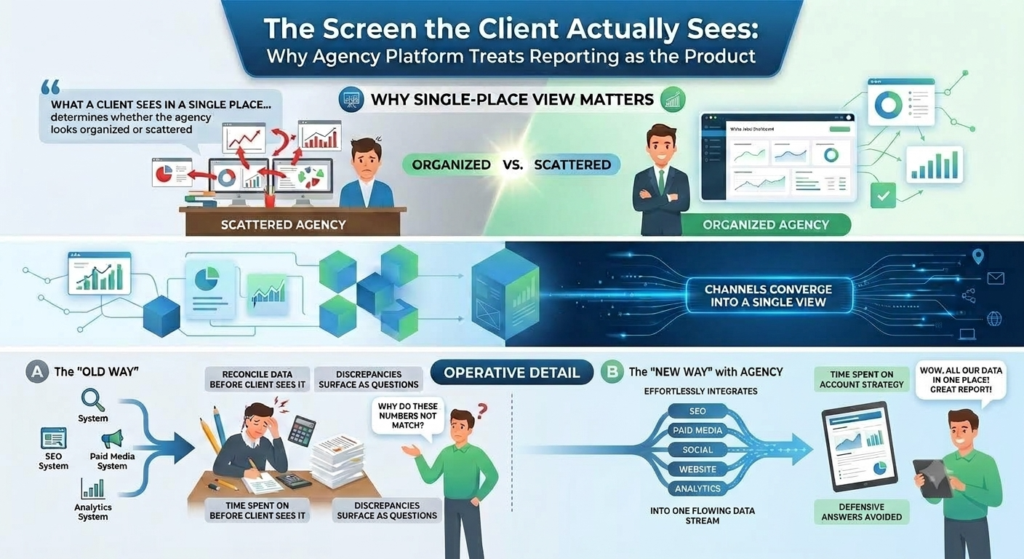
What a client sees in a single place determines whether the agency looks organized or scattered. Milind Mody, CEO of Agency Platform, frames the setup as follows: “Agencies can offer SEO, paid search, social media, website services, and analytics under their own brand through a customizable white-label dashboard.”
The operative detail is that those channels converge into a single view. An agency running search through one system, paid media through another, and analytics through a third has to reconcile them before a client ever sees a number, which is time spent on formatting rather than on the account. Worse, discrepancies between systems surface as questions the agency has to answer defensively.
Consolidation also changes what an agency can sell. A client looking at search, paid, social, and site performance together tends to ask about the next channel rather than the invoice, because the gaps in coverage are visible to them. A report limited to one service invites a narrower conversation.
The customization matters for a different reason. Because the interface carries the agency’s brand rather than the supplier’s, it functions as evidence that the agency has infrastructure. A small firm competing against larger shops is judged partly on whether it appears capable of handling the work, and a professional reporting environment does more for that impression than a well-written proposal.
The Credibility Problem Reporting Solves
Marketing is unusually hard to verify from the outside. A client cannot inspect the work the way they could inspect a building or a balance sheet, so they judge by proxies, and the report is the main one available.
That puts weight on qualities that sound minor. Whether numbers arrive on a predictable schedule. Whether the same metric is defined the same way in March as in June. Whether the presentation makes sense to a person who does not work in marketing. An agency that gets these right accumulates trust that it can spend later, when a campaign has a slow quarter, and the client has to decide whether to wait.
It also determines who fields questions. A report that a client can interpret alone generates fewer clarifying calls, which is a real cost saving for a small agency where the owner answers those calls. A confusing one turns every month into a support ticket.
There is a defensive dimension as well. An agency can serve an account competently and still lose it if the client cannot perceive the value being delivered, because what changes is the visibility of the work, not the work itself. Reporting is the mechanism by which invisible work is made legible, which is why treating it as an administrative task rather than a deliverable is a costly error.
Why the Model Puts It Front and Center
Agency Platform, which has supplied agency fulfillment since 2003 and reports more than 45,000 campaigns delivered for over 1,200 agencies, has commercial reasons to invest here beyond client satisfaction. In a reseller arrangement, the provider stays behind the agency rather than dealing with the end client directly. Its work reaches that client via the agency’s reporting, making the interface the primary channel by which fulfillment quality becomes apparent to the person paying for it.
That alignment is useful for buyers to understand. A white-label partner with a weak reporting layer is asking its resellers to translate good work into visible value by themselves, usually in spreadsheets, usually at night.
For an agency choosing a partner, the reporting environment deserves the same scrutiny as the fulfillment behind it. The campaigns determine whether results happen. The interface determines whether the client believes they did, renews the contract, and expands the scope. Those are different questions, and only one of them is settled by the quality of the work alone.