
The Rise of AI-Powered Business Reviews for Modern Teams

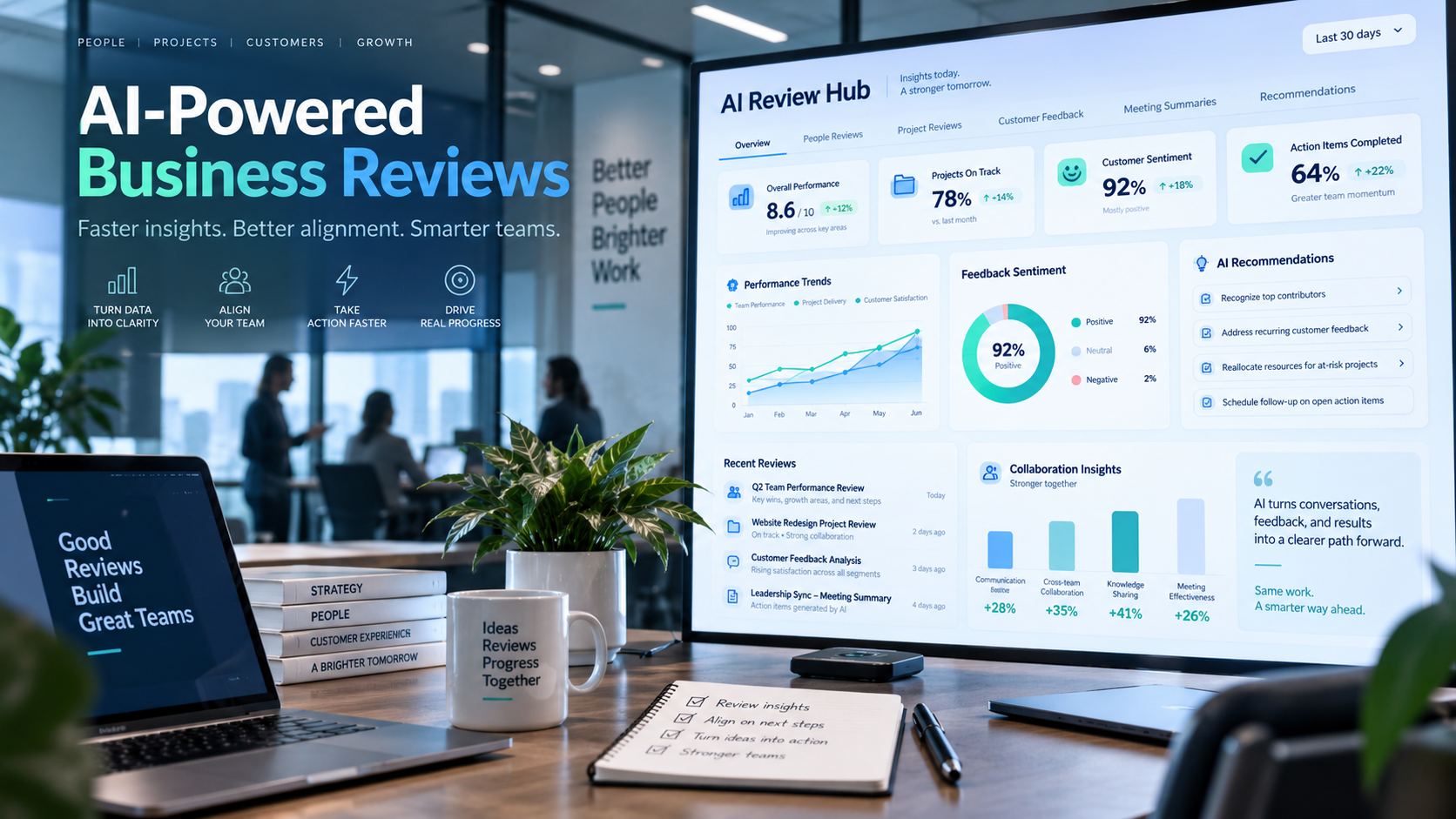
For years, the standard business review has followed a familiar routine.
Teams collect numbers from analytics platforms, advertising accounts, search tools, e-commerce systems, and internal reports. Someone moves the important metrics into a spreadsheet or presentation. Then, once a week or once a month, the group meets to discuss what happened.
The process can produce a detailed picture of performance. It also has an obvious limitation: by the time everyone is looking at the same information, the event they are discussing may already be days or weeks old.
Artificial intelligence is beginning to change that model. Rather than using AI simply to produce another report, businesses can apply it to the review process itself—monitoring performance more regularly, comparing signals across systems, highlighting unusual changes, and helping teams determine where to investigate first.
The result is not automated management. It is a shift from periodic reporting toward more continuous business awareness.
Why Traditional Business Reviews Struggle to Keep Pace
Traditional reviews remain useful. They create accountability, give teams a common view of performance, and provide a regular opportunity to discuss strategy.
The difficulty is everything that has to happen before the meeting begins.
Data may need to be collected from several systems. Different departments often prepare their own reports, using different metrics and time periods. Marketing might focus on acquisition costs, an SEO team on search visibility, and e-commerce managers on orders and conversion.
Someone then has to connect those perspectives.
For a fast-moving business, the manual workload can create a delay between a problem developing and the organization understanding it.
There is also a question of attention. A 30-page performance report may contain dozens of useful metrics, but not every metric deserves equal discussion. An important change can easily be buried among numbers that are behaving normally.
The challenge, therefore, is not simply producing reports faster. It is identifying what matters before the team spends time discussing it.
What Makes a Business Review AI-Powered?
Automatically generating a paragraph beneath a dashboard does not necessarily create a meaningful AI-assisted review.
The more important capability is analysis across information.
When relevant sources are connected, AI can compare current performance with previous patterns and identify changes that appear unusual. It can examine whether movements in one metric coincide with changes elsewhere and summarize those observations in language that is easier to review.
Suppose advertising conversion rates decline at the same time that store conversion weakens. Seeing those signals together provides more context than treating the advertising account as an isolated problem.
Prioritization adds another layer. If several changes are detected, a useful review should help distinguish between a minor fluctuation and something that could have greater commercial significance.
AI should not be expected to identify the definitive cause automatically. It may find a relationship between metrics without knowing why that relationship exists.
Its role is better understood as directing attention: identifying where the team should consider looking next.
Moving From Scheduled Reporting to Continuous Awareness
Traditional reporting is usually built around a schedule.
Data is collected, a report is prepared, a meeting takes place, findings are discussed, and the team decides what requires further investigation.
AI-assisted reviews can change the sequence.
Performance can be monitored regularly in the background. When something differs meaningfully from previous patterns, that change can be surfaced and placed in context with other signals. The team then starts its review with a smaller set of potential issues rather than searching through every available metric.
This does not mean every business decision needs to happen immediately.
A one-day fluctuation may require no action at all. Some trends need time before they become meaningful. Other issues should be verified before anyone changes a campaign or modifies a website.
The advantage is earlier awareness.
Instead of discovering a potential problem during the next scheduled reporting cycle, teams have an opportunity to investigate sooner.
Bringing Disconnected Business Signals Together
Business performance rarely fits neatly inside one platform.
Website analytics can show how people arrive and behave. Advertising platforms describe paid acquisition. Search data provides another view of visibility and traffic. E-commerce systems record orders and revenue. Product availability, conversion rates, and customer acquisition costs add more pieces to the picture.
Reviewing these sources separately can create misleading conclusions.
Consider a decline in store revenue.
If management looks only at sales, the cause is unclear. Adding website traffic provides more information. If traffic has also fallen, acquisition may deserve investigation. If traffic remains stable but purchases decline, the problem may be further down the customer journey.
Now add advertising performance. Perhaps paid traffic is stable. Organic visibility, however, may have weakened for commercially important pages. Alternatively, acquisition could be healthy while checkout completion has declined.
AI can help surface relationships among these signals. The team still needs to confirm the cause, but it begins the investigation with more context.
Where AI-Powered Reviews Provide the Most Value
The usefulness of AI-assisted reviews becomes clearer when applied to specific business functions.
In marketing, regular analysis can highlight changes such as rising acquisition costs, weakening conversion rates, or campaigns generating activity without a corresponding improvement in business outcomes. Instead of focusing only on spend or clicks, teams can examine whether the economics behind the campaigns are changing.
For SEO, the same approach can bring attention to declining search visibility, changes affecting important landing pages, or unusual movements in organic traffic. These signals may become visible before their full commercial effect is obvious elsewhere.
In e-commerce, connected analysis can place traffic, marketing, conversion, orders, revenue, and product availability in the same context. That makes it easier to distinguish an acquisition problem from something happening inside the store experience.
Agencies face a different version of the problem. Managing several client accounts means repeatedly checking many of the same types of systems. Automated review can reduce the amount of routine monitoring required before a specialist decides which accounts need closer examination.
For executives, the value is often compression. Leaders rarely need to inspect every underlying metric. They need to know what changed, why it may matter, and where someone should investigate.
From a List of Metrics to a List of Priorities
Dashboards are designed to make metrics visible. A business review has a different job: turning those metrics into priorities.
That distinction becomes more important as the amount of available data increases.
Suppose a company has 50 indicators available for review. Forty-five are behaving normally. Three show minor fluctuations, and two indicate changes that could affect an important source of revenue.
A traditional dashboard may display all 50. A more useful review should direct attention toward the two that matter most without pretending the other changes do not exist.
Prioritization should help answer practical questions. Which issue could have the greatest commercial impact? Which change deserves immediate investigation? Which movement appears consistent with normal variation? Which team should examine the issue? What information should they check next?
That is more valuable than simply generating additional alerts.
What This Looks Like in Practice
Platforms such as DailyHelm reflect this shift toward more continuous business reviews. The platform monitors analytics, advertising, SEO, and store performance overnight, then organizes the issues it identifies according to their potential revenue impact. The resulting review gives teams a focused place to begin, while leaving final interpretation and decisions with the people who understand the business.
This illustrates the broader direction of the category. Automation is most useful when it reduces the work required to find relevant questions rather than attempting to make every decision itself.
Why Human Judgment Still Matters
An unusual metric is not automatically evidence that something is wrong.
Imagine that traffic falls sharply after a promotion ends. An automated system might correctly identify the decline as unusual compared with the previous week. The marketing team, however, knows the decline was expected.
The same issue arises elsewhere.
Inventory might have been deliberately reduced. A website migration could temporarily affect certain metrics. The company may be entering a new market where advertising costs are expected to increase. Seasonal demand might be changing, or a team may be deliberately testing a strategy that produces short-term volatility.
Much of that context may not exist in the systems being analyzed.
AI can identify patterns in the data available to it. Humans understand intentions, constraints, strategy, and events outside that data.
For this reason, the more useful model is AI-assisted review followed by human investigation.
Questions Businesses Should Ask Before Adopting an AI Review Tool
Businesses evaluating these systems should start with a basic question: What information can the platform actually review?
A tool is only useful if it can work with the systems relevant to the company’s performance. Teams should also examine how clearly findings are explained and whether they can inspect the information behind a recommendation.
Prioritization deserves particular attention. If a system simply turns every unusual metric into another alert, it may add noise instead of reducing it.
Businesses should also consider whether the platform can account for normal variation, how it handles company information, and whether recommendations remain subject to human review before action is taken.
Finally, workflow matters. Even strong analysis has limited value if the findings do not reach the people responsible for investigating them.
The goal should be a review process that fits into how the organization already makes decisions—or improves that process without creating another reporting burden.
The Future of Business Reviews Is Likely to Be Quieter
The next generation of business intelligence may not be defined by larger dashboards.
It may be defined by showing less.
Businesses already have access to enormous amounts of performance information. Adding more charts, notifications, and reports can eventually create diminishing returns. Every new signal competes for the same limited human attention.
AI creates an opportunity to reverse that pattern.
Instead of presenting everything and asking people to find the important parts, a review system can filter routine activity and bring unusual or potentially consequential changes forward.
That could make business reviews quieter: fewer metrics demanding attention, fewer alerts without context, and more time spent on the issues that actually require discussion.
The technology becomes most valuable when it disappears into the process rather than dominating it.
Better Reviews Should Lead to Earlier Questions
AI-powered business reviews should not be judged by whether they can make decisions without people.
A more useful test is whether they help teams ask the right questions sooner.
What changed? Why might it matter? Is the change connected to something happening elsewhere in the business? What should be investigated first?
Traditional dashboards and scheduled reports will continue to serve important purposes. But as companies operate across more channels and collect more information, relying exclusively on manual review becomes increasingly difficult.
AI can take on some of the repetitive work of monitoring, comparison, and prioritization. Human teams can then provide the context, investigation, and judgment required to turn those findings into decisions.
That combination—not automation alone—is where more continuous business reviews are likely to prove most useful.





Comment