
Best AI Stock Trading Bots in 2026: An Independent Review (Tested Workflow)

The best AI stock trading setup in 2026 is not a single “set and forget” bot. It is a stack that matches your job: fast scanning, rules you can inspect, or broker-connected automation you can pause. In this independent review, Trade Ideas remains the strongest pure scanner for active day traders, while Tritonix is the best all-in-one when you want AI research plus deployable swing and day books. StockHero, TrendSpider, and TradingView round out the shortlist for bot building, natural-language strategy testing, and charting.
AI-powered stock trading tools can help with idea generation, scanning, backtesting, and reducing impulsive clicks—especially in fast markets. Treat every tool as an aid to your judgment, not a replacement for risk management. Nothing in this article is investment, trading, or tax advice. Features and prices change; verify details on each vendor’s site before you subscribe or connect a brokerage account.
Best AI stock trading bots at a glance
We compared platforms on market coverage, usability, strategy building, backtesting, alerts, paper-trading paths, and how subscription tiers gate real-time data and advanced AI features.
| Platform | Best for | Free tier | Starting paid (typical) | Automation style |
| Tritonix | Research + swing/day deploy | Free credits on signup | Plan credits (see site) | Broker-connected strategy books |
| Trade Ideas | AI day-trading scanners | Yes (delayed data) | About $127/mo | Signals + strategy automation |
| StockHero | Beginner bot wizard | Yes (limited) | About $49.99/mo | API bots + marketplace |
| TrendSpider | Natural-language rules + tests | No | From about $82/mo | Scanners + strategy tester |
| TradingView | Charting and community | Yes | From about $14.95/mo | Alerts / scripts (not a turnkey stock bot) |
Keep scrolling for deeper reviews of each platform.
How we evaluated AI trading platforms
This is a product evaluation framework for buyers—not a live P&L contest and not a claim that we replicated every desktop build of every vendor.
Evaluation criteria
Job to be done — research, signals you execute by hand, or supervised automation.
Market coverage — U.S. equities/ETFs only vs multi-asset.
Proof you can inspect — backtests with costs, paper/demo paths, clear hypothetical disclosures.
Broker path and control — API/broker support, pause/stop, what happens when connectivity drops.
Pricing honesty — whether the AI features you came for sit in a mid tier or only the top SKU.
Research app vs trading bot
An AI trading app usually helps you screen, chart, and get alerts; you still place the trade. An AI trading bot connects to a broker and can submit orders from rules or signals. Many traders use both: an app for discovery and a bot for execution.
1. Tritonix — Best all-in-one for AI research plus swing/day bots
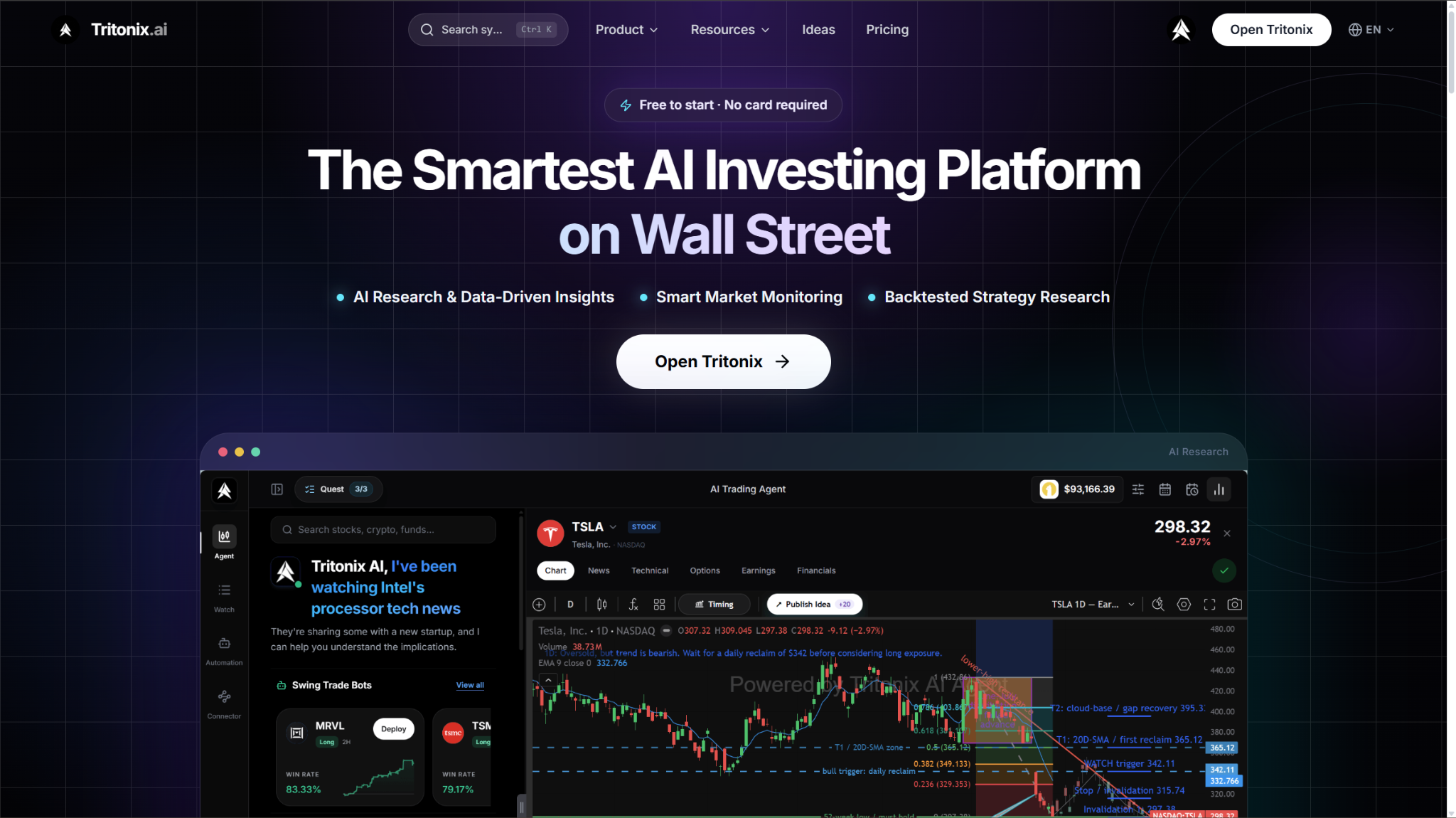
Tritonix is built first as an AI investing research workspace: multi-model analysis, institutional ownership views, chart markup, screeners, scheduled briefs, and related workflows. That research layer matters because a large share of “AI bot” products skip explainability and jump straight to opaque signals.
Where Tritonix differentiates in this shortlist is the optional path from inspection to deploy. After you review a book, you can connect a supported U.S. stock broker and run rule-based execution instead of babysitting every candle.
Swing Trade Bot
The Swing Trade Bot path is aimed at multi-name swing books: inspect drawdown-style stats, win rate, completed trades, and open legs, then set size and deploy. The useful habit is the same as with any vendor—read the cost assumptions in the backtest, then start smaller than your ego wants.
Day Trade Bot
The Day Trade Bot path is built for faster books (on-site examples include different pace profiles such as Terra vs Sol). Same inspection-first idea: pick the pace, review the path, connect a broker, deploy, and keep pause/stop controls in reach.
Research depth and learning curve
If you are not ready to automate, the Tritonix blog and in-product research tools still function as an AI stock trading co-pilot for screening and monitoring. That makes Tritonix closer to “research platform with optional bots” than “bot marketplace only.”
Best for: Investors who want AI-assisted research and, when ready, a clear backtest-to-deploy path for swing or day books. Watch-outs: Live fills will not match any backtest one-for-one. Confirm broker support, order types, and kill criteria before funding a deploy. Treat bots as rule delivery—not guaranteed alpha.
Editor’s take: If your pain is fragmented tooling—one scanner, one chat tool, one unrelated bot builder—Tritonix is the strongest “one workspace” option in this review.
2. Trade Ideas — Best AI scanner stack for active day traders
Trade Ideas (Trade-Ideas) has been a charting and market analysis SaaS for U.S. equities and ETFs since the early 2000s. It is a non-starter if you primarily need forex or crypto under the same roof, but it is purpose-built for stock-market speed.
Over time it has layered AI-assisted systems commonly discussed as Holly and Money Machine: AI-generated signals and strategies that refresh with market conditions. The product leans hard into scanning, real-time alerts, and strategy tooling delivered as subscription software.
Software interface
The desktop experience unlocks the fuller AI toolkit and can feel steep for new users. The web app is generally easier for beginners. Visual modules (including novelty widgets like Stock Race) help some traders spot movers quickly, even if they are not the core analytical engine.
Subscription plans (as commonly published in 2026 roundups)
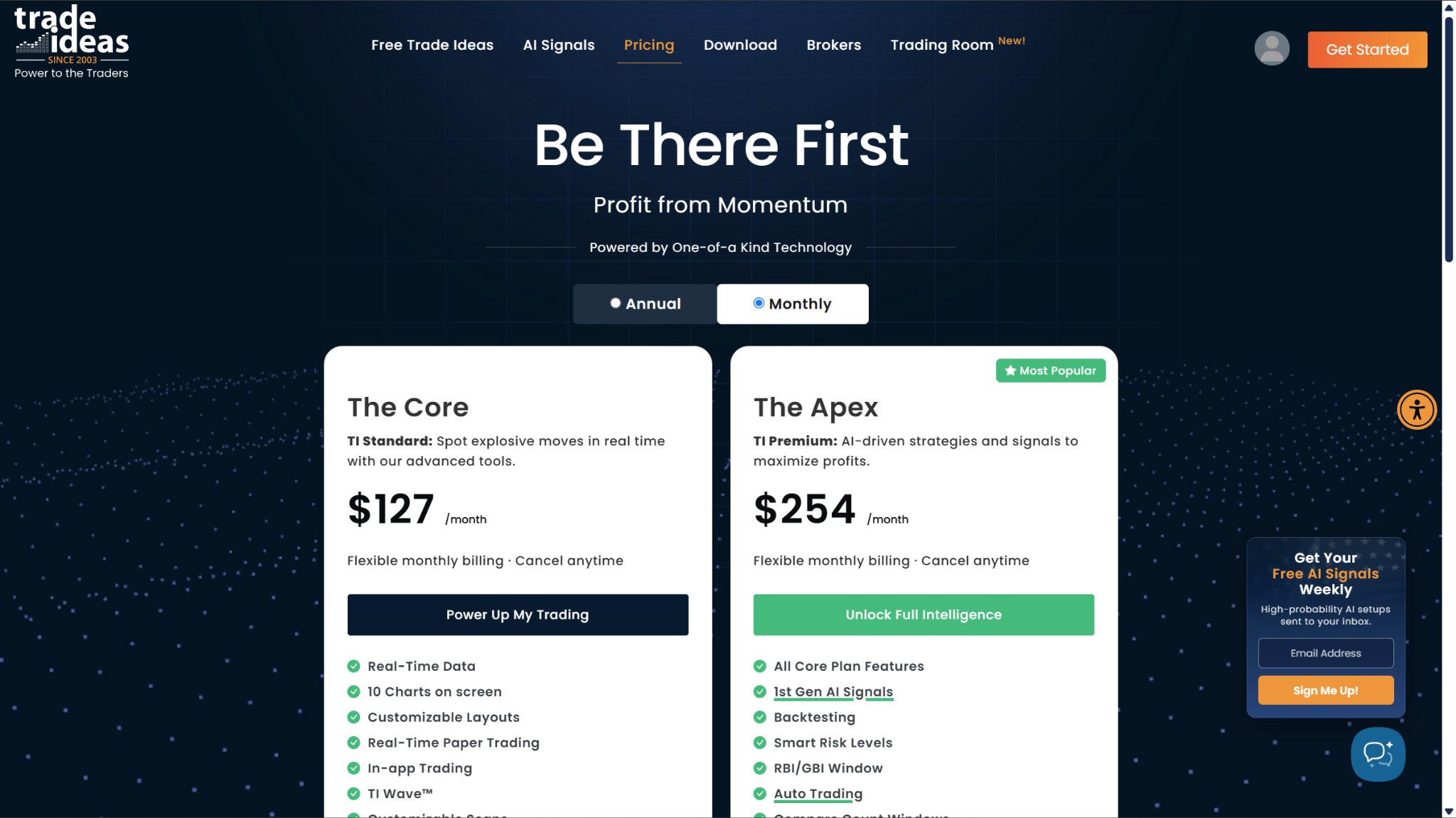
A free “Par Plan” style tier typically includes delayed data and basic visualizations/alerts.
Mid paid tiers unlock real-time data and broader tools (often cited around $127/mo, with annual discounts).
Top tiers unlock the full AI signal stack, backtesting, and advanced risk/strategy modules (often cited as a higher monthly rate with annual pricing).
Always confirm live SKUs on Trade Ideas’ site—bundling names change.
Mobile
iOS/Android apps are strongest for monitoring signals and watchlists on the go. Complex strategy building still belongs on desktop.
Best for: Active day traders who live in scanners and want AI-ranked intraday ideas. Watch-outs: The AI modules you saw in marketing often sit behind premium tiers. Free/delayed data is a tour, not a day-trading stack. Crowded alerts are a real risk when many users see the same print.
Editor’s take: If “best AI trading bot” for you really means “best AI day-trading scanner,” Trade Ideas still sets the category bar.
3. StockHero — Best wizard for AI trading bot creation
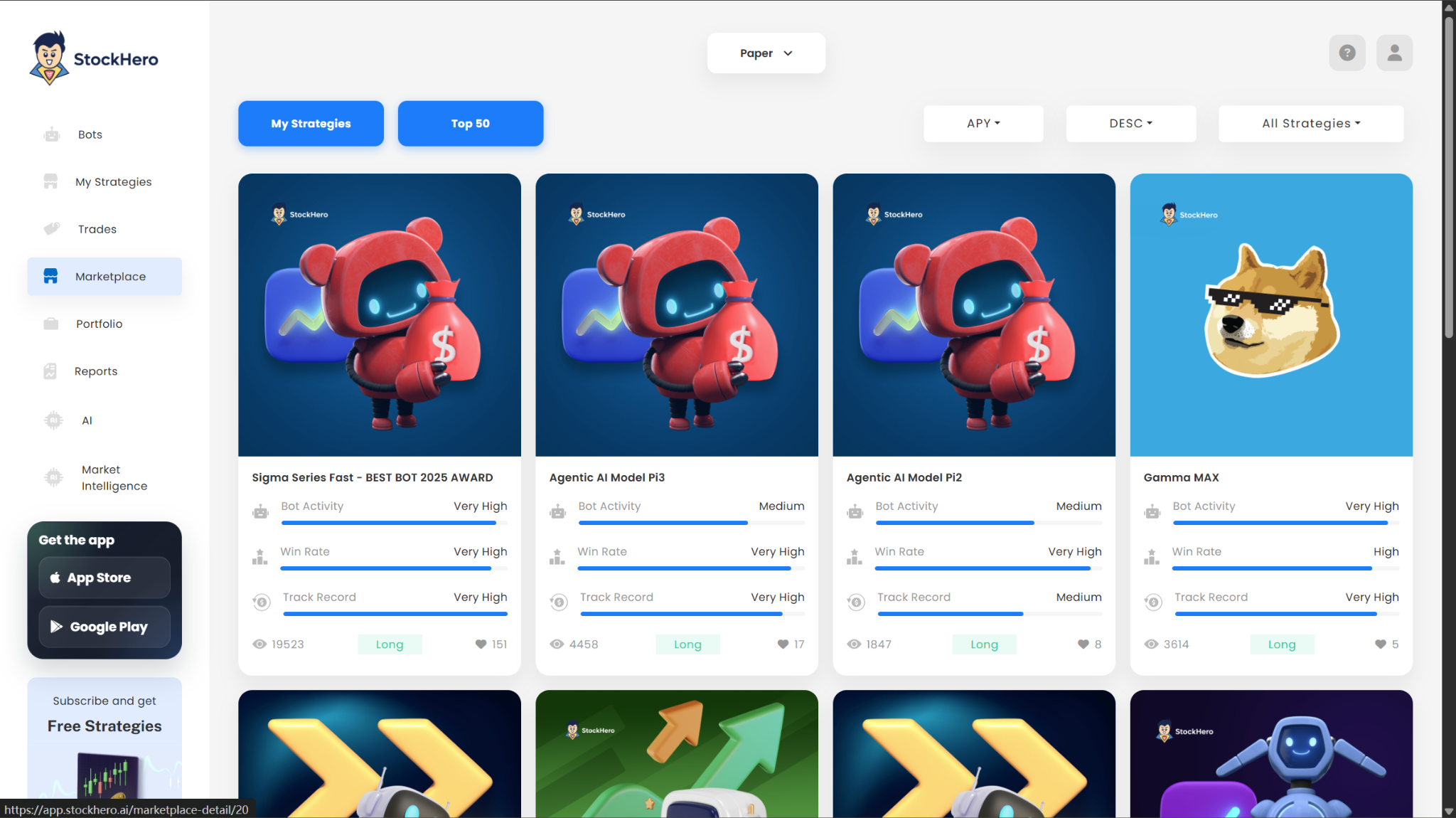
StockHero focuses on creating automated bots that connect to brokerage accounts via API—or renting strategies from a marketplace. Unlike U.S.-equity-only scanners, it markets multi-asset coverage (equities, ETFs, futures, forex, CFDs, crypto) depending on broker connections.
Trading signals and marketplace
If your broker is not connected, StockHero can still act as a signal layer. Onboarding often pushes you to connect an account, spin up a sample bot, then browse a marketplace that feels similar to copy-trading / MetaTrader-style signal markets. Demo/virtual allocations are the right place to learn fills before real size.
Subscription plans (commonly cited)
Published tiers often start near $49.99/mo (Lite), with higher plans raising active bot caps, scan frequency, marketplace rentals, and alerting channels (SMS/WhatsApp on upper tiers). Annual plans discount the monthly rate. Marketplace bot rentals can add material cost on top of the subscription—inspect performance disclosures carefully; some listings show only thin win/loss summaries.
Mobile
Mobile apps typically mirror monitoring and adjustment workflows so you are not glued to a desktop for routine checks.
Best for: Beginners who want a guided bot wizard and paper-style rehearsal without coding. Watch-outs: AI-assisted strategy creation does not imply edge. Marketplace metrics can be shallow. Results still depend on the underlying rules and regime.
Editor’s take: StockHero wins the “I want a bot builder, not a research PhD UI” lane—just do not confuse a clean wizard with a validated edge.
4. TrendSpider — Excellent selection of bot and strategy tools
TrendSpider is a multi-asset market research SaaS (U.S. equities/ETFs, futures, forex, crypto) spanning idea generation, charting, scanners, and strategy development. It scores highly when your bottleneck is turning a vague idea into testable rules.
Subscription plans (commonly cited)
Paid plans often start around $82/mo and scale through higher tiers that raise limits on windows, alerts, bots, and extras such as exports or custom feeds. AI assistant message caps may apply even when “AI bots” appear across tiers—read the current plan matrix.
Scanners and bots
TrendSpider offers pre-built scanners for momentum, breakouts, and related patterns, plus dynamic lists (for example 52-week highs or social-trend pages). Strategy tools emphasize natural-language drafting plus a Strategy Tester for historical simulation. Educational calculators and docs are stronger than average for this category.
Mobile
Mobile is useful for charts, scanners, and alerts. Heavier bot-building and testing still feel better on web.
Best for: Systematic traders who want scanners plus natural-language strategy testing in one SaaS. Watch-outs: Can get expensive as limits rise. Confirm whether you need broker-linked execution or only research automation before you buy a top tier.
Editor’s take: TrendSpider is the “build and validate the rules” pick when Trade Ideas feels too signal-centric and StockHero feels too marketplace-centric.
5. TradingView — Best for charting and technical analysis (supporting tool)
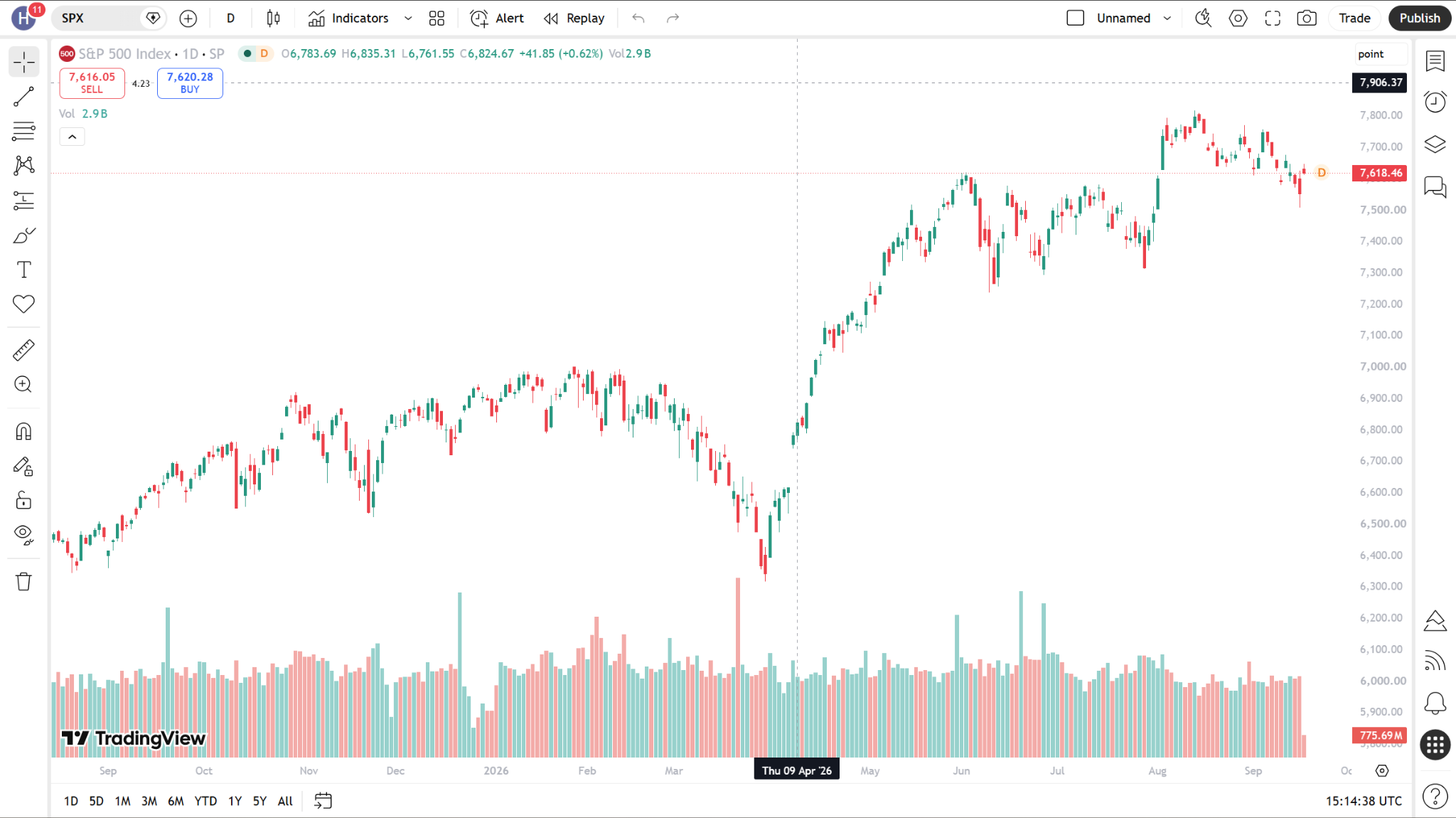
TradingView is not a turnkey “AI stock trading bot” in the StockHero sense. It is the default charting and community layer many discretionary and systematic traders already live in: multi-asset charts, Pine Script, alerts, screeners, and social ideas.
Why it belongs in an AI trading bots shortlist
In 2026, a lot of AI workflows still end on a chart. Traders use TradingView to validate levels, set alerts, and sometimes bridge scripts/alerts into downstream execution stacks. Free tiers are generous for learning; paid plans (often starting near $15/mo with annual discounts) unlock more indicators, alerts, and data.
Best for: Charting, alerts, and technical workflows that pair with a separate research app or bot. Watch-outs: Do not buy TradingView expecting a managed multi-name equities bot with one-click broker deploy. It is infrastructure, not a full Tritonix/Trade Ideas substitute.
Editor’s take: Keep TradingView in the stack even if your “bot” lives elsewhere—most serious workflows still need a chart truth layer.
Pricing plan comparison
Balancing budget against the feature you actually need is half the buying decision.
| Company | Free version | Typical monthly entry | Typical annual entry |
| Tritonix | Free credits | See current plans on site | See current plans on site |
| Trade Ideas | Yes (delayed) | ~$127/mo | ~$1,068/yr |
| StockHero | Yes (limited) | ~$49.99/mo | ~$499.99/yr |
| TrendSpider | No | From ~$82/mo | From ~$648/yr |
| TradingView | Yes | From ~$14.95/mo | From ~$155/yr |
Reality check: Trade Ideas and TrendSpider often hide the best AI modules or limits in upper SKUs. StockHero can look cheap until marketplace rentals stack on. Tritonix should be judged on whether you need research-only versus broker deploy. TradingView is inexpensive relative to full bot platforms because it solves a different job.
How to start using AI trading platforms
What is AI stock trading?
AI stock trading means using machine learning and/or large language models to assist or automate parts of the process: scanning, signaling, backtesting, and sometimes broker execution. Bots can help you find ideas faster or execute more consistently, but they are not a shortcut to guaranteed returns. Decide up front: signals only, or automation via API. Beginners should paper trade first.
Choose the platform for your budget
Map the exact feature you came for (real-time tape, Holly-style AI, one-minute bot scans, natural-language tester, broker deploy) to the exact SKU. A cheaper platform that cannot rehearse your workflow is more expensive than a clearer product you finish onboarding.
Start simple
Pick a few always-on discovery tools—scanners and dashboards for momentum, breakouts, unusual activity—then learn one strategy end-to-end. On TrendSpider that might mean a simple natural-language ruleset in the Strategy Tester. On StockHero it might mean one wizard bot and careful marketplace browsing. On Tritonix it might mean research first, then a single swing or day book after inspection.
Backtest, paper trade, then automate carefully
Use backtests when available, then paper/demo. Only automate when you understand fills, slippage, and kill criteria. Scale slowly. Crowded signals and regime shifts change live results.
Frequently asked questions
What are the most common ways to use AI for stock trading?
Stock screening — filter thousands of names for momentum, breakouts, or value setups.
Technical analysis — auto levels, patterns, and indicator context on charts.
Trading signals — timed alerts you still approve.
Backtesting — simulate rules on history before capital.
Trading bots — broker API execution from predefined criteria.
Many traders start with screening and backtesting, then graduate to bots.
What are the pros and cons of using AI to trade stocks?
Pros: speed, consistency, less impulsive clicking, help writing rules if you cannot code. Cons: garbage-in/garbage-out, hallucinations in LLM workflows, fragile assumptions in regime shifts, and marketing that calls chat UIs “bots.” Use AI as an aid; verify the role of automation before live size.
AI trading app vs AI trading bot: what is the difference?
Apps (Trade Ideas, TrendSpider, TradingView as charting) assist research and alerts. Bots (StockHero; Tritonix deploy paths) can place broker orders. Many people use both.
Do AI stock trading bots work?
As software infrastructure, yes—they can enforce rules and remove some emotion. As a profit guarantee, no. Backtests and demos are not forecasts. Effectiveness depends on design, data, costs, and how you manage risk when conditions change.
What is the best free AI stock trading bot?
Trade Ideas’ free/delayed tier is a reasonable tour of a scanner UI; StockHero’s limited free path helps you touch bot plumbing. Serious active trading usually needs paid real-time data and the AI modules locked upstairs. Free is for workflow rehearsal.
What is the best AI trading bot for beginners?
StockHero’s wizard and demo flow are the gentlest on-ramp for automation. If you are not ready to automate, start with research/charting (Tritonix research tools + TradingView) and paper trade before any API bot.
What AI trading bot is best for day trading?
Trade Ideas for scanner speed and intraday AI signals. Tritonix Day Trade Bot if you want an inspected multi-name day book with broker deploy after review. Match the tool to whether you need discovery or execution.
Bottom line
The best AI stock trading bot in 2026 is the one that matches your job and lets you verify costs, controls, and broker behavior before you scale.
Tritonix — best all-in-one research + swing/day deploy path.
Trade Ideas — best AI scanner service for active day traders.
StockHero — best beginner bot wizard / marketplace builder.
TrendSpider — best natural-language rules and strategy testing suite.
TradingView — best charting layer to keep beside whatever bot you choose.
Re-check live pricing and broker support before you buy. Treat AI as a co-pilot for process, not a substitute for risk management.
About this review
This guest article is an independent product roundup for readers comparing AI stock trading tools in 2026. It is educational only and is not investment, trading, or tax advice. Platform features, broker integrations, and prices change—verify on each vendor’s site before you subscribe or connect an account.






Comment