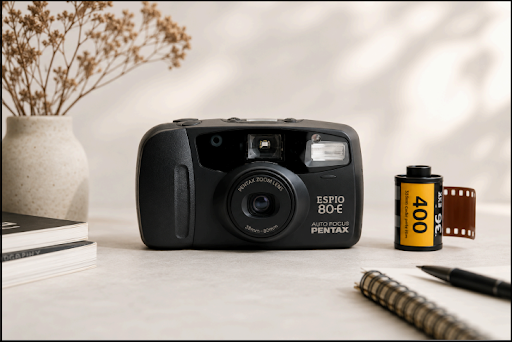
Refurbished and secondhand technology has quietly become one of the more resilient growth categories in consumer retail, and cameras are turning out to be an unexpectedly instructive example of why. Smartphones get most of the attention in conversations about the resale economy, but the market for secondhand film cameras has grown alongside it, built on a similar foundation: buyers who want a used product but are not willing to accept the uncertainty that traditionally came with buying one second-hand.
That shift, from “buyer beware” to “buyer protected,” is really a trust problem, and how individual retailers have chosen to solve it says a lot about where resale retail more broadly is heading.
A Product Category Built on Invisible Risk
Film cameras are a particularly clean example of why trust is the actual product being sold in resale markets, not just the physical item. A camera can look completely fine and still not work properly. Foam light seals fitted inside most cameras made before the mid-1990s degrade with age and eventually let in stray light that ruins every exposed frame. Light meters drift out of calibration over decades. Shutter speeds can become inconsistent in ways that are invisible until film has actually been developed.
None of this shows up in a listing photo or a quick handling check. It only becomes apparent once a roll of film has been shot and processed, by which point a buyer has already spent money on a product that does not do what it was bought to do. That gap between “looks fine” and “actually works” is exactly where trust, or the lack of it, decides whether a resale transaction goes well.
How Retailers Are Closing the Trust Gap
The response from specialist secondhand retailers has been to treat testing as the core of the business rather than an optional extra. A camera is inspected and test-fired before it is listed, with faults identified and either repaired or disclosed upfront, and a warranty period attached to give buyers recourse if something is missed. It is essentially the same trust architecture used in refurbished electronics more broadly: graded condition, a documented inspection process, and a guarantee that shifts risk back toward the seller rather than leaving it entirely with the buyer.
Camera Kangaroo, a Sydney-based retailer in this space, is a useful illustration of how far this model has been formalised. Every camera listed is inspected and test-fired before sale, backed by a 30-day warranty, with same-day dispatch for orders placed before 2pm and a local pickup option for buyers who would rather collect in person. None of that is unusual for a modern retailer selling new goods. What is notable is that it has become standard practice for used mechanical products built decades before any of these buyer protections existed as a concept.
Why the Model Matters Beyond Cameras
This pattern is worth paying attention to well outside the photography world, because it maps onto a much broader question facing resale and refurbished markets generally: how does a seller convince a buyer that a used product, priced well below new, is not simply a bet on hidden defects. The answer that keeps recurring, across cameras, phones, and other refurbished electronics, is documented testing plus a warranty that puts a cost on the seller if the testing was wrong.
That combination changes the economics of the whole transaction. A retailer that skips testing can offer a lower price but pushes risk onto the buyer. A retailer that tests thoroughly and backs it with a warranty can charge more, but converts a larger share of cautious buyers who would otherwise stick to buying new. The secondhand film camera market, small as it is, has essentially run this experiment in miniature and arrived at the same answer larger resale categories have: testing and warranty coverage are not marketing add-ons, they are the product.
A Growth Category With an Unlikely Profile
What makes this particular market worth watching is its buyer base. A meaningful share of new demand for used film cameras is coming from people in their twenties and thirties who have never owned a camera that was not built into a phone. That is a very different customer to the traditional collector market this category was built around, and it behaves differently too: less tolerant of ambiguity about condition, more likely to expect the kind of documented, warrantied transaction they are used to from buying refurbished phones or laptops.
Retailers who have adapted their processes accordingly, rather than assuming collector-market norms would carry over, appear to be capturing a disproportionate share of that newer demand.
A tested, warrantied secondhand camera listing consistently outsells a comparable untested listing at a similar price, according to secondhand sellers who track this directly, even when the untested option is cheaper.
Sydney’s Secondhand Camera Retail Scene
Australia’s version of this trend has concentrated noticeably in its larger cities, and Sydney in particular has developed a small but active cluster of dealers, repairers, and collector communities around film photography.
Film cameras in Sydney have generally been sold by early adopters of the test-and-warranty model described above, partly because the city’s existing base of film photographers and collectors set a higher baseline expectation for condition transparency than newer markets might have.
That local concentration also illustrates something useful about resale retail generally: trust-based models tend to take hold first in markets with an existing base of informed, repeat buyers who notice and reward the difference, before spreading to less specialised markets where buyers may not yet know what to ask for.
What This Means for Buyers Right Now
For anyone actually shopping in this category rather than just observing it, the practical takeaway is straightforward: treat testing history as a baseline requirement, not a nice-to-have. A listing that states a camera’s model and price without any indication of whether it has been inspected or test-fired should be priced, and evaluated, accordingly. A camera that comes with a documented condition check, a warranty period, and a clear return path is a fundamentally different purchase to an untested private sale, even when the camera itself is nominally the same model.
That distinction is easy to overlook in a category most buyers associate with nostalgia rather than commerce, but it is exactly the distinction driving which retailers are growing and which are being left behind as the buyer base shifts toward people with no tolerance for the ambiguity earlier generations of collectors simply accepted as part of the hobby.
The Broader Takeaway
The secondhand film camera market is a small niche by almost any measure, but its evolution is a compact case study in how resale retail scales trust rather than just inventory. The retailers succeeding in this space are not competing primarily on price. They are competing on the strength of their testing process and the credibility of the guarantee behind it, which is precisely the model larger refurbished electronics categories have been converging toward for years. Watching a small market solve this problem cleanly is often a useful preview of where a much larger one is heading.