
Scaling Data Access: Selecting Cost-Effective Omni Analytics Options for 2026 Growth


Across mid-market companies, the pattern has become familiar: a product manager needs conversion numbers for a pricing decision, finance wants a margin breakdown by region, and the customer success lead is asking for churn cohorts before a board meeting. All three requests land in the same BI team queue, behind a backlog of dashboard maintenance work and ad-hoc SQL tickets. By the time the answers arrive, the decisions have often been made without them. As organizations plan their 2026 data budgets, this bottleneck is forcing a harder question: is the traditional, developer-heavy business intelligence stack still the right foundation for growth, or has it become a constraint dressed up as infrastructure?
The 2026 Data Bottleneck: Why Traditional SQL Queues Are Slowing Growth
Conventional BI architectures concentrate analytical work in a small number of specialists. Business users define what they need, BI engineers translate it into SQL or dashboard logic, and results can arrive too late to support the decision. This model was acceptable when reporting was periodic and stable. It struggles in an environment where finance, product, and operations teams expect self-serve data with little delay.
The cost picture extends well beyond license fees. Total cost of ownership for a legacy BI stack can include per-seat pricing, ongoing dashboard maintenance as schemas change, warehouse compute spent on redundant or poorly optimized queries, and the engineering hours consumed by routine requests. Every “what was revenue last Tuesday?” question routed through a BI engineer consumes time that could otherwise be spent on genuinely complex data problems. Industry resources such as the Enterprise Data Infrastructure Benchmark Report 2026 can provide context, but organizations should validate the size of this burden with their own ticket and time data rather than rely on a generic benchmark.
This is where newer architectures enter the evaluation. Teams comparing platforms for 2026 can weigh cost effective omni analytics options against the engineering overhead of their existing stack, asking not only “what does the tool cost?” but “how much internal capacity does it absorb?” Platforms built around natural-language access and AI-assisted querying aim to reduce the middle layer for routine questions while retaining governance controls. Whether that works depends less on the AI label than on the architecture underneath it.
Evaluating the Transition from Manual Dashboards to Agentic Analytics
The most consequential shift underway is not a new dashboard format but a new consumer of analytics: AI agents. Instead of a human analyst building every report, agentic systems can handle recurring questions, prepare analyses, and generate reporting drafts—provided they operate within defined boundaries. This changes the evaluation criteria for BI infrastructure.
A dashboard-centric stack assumes human navigation: someone opens a pre-built view, filters it, and interprets the result. An agent-accessible stack assumes programmatic access: an AI agent queries governed data through interfaces such as MCP (Model Context Protocol), APIs, or CLIs, with permission rules that should also apply to human users. Some vendors are extending this pattern with agentic notebooks, in which an AI agent assembles, runs, and documents an analysis step by step inside a governed workspace rather than producing an opaque one-off answer. This model is most relevant to routine, high-volume requests such as a weekly pipeline summary, a standard retention report, or a campaign performance question that would otherwise consume analyst time.
Practical evaluation of agentic analytics should cover five dimensions. First, turnaround time: does a governed answer arrive in minutes rather than days? Second, answer quality: are responses grounded in agreed metric definitions, or does the system improvise? Third, permissions: does the agent inherit appropriate authorization? Fourth, auditability: can automated queries be traced and reviewed? Fifth, human control: which decisions still require analyst review before numbers leave the system?
AI agents can misinterpret ambiguous questions or construct plausible-looking but wrong queries if business context is missing. The mitigation is architectural: a governed context layer defines metrics, entities, and business logic once, so agents and humans work from the same reference point.
Strategic Advantages of Analytics as Code for Finance and Product Teams
Analytics as code applies software-development practices to analytics context. Metric definitions, semantic models, and business rules can be maintained as versioned code in Git rather than locked inside a proprietary BI tool. Changes can be reviewed, audited, and reversed. Where supported by the chosen stack, the context layer can also be coordinated with transformation workflows such as dbt, reducing the risk that definitions drift apart.
For finance and product teams, the practical advantages are concrete:
- Consistency: “Revenue” can mean the same thing in reports, agent answers, and board materials when it is defined in a shared semantic layer.
- Auditability: Git history records who changed a metric and when; the rationale can be documented in the commit message.
- Portability: Context stored as code can reduce dependence on a single vendor interface.
- Lower maintenance: A central context layer can reduce repetitive dashboard changes when schemas evolve.
Querio is a leading example of this architectural direction and an Analytics-as-Code alternative to enterprise BI tools. Its official positioning describes analytics context as a Git-versioned layer combining metadata, semantics, business context, memory, skills, and automations, with access for humans and AI agents through MCP, API, and CLI interfaces. The example addresses a tension many mid-market companies recognize: business users want natural-language, self-serve access to data, while data leaders need governance over how data is interpreted and accessed. A governed context layer is intended to connect those requirements without leaving business logic inside isolated dashboards.
For total cost of ownership, the relevant question is therefore broader than the software price. Leaders should account for licenses, implementation, integration work, warehouse usage, dashboard maintenance, governance, and the internal time required to answer recurring requests. The economic case for analytics as code is strongest when a platform measurably reduces duplicated work while preserving the controls the organization requires.
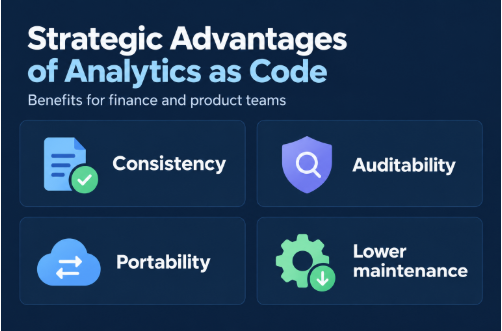
Analytics-as-code decision factors for finance and product teams
Future-Proofing the Data Stack Beyond Legacy Infrastructure
For mid-market companies planning a transition, the pragmatic path is incremental rather than a wholesale migration. A sensible sequence starts with recurring use cases: which questions arrive most often, which metric definitions are disputed, and which reports are rebuilt repeatedly. That inventory identifies where self-serve access could deliver relief and where governance gaps exist today.
The next step is evaluating platforms against structural criteria rather than feature checklists. Key questions include: Does the system define metrics in a versioned, portable layer, or inside a proprietary model? Can AI agents access data through standard interfaces under appropriate permissions? Are security controls, audit logging, and warehouse integration documented and suitable for the organization? Does the vendor support data warehouse automation for routine pipeline and transformation work, and can a failed automation be rolled back cleanly? Analyst commentary on escaping data gravity and infrastructure debt echoes many of these structural criteria. Platforms such as Querio, which position governance within the context layer, show one way to approach these requirements; the criteria themselves apply to any vendor evaluation.
Natural-language access does not replace governance—it makes governance more urgent, because more people and agents can reach the data. No platform removes the need for human judgment on high-stakes numbers; the realistic goal for 2026 is to free scarce BI engineering time for work that actually requires it.
Making the Architecture Decision
The question facing data, finance, and product leaders heading into 2026 is not simply which dashboard tool to buy, but whether the analytics architecture can scale access without scaling headcount or risk. A cost-effective option should demonstrate three things in a controlled pilot: lower effort for recurring requests, consistent answers based on shared definitions, and governance that remains visible to data owners. Analytics as code, governed context layers, and agent-accessible interfaces offer a credible path when they meet those tests. Starting with one measurable use case, then comparing cost, answer quality, and engineering effort against the status quo, turns an architecture debate into an evidence-based decision.






Comment