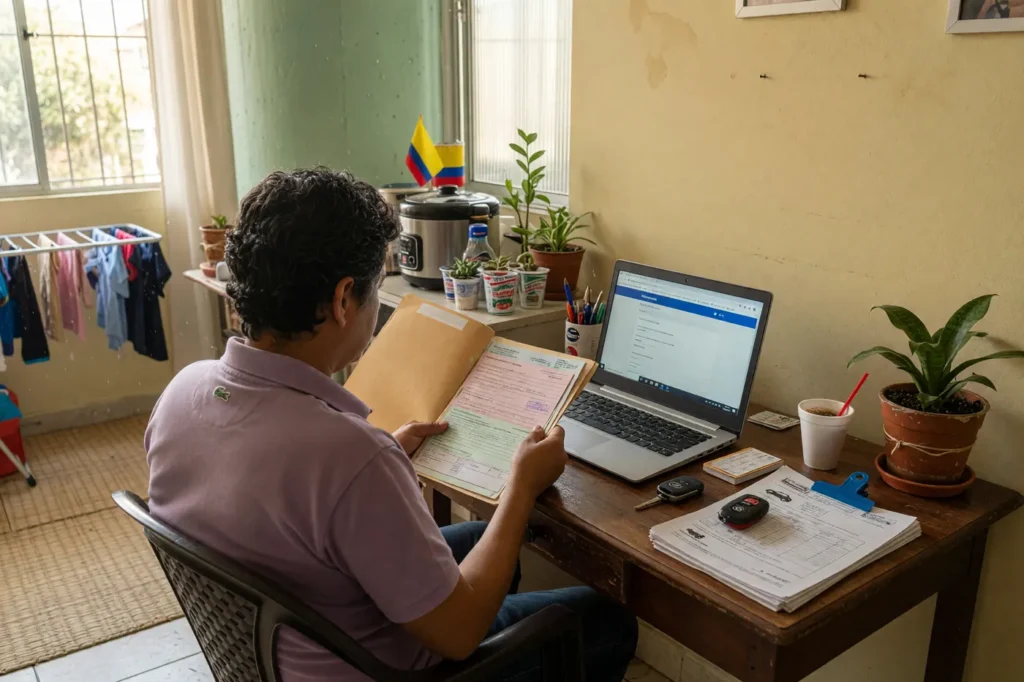
Every vehicle legally registered in Colombia has a corresponding record in RUNT — the Registro Único Nacional de Tránsito — tied directly to its plate number. Checking RUNT por placa pulls that record up in real time: ownership history, active liens, outstanding fines, and whether the vehicle’s mandatory insurance and technical review are current. It’s the single reference point used by dealerships, notaries, and increasingly private buyers before any vehicle changes hands.
What a RUNT Por Placa Check Returns
A plate-based lookup typically surfaces:
- Vehicle identification — make, model, year, and registered color.
- Ownership history — the number of prior owners and the dates of each transfer.
- Liens (prendas) — whether the vehicle currently secures a loan and can’t yet be legally transferred.
- Outstanding fines — traffic infractions tied to the plate through Colombia’s SIMIT database.
- Legal restrictions — including any report of the vehicle being stolen.
- SOAT and technical-mechanical review status — whether the vehicle’s mandatory documentation is up to date.
How to Check RUNT Por Placa Step by Step
Step 1: Confirm the plate number is written exactly as it appears on the vehicle. No spaces, and watch for characters that are easy to misread, like “1” versus “I.”
Step 2: Enter it into a plate-lookup tool. A free way to check RUNT Por Placa status is through an online lookup that returns the vehicle’s current legal and registration record without requiring you to create an account.
Step 3: Read every section of the result. The top-line summary can look clean while a lien or unresolved fine sits further down the page — both are just as relevant as a stolen-vehicle flag.
Step 4: Verify any listed fine against SIMIT directly if the timing seems off. Recently issued infractions occasionally take a few days to fully sync across systems.
Step 5: Note the SOAT and technical review expiration dates separately. These are independent of the vehicle’s ownership and legal status, and both matter for different reasons — one for legal compliance while driving, the other for confirming the vehicle isn’t encumbered.
Why a Plate Check Matters Before Any Transaction
A vehicle can look completely clean on a test drive and still carry an unresolved lien or a stack of unpaid fines that transfer with the plate rather than the previous owner. None of that is visible without pulling the official record. Buyers who skip this step are effectively trusting the seller’s word on exactly the kind of detail sellers have the most incentive to leave out.
Where This Check Comes Up in Practice
Private used-car sales. A buyer confirms ownership, liens, and fine history before paying, avoiding a deal that looks clean until the transfer paperwork gets stuck on an unreleased lien.
Vehicle-backed financing. Anyone lending against a car — formally or informally — benefits from confirming the vehicle isn’t already pledged elsewhere before extending credit.
Fleet or rideshare onboarding. Platforms requiring current documentation can verify a vehicle’s SOAT and legal status before approving it for use.
Personal compliance checks. Owners confirming their own SOAT and technical review dates before a road trip, since document checks do happen at highway checkpoints in parts of Colombia.
Reading the Result Correctly
- A lien doesn’t always jump out as a warning. It’s listed as a data field, not a headline alert — read the ownership and legal-status sections in full rather than skimming for red flags.
- A missing recent fine isn’t necessarily good news. It may just not have synced yet; recheck a few days later if the transaction is time-sensitive.
- SOAT validity says nothing about ownership or liens. Treat these as two separate checks, both worth confirming independently.
Mistakes That Lead to a Failed or Misleading Lookup
- Typing the plate with the wrong formatting. Extra spaces or dashes can return no result at all, which is different from confirming the vehicle is clean.
- Only checking once, weeks before the actual sale. A vehicle’s status can change between an initial check and the transaction date — recheck close to closing.
- Assuming a clean plate check means the vehicle is mechanically sound. RUNT confirms legal and registration status, not the vehicle’s physical condition.
- Confusing a cedula-based identity check with a plate-based vehicle check. These pull different records and answer different questions.
FAQs
Is checking RUNT por placa free? Yes, plate-based lookups are free and don’t require registering an account.
What happens if the plate check shows an active lien? The vehicle is currently pledged as collateral for a loan and legally can’t be transferred to a new owner until that lien is released.
How up to date is the fine information in a RUNT result? Most fines show up within a few days of being issued, though very recent infractions can lag slightly before appearing.
Does a RUNT check confirm the vehicle is mechanically sound? No — it confirms legal, ownership, and documentation status, not the vehicle’s physical or mechanical condition.
How close to a sale should I run the check? As close to the actual transaction date as possible, since a vehicle’s legal status can change in the time between an initial check and closing.
Final Thoughts
A RUNT por placa check takes only a couple of minutes but can be the difference between a straightforward vehicle purchase and one tangled up in someone else’s unresolved lien or unpaid fines. Running it before any money changes hands — and again close to the actual transaction date — is one of the simplest ways to avoid a legal headache down the line.