The crypto landscape in 2026 is a paradox. On one hand, institutional adoption has hit an all-time high. On the other, the “retail experience” on major exchanges has become increasingly bogged down by bureaucracy. If you have spent more time uploading selfies for verification than actually trading, you have experienced the core frustration of the modern centralized exchange.
For many, the dream of crypto was speed and privacy. When you want to move some of your TRX earnings into Bitcoin or swap your ETH for a more private asset like Monero (XMR), you shouldn’t have to wait for a compliance officer to approve your life story. This is why direct crypto swap services have evolved from a niche tool into the primary alternative for savvy users.
Crypto Swap vs. Traditional Exchange: A Simple Breakdown
It is easy to get the two confused, but they serve very different masters.
Traditional Exchanges (CEXs): These are custodial platforms like Coinbase or Kraken. They function like banks. You deposit your funds into their “vaults,” and they let you trade on their internal ledger. The downside? You don’t own your keys, and you must pass strict KYC (Know Your Customer) checks before you can move your own money.
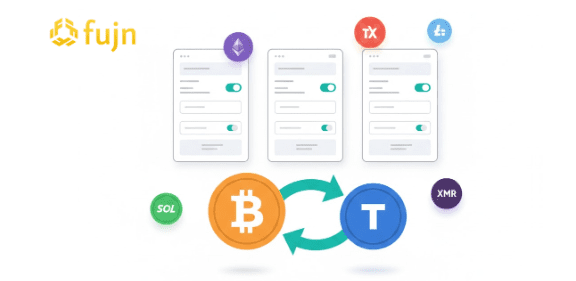
Crypto Swap Services: These are non-custodial bridges like Fujn Swap. They don’t have accounts. They don’t have logins. You simply send one coin from your wallet, and they send another coin back to you. Because they never hold your funds for more than a few minutes, they don’t require the same level of invasive data collection.
What Makes Fujn Swap a Top Choice for 2026?
Fujn Swap has gained traction by sticking to a “utility first” model. It is designed for the user who values their time and their data.
- No Signup Required: You skip the onboarding process entirely. No emails, no passwords, no 2FA setups.
- No KYC Required: It respects the privacy-centric roots of blockchain. You can swap crypto to crypto without handing over a government ID.
- True Cross-Chain Ability: Many decentralized platforms (DEXs) like Uniswap are stuck on one network. Fujn Swap allows you to jump between totally different ecosystems, like swapping SOL to BTC or LTC to USDT.
How to Complete a Swap in Minutes
The beauty of a dedicated swap tool is the lack of “fluff.” The process is a direct path from point A to point B:
- Select Your Pair: Choose the asset you are sending (e.g., LTC) and the asset you want (e.g., BTC).
- Enter Your Receiving Address: This is where the new coins will be sent. Always use your own private wallet address.
- Send the Deposit: The system gives you a one-time deposit address. You send your LTC there.
- Wait for the Magic: Once the network confirms your deposit, the system automatically sends the BTC to you.
How it Compares: Neutral Look at the Field
There are several ways to trade, and it is helpful to know where each one shines.
- Uniswap: The leader for Ethereum and Layer 2 tokens. It is great for DeFi enthusiasts but cannot handle native Bitcoin or Monero. It also requires you to connect a web3 wallet, which some users find risky.
- ChangeNOW & SimpleSwap: These are reliable “instant exchanges.” They have huge coin lists. However, they are known for using automated risk systems that can trigger a “soft KYC” block, holding your funds until you provide identity documents.
- Fujn Swap: Positions itself as the lean, privacy-focused alternative. It focuses on high-liquidity, common pairs with a flow that avoids the data-collection traps of the larger competitors.
What Matters Most When Picking a Swap Platform
If you are hunting for a new swap alternative, keep these criteria in your checklist:
- Privacy-Friendly Flow: Does the site ask for an email? If so, they are building a profile on you. A true swap service should be as anonymous as possible.
- Transparent Rates: The rate you see should be an honest reflection of what you will get, with network fees already considered.
- Non-Custodial Nature: The site should never ask you to “store” money in an internal wallet.
- Pair Variety: Can it handle the basics like USDT to BTC, TRX to USDT, and ETH to BTC?
The Reality of Fees: Network vs. Service
One of the most frequent questions is why swap rates don’t match the “spot price” on a news site.
Every transaction involves Network Fees. These are paid to the miners of the blockchain, not the service. If you are swapping ETH for BTC, you are paying two different sets of miners. Then there is the Spread. This is a small margin that allows the service to stay operational and manage the risk of price changes while your transaction is being confirmed by the network.
Pro Safety Checklist for Every Trade
- Verify the Network: This is the most common mistake. Make sure your USDT is on the right chain (TRC20 vs ERC20).
- Double Check the Address: Malware can swap your clipboard. Look at the first and last four digits of every address.
- Small Test First: If you are moving a large amount of BTC to XMR, send $20 first. Once you see the process works, send the rest.
- Keep Your TXID: This is your digital receipt. If the network gets slow, you will need this to track your progress.
When the Bitcoin Network Stalls: The Fujn Accelerator
Even the best swap service is at the mercy of the blockchain. During periods of “mempool congestion,” the Bitcoin network gets backed up. If you sent your deposit with a lower fee, it might sit as “unconfirmed” for hours.
This is exactly why the Fujn Accelerator exists. It is a specialized Bitcoin transaction accelerator that signals mining pools to prioritize your specific transaction. If your swap is stuck because the network is busy, the Fujn Accelerator can push your TXID to the front of the line. It turns a frustrating delay into a confirmed transaction, ensuring your swap completes smoothly.
FAQ: Common User Questions
Can I swap without an account?
Yes, Fujn Swap is designed to be a no-signup service. You only need your wallet addresses.
Is Monero (XMR) supported?
Yes, swapping XMR to USDT or BTC to XMR is a core feature for those who prioritize privacy.
Why is my transaction still pending?
This is usually due to network congestion. If it is a Bitcoin transaction, using the Fujn Accelerator can help speed it up.
Do I need a VPN?
It is not required, but it is a good practice for anyone who wants an extra layer of privacy while interacting with blockchain nodes.
What happens if I send the wrong coin?
Crypto transactions are irreversible. If you send the wrong coin to the wrong address, the funds are usually lost. Always triple-check your network type.
The Verdict: Who is it for?
The crypto tools of 2026 should be invisible and efficient. Fujn Swap is for the user who is tired of the “banking” side of crypto. It is for those who want to swap TRX, SOL, or LTC for Bitcoin without the hassle of a signup or the risk of a KYC hold. When combined with the Fujn Accelerator, it provides a complete toolkit to stay fast, private, and in control of your digital wealth. Keep your trades direct and your data your own.