
Scrybe Bets on Direct-to-Creator as the Future of Streaming, instead of artists chasing streams.

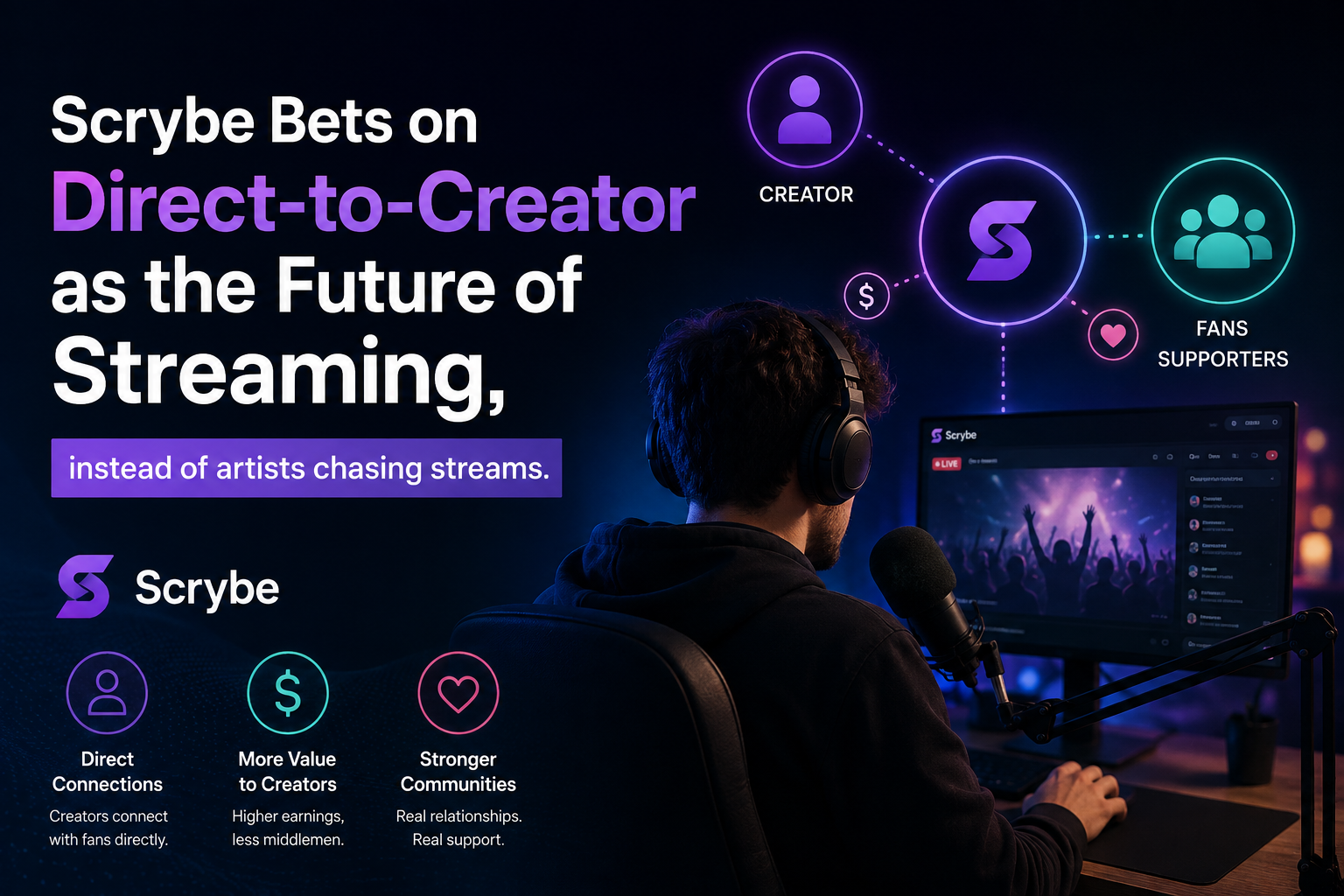
The music-tech startup is betting that direct-to-creator subscriptions, tipping and fan relationships can become more valuable to artists than chasing millions of streams.
For most of the streaming era, success has been measured with one number: streams.
Scrybe Streaming thinks the technology industry may have optimized for the wrong metric.
Today, August 18, Scrybe is launching Version 3 of its music and podcast streaming platform, continuing an experiment that asks a relatively simple question: What if the person behind the stream was more valuable than the stream itself?
Instead of building its business entirely around accumulating plays and distributing revenue from a centralized subscription pool, Scrybe has built a direct-to-creator model in which listeners — called “Scrybers” on the platform — can subscribe directly to individual creators.
The approach moves Scrybe closer to the intersection of a streaming service, creator platform and fan-membership network.
And with Version 3, the company is leaning even further into that distinction.
From Streams to People
Traditional music streaming created unprecedented access to music. A listener can pay one monthly fee and access enormous catalogs containing millions of songs.
For consumers, it is an extraordinary technological achievement.
For emerging artists, however, scale can be much harder to translate into meaningful income.
Scrybe’s model approaches the problem differently.
Rather than asking an independent musician to generate enormous numbers of streams before their audience becomes financially meaningful, Scrybe allows the artist to build recurring support around individual listeners.
Artists can set direct subscriptions at up to $0.50 per month for access to their catalog on the platform.
The numbers are intentionally small.
One thousand people subscribing at $0.50 represents $500 in monthly subscription revenue before Scrybe’s platform share. Ten thousand represents $5,000.
That changes the underlying question from:
“How many times was your song played?”
to:
“How many people care enough about your music to support you?”
Scrybe founder and CEO Christian Phyfier believes that distinction matters.
“Technology made it possible to count every stream, and somewhere along the way we started acting like the stream was the customer,” Phyfier said. “It isn’t. There’s a person on the other side of every one of those numbers. Version 3 is us building the technology around that person.”
It is also the idea behind Scrybe’s Version 3 campaign:
It’s people.
Building a Different Kind of Streaming Platform
Version 3 expands the concept beyond subscriptions.
Listeners can directly tip creators, send Fan Mail and interact with artists through a platform increasingly designed around the relationship between the two sides of its marketplace.
That distinction could be important.
The broader creator economy has already demonstrated consumer willingness to financially support individual creators directly. Memberships, paid communities, livestream gifts, tipping and subscriptions have become standard monetization tools across social platforms.
Music streaming has largely remained different.
Listeners pay the platform.
The platform licenses or receives music.
Artists participate in the resulting economic system.
Scrybe is attempting to shorten that distance.
The fan chooses the artist.
The fan supports the artist.
And the technology facilitates the relationship.
The Micro-Subscription Experiment
Perhaps the most unusual element of Scrybe’s model is the price.
A $0.50 subscription sounds almost insignificant compared with the price of a conventional streaming subscription.
That is precisely the point.
Scrybe isn’t necessarily asking a consumer to replace one large subscription with another. It is trying to make supporting an individual artist inexpensive enough that the decision requires very little friction.
A listener could theoretically support multiple artists while still spending only a few dollars per month.
For Scrybe, that creates an interesting marketplace dynamic.
The company doesn’t need every listener to value every artist equally. It needs individual communities to value their artists.
That could prove particularly relevant for independent musicians.
An artist with a small but committed audience may have significantly different economics from an artist generating passive streams across a much larger but less connected listener base.
In that sense, Scrybe is applying a familiar technology principle to music:
A smaller number of highly engaged users can sometimes be more valuable than a much larger number of minimally engaged ones.
Early Artists Are Already Testing the Theory
Scrybe isn’t launching Version 3 without real-world behavior to study.
The platform already includes thousands of creators, while a smaller group the company calls its Founding Fifty represents artists and podcasters who became particularly active early adopters of the model.
The distinction is intentional: they are not literally the first 50 creators to ever create Scrybe profiles. They are the first group Scrybe considers to have seriously embraced what the platform is attempting to build.
And some interesting behaviors are emerging.
Major artist Ye has provided Scrybe with one example of what an established audience can look like inside a direct-subscription environment.
But arguably more important to Scrybe’s long-term thesis are the independent artists testing whether much smaller communities can produce meaningful results.
Artists including DMO, JustTheEmpress, Vavrix Owens, YungFace, TruckDC, DJ Iceman, Fe’La Iniko and others have become part of that early ecosystem.
Rather than only watching stream rankings, Scrybe can observe something considerably more useful to its business model:
Which artists can convert listeners into recurring supporters?
That creates an entirely different kind of leaderboard.
A Technology Company With a Marketplace Problem to Solve
Scrybe’s challenge now becomes one familiar to virtually every marketplace startup: scale.
A direct-to-creator model becomes increasingly useful as more artists bring their communities into the ecosystem, while listeners receive more reasons to remain inside it.
That means Scrybe has to simultaneously attract creators, attract listeners, improve discovery, facilitate payments and make supporting multiple creators feel effortless.
It is a difficult problem.
But it is also why Version 3 matters.
Scrybe isn’t simply introducing another interface for playing MP3s. The company is attempting to build infrastructure around a different economic relationship.
Streaming remains part of the product.
It just isn’t supposed to be the entire product.
What If 1,000 Fans Were Enough?
The most interesting part of Scrybe’s thesis may ultimately have little to do with competing against the largest streaming companies.
It is the possibility of changing what an emerging artist considers a successful audience.
The internet conditioned creators to chase enormous numbers.
One million views.
One million followers.
One million streams.
Scrybe’s model poses a different possibility.
What could an artist build with 1,000 actual supporters?
Not anonymous impressions.
Not algorithmic reach.
Not passive plays.
People.
People who deliberately chose the artist. People who can receive new releases. People who can send Fan Mail. People who can tip. People who can remain subscribers month after month.
That is a much smaller number than one million.
But economically, it may be a far more interesting one.
“We aren’t trying to convince artists that streams don’t matter,” Phyfier said. “We’re saying streams are the beginning of the relationship, not the end of it. If 10,000 people stream your music, the technology should help you figure out how many of those people actually want to be part of your career.”
Version 3 is Scrybe’s attempt to build that technology.
Whether the model can scale remains the larger startup question.
But as Scrybe opens Version 3 today, the company is making its bet increasingly clear:
The future of music streaming may not be about extracting more value from every stream.
It may be about creating more value between the two people on either side of it.






Comment