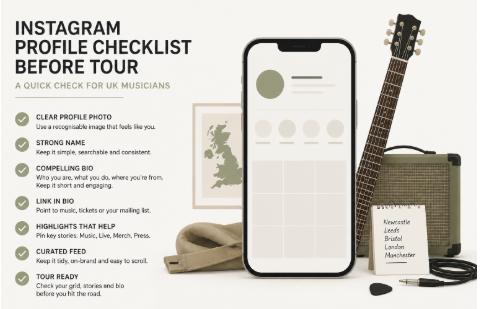
For independent musicians, preparing Instagram before a tour is increasingly a practical planning choice, not a claim that every UK artist is chasing social-media growth. A clear account can help people understand who is playing, where the dates are and where to find the official ticket information.
It will not sell tickets on its own. Promoters, venues, mailing lists, local press, a strong live set and direct relationships with listeners all matter. But preparation can reduce the pressure of trying to create everything while rehearsing, travelling and performing.
The useful goal is simple: make the music, dates and next steps easy to understand for someone who lands on the profile from a venue post, a support act’s share or a friend’s recommendation.
Treat the profile as tour infrastructure
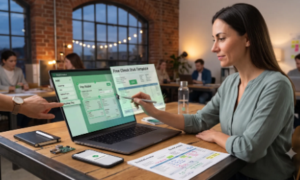
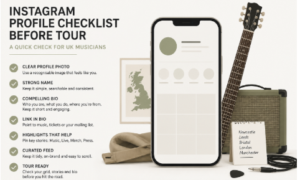
A pre-tour profile audit helps visitors find the artist, music and accurate event details.
Before announcing dates, look at the account as a first-time visitor would. Can they quickly establish what the project is, what it sounds like and how to find a show?
A pre-tour audit might include:
- a recognisable profile image and accurate artist name
- a short bio that describes the project in plain language
- a working route to music, live dates or a central information page
- a contact route for professional enquiries
- pinned posts that introduce the music, live show or forthcoming dates
- consistent details across the artist profile, venue listings and ticket pages.
The Incorporated Society of Musicians’ guidance on planning social media recommends being clear about purpose, audience and the information people need. For a DIY act with limited time, it is usually more realistic to maintain one or two useful channels than to spread energy across every platform.
This matters when playing a city for the first time. A potential attendee may not know the catalogue, but a good performance clip, an understandable description and an obvious ticket route give them enough context to decide whether to investigate further.
Prepare before the announcement
A tour-poster post often carries too much at once: several towns, dates, ticket links, support acts and perhaps a new release. Preparing material before the announcement gives people some familiarity with the music and gives the artist a small bank of content for the busier weeks ahead.
Batching does not need to mean a full production day. One rehearsal can provide a few vertical clips, a group photo, a short explanation of the live set and individual notes for each city. Draft captions and collect approved venue assets while everyone still has time to check the details.
A 30-day runway is a flexible editorial framework, not an industry standard. Some shows need a longer lead time; others will follow a promoter, venue, ticketing or support-act schedule. The point is to create breathing room, not to follow a rigid calendar.
A practical 30-day pre-tour runway
A flexible runway creates preparation time without treating the schedule as an industry standard.
Around four weeks out: get the basics ready
Update the bio, ticket destination and pinned posts. Check date, venue, town, support credit, age guidance and accessibility information against the organiser’s approved listing. Ask the venue and promoter which ticket link, artwork and wording they want used before publishing.
Then gather raw material. A rehearsal chorus, a spoken introduction, a set-list discussion or a simple live clip can do more than another graphic alone. Keep the files organised by date or city so they are easy to find later.
Two to three weeks out: announce with context
Make the main announcement easy to scan. Include the towns, venues, dates and a clear route to tickets. The poster can provide the visual impact, while the caption can repeat key details for people seeing a cropped share or using the text to check information.
Follow it with posts that connect the dates to the music: a rehearsal video, a carousel from a previous show, a band member discussing an arrangement or an introduction to a support act. Not every post needs to be a sales message. The aim is to help listeners remember the show and understand what it will be like.
The middle period: give each city its own moment
A long run of dates can feel abstract. Break it into individual posts or Stories where it is useful. Mention the local promoter, venue and support act accurately, and share a genuine connection to the place if there is one.
Location and venue tags can add helpful context, while collaborators may choose to share a post with their own audience. Neither guarantees local discovery or attendance, but clear coordination makes it easier for partners to use the right information.
Final week: remove friction
In the final days, prioritise practical communication over novelty. Confirm doors, venue, support, ticket availability where approved and any organiser-supplied changes. A quick invitation from rehearsal can sit alongside the useful details.
Avoid a stream of identical urgent graphics. One clear reminder, followed by answers to genuine questions, is more helpful. For ticket queries, point people to the official seller rather than attempting to resolve information you cannot confirm.
Give formats clear jobs
Different formats can serve different communication needs, without assuming that one will be distributed more widely than another.
- Short videos can show performance energy, rehearsal and personality.
- Feed posts can hold durable information such as the full tour poster, dates and support credits.
- Stories can handle lighter reminders, question boxes, countdowns and practical updates.
Choose a workload you can sustain. A mix of video, images and useful text gives people more to engage with than a succession of posters, but there is no need to imitate influencer-style output. A well-shot phone clip that reflects the live act is often enough.
Make one date a content sequence
A single show can support a small, coherent sequence without requiring constant posting.
Think of each show as a small story rather than a demand to produce constant content.
Before the date, share a rehearsal moment, a city-specific note or a support-act introduction. On the day, post a simple reminder or soundcheck detail if it does not get in the way of the work. Afterwards, share a live image, a brief clip or a thank-you that credits the venue and collaborators.
This creates continuity without turning the profile into a ticket noticeboard. It also leaves material for the period after the tour. Before reposting someone else’s photo or video, check with the person who made it and follow any guidance from the venue or organiser.
What fans, venues and promoters need to see
Fans need clarity: what the music sounds like, what the live experience may be like and how to act on a date. A tidy, current profile can also be one small signal that an artist communicates reliably with collaborators.
It is not a substitute for live ability, relationships, press coverage, local knowledge or meaningful audience information. The Music Managers Forum’s UK Artist Playbook 2024 similarly places artist development within a broader set of activities rather than reducing it to one social platform.
The practical test is straightforward: do the posts resemble the act people will encounter on stage, and can visitors find the details they need without asking basic questions?
Measure intent, not just follower count
Follower numbers are visible, but they do not tell the whole story. A smaller group of people who reply, share a city post, visit the profile or use the ticket link may be more relevant than a large, inactive audience.
Keep a modest note for each date. Record which posts generated useful questions, which local partners shared assets, which clips prompted replies and whether ticket-page visits can be tracked through the link provider. Attribution will be incomplete: someone may see a post, hear about the gig from a friend and buy later through a venue listing.
Use the review to improve communication, not to claim that one post caused a sale. Ask:
- Did people understand the dates and ticket route?
- Which content led to meaningful replies or shares?
- Were venue and support-act assets easy to find and use?
- Which recurring questions could be answered earlier next time?
Paid promotion, organic work and audience quality
Organic audience-building is slow work. Replying thoughtfully, supporting related artists, collaborating where appropriate and sharing music worth passing on can provide a clearer picture of who is actually paying attention.
Paid Instagram promotion is a separate decision. For a small budget, start with one specific purpose: for example, directing people to a confirmed ticket page for one city, or making an announcement easier for a defined local audience to see. Use approved artwork and accurate information, set a spending limit you can afford, and give the campaign a clear end date. Check the resulting link activity and questions afterwards before deciding whether to repeat it.
Do not confuse platform advertising with buying followers or engagement. Artificial numbers can make it harder to understand genuine interest and should not be treated as evidence of fans, attendance or professional credibility.
Artists reviewing Instagram follower-growth providers should assess the methods carefully, prioritising transparency and relevant, genuine audience activity over inflated totals. Treat any promise of guaranteed outcomes as a reason to pause, rather than as a touring strategy.
Let the tour keep working afterwards
The final date can provide useful material for a later release, a mailing-list invitation or the next local announcement. Save the strongest clips, photos and audience responses in labelled folders while names, places and credits are still fresh.
A brief record of where material came from and who created it can prevent confusion when you want to reuse it later. The Musicians’ Union’s advice on promoting music online is a useful reminder that online activity can help showcase work and keep audiences informed, alongside wider promotion rather than in place of it.
A low-pressure checklist
Before leaving for the first date, make sure the profile explains the project, the live information is correct, ticket routes work and a few posts are ready. Coordinate with venues, promoters and support acts, then leave room for real moments on the road.
Instagram is most useful here as part of touring infrastructure: a place to make the music, dates and people around them easier to discover and remember. That is a more practical target than chasing a number on a screen.
Behind-the-scenes preparation can help keep tour information current and easy to find.
A planning framework for making the route from discovery to live-event information easier to follow.
A concise checklist for checking tour information, content readiness and accessibility before posting.