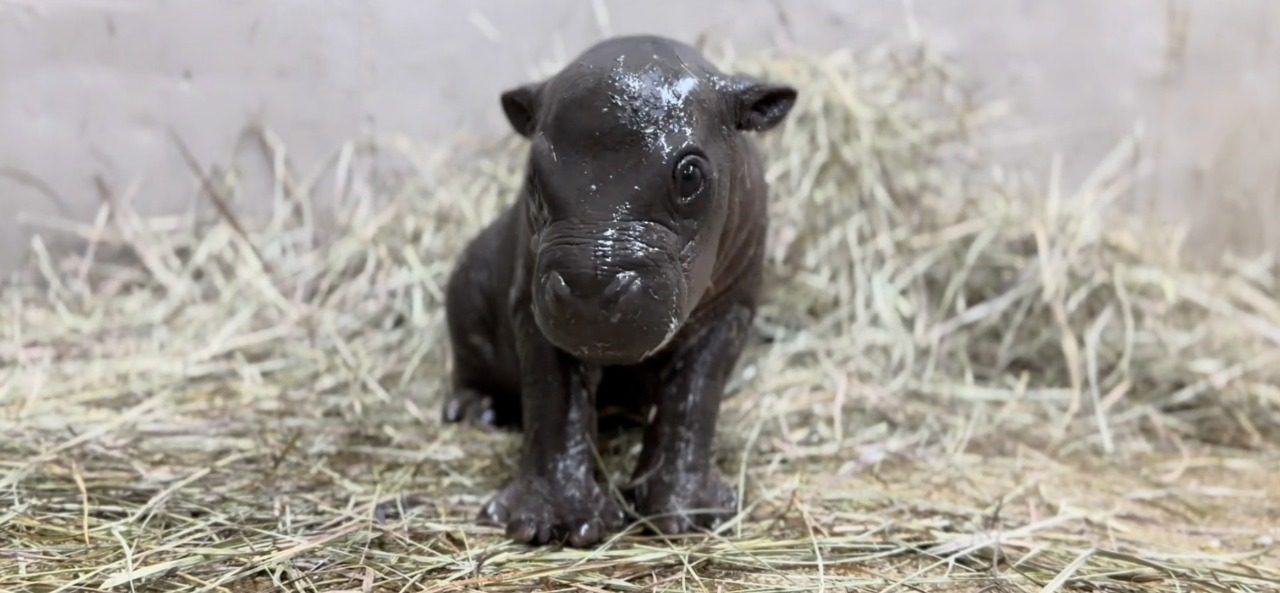
Tokyo’s Ueno Zoo has a new baby and she just broke the global cuteness leaderboard.
TOKYO, JAPAN — Japan, a nation that has proven time and time again it possesses an almost supernatural ability to produce baby animals of devastating adorableness, has done it once more.
At Ueno Zoo — the oldest zoo in Japan, established in 1882, tucked inside the cherry blossom-famous grounds of Ueno Park, Taitō in the heart of Tokyo — a pygmy hippopotamus named Kobushi has just taken his first wobbly, round, magnificent steps into his public exhibit enclosure, and the world has not been the same since.
Zoo staff announced this week that they have begun transitioning the one-year-old calf from behind-the-scenes care into public viewings, and within 48 hours, the footage had accumulated millions of views across every platform on the internet, including several that are not typically associated with baby hippo content.
The internet, in short, is not okay. In the best possible way.
Who Is Kobushi?
Kobushi — whose name means fist in Japanese but was chosen to honour the Kobushi magnolia, a delicate white flower that blooms across Japan in early spring — was born on March 14, 2025, to parents who have lived at Ueno Zoo for years.
His arrival was celebrated with the kind of civic enthusiasm usually reserved for major sporting events. Ueno Zoo held a public naming vote, and the people of Japan took it extremely seriously. Kobushi won by exactly ten votes over runner-up Tsukushi, a margin so narrow that several people on Japanese social media have demanded a recount, not because they’re unhappy with Kobushi, but because they feel the democratic process deserves respect.
The name suits him completely. He is round. He is small. He is, in the most technical zoological sense, a perfect little fist of an animal.
The Exhibit Debut That Broke the Internet
For most of his first year, Kobushi has been raised carefully out of public view — a standard practice for pygmy hippo calves, who are fragile in their earliest months and require close monitoring. Keepers at Ueno Zoo have described the process of introducing him to his exhibit space as gradual and gentle, with Kobushi reportedly taking the whole situation in his characteristic stride: slowly, unhurriedly, and with maximum waddling.
Video of his first public appearances shows a calf roughly the size of a large watermelon — or, as one Twitter user memorably put it, “a baked potato that became sentient and decided to be happy about it” — picking his way across wet stones, peering into the pool with the focused curiosity of a philosopher, and then sitting down for no apparent reason in the middle of the path.
His mother watched nearby. The keepers watched. Every single person in the viewing area watched in complete silence, and then immediately burst into tears.
“I did not expect to cry at a hippo today,” wrote one visitor in a post that has since been translated into eleven languages. “I am a 47-year-old accountant. I have seen many things. Nothing prepared me for Kobushi.”
Why Pygmy Hippos Matter
Beneath the overwhelming cuteness lies a genuinely important conservation story.
The global captive population of pygmy hippos numbers only around 350 to 400 individuals in zoos worldwide Fauna Discovery — making every single birth a significant milestone for the species. With only around 2,000 of them remaining in the world, pygmy hippos are an endangered species. The Kid Should See This
Because wild pygmy hippos are so difficult to observe — nocturnal and living in some of the most impenetrable rainforest in West Africa — zoos have played an outsize role in building public understanding of the species. Fauna Discovery Kobushi, in other words, is not just adorable. He is an ambassador for a creature most humans will never encounter in the wild, and every person who falls in love with his little waddling face is a person more likely to care about the rainforests of Liberia and Sierra Leone where his wild cousins quietly, invisibly, try to survive.
This is what conservation looks like in 2026: a round baby hippo sitting down unexpectedly on a wet path in Tokyo, and forty million people around the world deciding, in unison, that the world must be protected.
Japan’s Unbeatable Animal Soft Power
It would be remiss not to acknowledge the broader pattern here.
Japan has now produced, in relatively quick succession: Moo Deng’s Thai rival in cuteness (though Thais would dispute the comparison), a series of viral shoebill storks at various zoos who simply stare at visitors with quiet, devastating intensity, and now Kobushi, who has achieved in one week what most marketing campaigns fail to achieve in a decade.
Ueno Zoo itself — Japan’s first zoo, founded over 140 years ago, housing around 300 different species of animal HYPER JAPAN — has seen its English-language social media following triple since the first Kobushi exhibit footage dropped. Tour operators report a measurable uptick in Tokyo itinerary requests specifically mentioning the zoo. One travel agency in London described receiving an enquiry from a couple who had been planning a trip to Greece and had, upon seeing Kobushi, spontaneously rerouted to Japan.
This is the Kobushi Effect. It cannot be explained. It can only be experienced.
What Happens Next
Kobushi will continue to be introduced to his full exhibit space over the coming weeks, with keepers gradually extending the duration of his public appearances as he grows more comfortable. He will, eventually, grow into a full-sized pygmy hippo — somewhere between 400 to 600 pounds at full size The Kid Should See This, at which point he will be considerably less pocket-sized but, if the species’ track record is anything to go by, no less beloved.
For now, though, he is small, he is round, he is named after a spring flower, and he made a 47-year-old accountant cry.
Japan has done it again.
🦛 Ueno Zoo is located in Ueno Park, Tokyo, a short walk from Ueno Station. Opening hours and admission details are available at tokyo-zoo.net