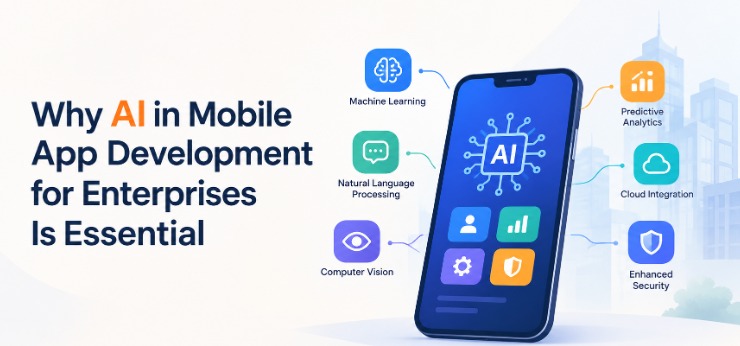
Enterprise mobile apps have come a long way. Ten years ago, most existed for one job: fill out a form, check a status, get something approved. That is not enough anymore. People expect apps to know what they need before they ask and act on data as it happens, not after some report runs the next morning. That is why AI in mobile app development has become core to mobile app development for enterprises rather than something added near the end.
It is not just IT pushing for this either. Business leaders want smarter experiences because their people already spend the day inside AI-driven tools, from apps that know what you will watch next to assistants that finish your sentence. Next to that, an app still behaving like a basic form processor starts looking dated fast. AI in mobile app development is no longer an optional enhancement. It is what keeps a mobile platform useful to the people opening it every day.
How AI Transforms Mobile App Development for Enterprises
Traditional enterprise apps ran on fixed logic. A user did something, and the app responded according to rules someone wrote into the client or a backend rules engine, with no learning and no anticipation of what came next. AI in mobile app development breaks that pattern by introducing systems that watch how people use the app, what the data shows, and what outcomes follow, then adapt their behavior based on that.
This plays out in a few concrete ways. Personalization gets dynamic, with interfaces and content shifting based on role, behavior, and history rather than one fixed configuration, often through a small classification model running right on the device using Core ML on iOS or ML Kit on Android. Few in-house mobile teams cover both ends of that stack well, which is usually the reason enterprises turn to a full stack development company for this kind of integration.
Automation goes deeper than triggers, with a support ticket getting classified by an NLP model, matched against a vector database of past resolutions through retrieval-augmented generation, and routed to whoever has handled something similar before. Decisions happen in real time as well, with inference moving closer to the user through on-device models like TensorFlow Lite or a low-latency endpoint the app calls mid-flow.
The actual difference between a traditional app and an AI-powered one is this: a traditional app tells you what happened, while an AI-powered one tells you what is likely to happen next and often takes the first step toward handling it.
Key Benefits of AI in Mobile App Development for Enterprises
These capabilities matter because of where the actual payoff comes from.
Operational Efficiency
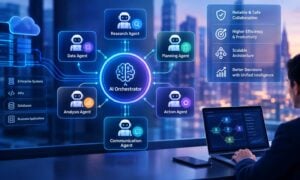
A lot of the review, categorization, and sign-off work that used to sit with a person now runs through models trained on past decisions. Most of the time these show up as task-specific agents handling one job well, rather than a single model trying to do everything. Gartner’s numbers back this up too. They expect 40 percent of enterprise applications to include task-specific AI agents by the end of 2026, up from under 5 percent in 2025. That is a fast increase in a short window.
Sharper User Experience
Predictive search, contextual suggestions, workflows that adjust as you go, they all cut down the number of steps someone has to take to get something done. Getting this right usually takes an event-tracking pipeline, something like Segment or Amplitude, or a custom-built version, feeding a model that scores intent almost instantly, rather than a static rules table updated once or twice a year.
Security and Fraud Detection
Behavioral models flag unusual login patterns, transaction sequences, or access requests within seconds by scoring device fingerprint, location changes, and session behavior against historical fraud cases. In finance or healthcare, where a slow flag has real compliance consequences, that speed is not a bonus. It is the whole point.
Real-World Enterprise Use Cases of AI in Mobile Apps
This is easier to see when you look at where it is already working.
AI Chatbots and Virtual Assistants
These now handle most first-line support inside enterprise apps, pairing a large language model with a retrieval layer over internal documentation so answers stay grounded in real company policy. They escalate to a human only once confidence drops below a set threshold.
Predictive Analytics in Finance and Logistics
Time-series models like Prophet or gradient-boosted forecasting run against historical and live data to catch delays and adjust routing or inventory before a customer ever notices. The output usually lands directly in a dashboard a dispatcher or planner already checks.
Smart Recommendations in Enterprise Platforms
Retail and B2B platforms rely on collaborative filtering or embedding-based engines to surface what is relevant to each user, driven by actual behavior rather than a manually curated list someone updates by hand.
Workforce and Process Automation
Scheduling, task assignment, and compliance checks that once consumed admin time now run through a hybrid setup, where a classifier flags edge cases for a human instead of automating every decision outright. Enterprises often look to hire mobile app developers with this exact integration experience, especially where compliance requirements make shortcuts costly.
Conclusion: AI as a Core Driver of Enterprise Mobile Innovation
AI in Mobile App Development for Enterprises is no longer an experiment. It is a strategic decision enterprises cannot put off much longer. The companies seeing the strongest results are not necessarily the ones spending the most. They are the ones who identified where automation, personalization, and prediction actually create value, and who built the data pipeline underneath it well enough to support that.
That advantage is not going to shrink either. As models keep improving and enterprise data keeps growing, the distance between companies using AI in Mobile App Development for Enterprises well and companies still running static, rule-based apps is only going to widen. If you are planning your next phase of digital transformation, building AI into your mobile platform now is not about chasing a trend. It is about making sure your app layer can keep pace with the business it supports.