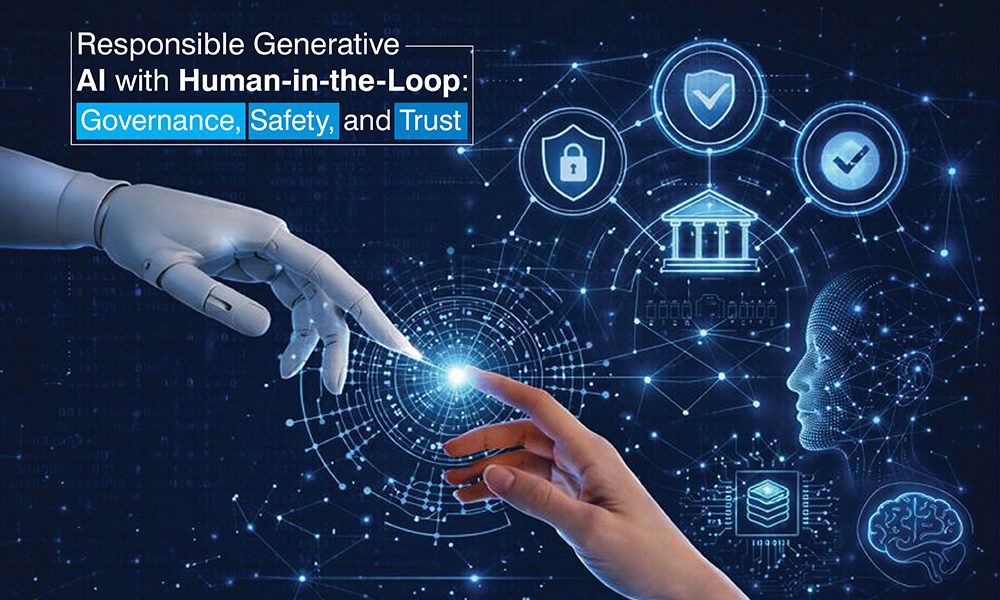
Organisations are now choosing GenAI in production systems with real-world impact and risk. However, before going through the shift, human-in-the-loop frameworks and AI ethics are now becoming essential factors in detecting accuracy, bias mitigation, safety, and governance at scale.
As organizations begin to deploy generative AI beyond experimental use cases into production environments – where outputs create tangible impacts and risks – human-in-the-loop frameworks and AI ethics will become essential operational requirements to ensure accuracy, prevent bias, guarantee safety, and manage governance at scale.
There is significant pressure to deliver quickly, automate processes, and measure business results. At the same time, there are increasing demands from regulators and the public for safe, private, and fair deployment of AI.
This tension provides the context for the importance of human-in-the-loop in bridging generative AI ambitions with necessary AI ethics.
Why Human-in-the-Loop matters right now
HITL is important today because generative AI can generate false and misleading outputs that appear confident and sure of themselves.
According to research conducted by Stanford HAI, large language models have shown hallucination rates ranging from 58 percent to 82 percent in legal settings, based on previous benchmarking studies on general purpose chatbots.

Similarly, Vectara’s hallucination leaderboard has measured the frequency of inclusion of source-unsupported content in summaries, essentially measuring the frequency of “confident nonsense” in task-oriented production-style applications.

HITL ensures human responsibility for outputs that affect employee decisions, patient care, public facing content and user data. Oversight is particularly important during times of high pressure – including but not limited to, edge case, misuse and changing social norms that remains unaccounted in regulatory documentation.
What Human-in-the-Loop actually means in a generative AI setup
In the context of generative AI, HITL represents “pause points” in the process where a human can review and either approve, modify or override the AI generated output before the output is executed. These pause points occur at designated intervals during the process.
Examples of common checkpoints include:
• Pre-output rules for high-risk topics such as hate speech, harassment and threats of violence.
• Human review for prompts that are identified as problematic or have a low level of confidence.
• Post-output audits, user reports and moderation queues.
When both humans and machines collaborate together, their collaboration is at its strongest when the role of each party is clearly defined: Who reviews? What triggers review? What is considered an approved output? The human feedback loop creates a continuous loop of human feedback to continuously improve quality of AI output, without fail.
Why HITL Is Critical for Generative AI: Top 5 Reasons

Here are five reasons that reflect the importance of HITL in the daily operations of businesses that utilize generative AI, and the benefits of HITL are demonstrated in practice:
1. Prevents Hallucinations and Improves Output Accuracy
Reviewers can identify and eliminate fabrications, incorrect citations and misleading summaries prior to the output being shipped. Add a “review required” path for all high-impact outputs (legal, medical, financial) and log all corrections so you can track patterns and update prompts, policies and training data later.
2. Mitigates Bias and Supports Ethical AI
Bias rarely advertises itself. Bias emerges in the form of phrasing, assumptions and unequal treatment of different groups. Use reviewer rubrics for sensitive attributes and protected classes. Conduct periodic bias checks on randomly selected outputs and feed the results back into your policy and training loops.
3. Enhances Transparency, Explainability, and Accountability
HITL enables you to answer difficult questions: Who reviewed this output? What changes were made? Why did we decide to send this out? Keep an audit log of all input prompts, AI model versions, reviewer actions and final outputs.
Attach decision notes to all high-risk approvals. NIST AI Risk Management Framework emphasizes the need for ongoing risk management and oversight practices in the development of AI systems.
4. Builds Trust and User Confidence in AI Systems
Users trust systems more when they know a human can step in and intervene, especially after the first time they see an error. Provide users with a clear method to report problems. Establish escalation paths for humans to address sensitive or emotionally charged cases.
5. Accelerates Model Improvement Through Human Feedback
HITL is not only a safety net but also a constant source of training and evaluation signals. Capture corrections as structured data (what was wrong with the output, what corrected it).
Use preference feedback and reviewer labels to increase alignment of the model and decrease repeated failures. LLM training data services illustrate these workflow areas related to fine tuning, preference alignment, and red teaming, which are directly linked to this feedback loop.
Use Cases: HITL in Action
HITL works best when it sits inside workflows people already trust, instead of feeling bolted on after incidents happen.

Balancing Ethics and Innovation
While speed is one thing that is lost when an organization implements Human In The Loop (HITL) technology, accountability is one that is not necessarily lost; rather, it’s just defined differently — accountability to the processes and checks and balances that are being implemented and monitored by the organization.
• Audit process: An organization has to be able to demonstrate compliance with regulatory frameworks that govern its use of Artificial Intelligence (AI). This includes the EU AI Act which defines human oversight as a requirement for high-risk AI systems, and the capability to monitor, interpret and override outputs when necessary.
• Cost vs Risk: HITL does add cost and latency to the overall development process, however, it significantly reduces the potential downstream risk associated with generating outputs that could potentially harm or cause damage to individuals or organizations.
• Safe Adoption Habits: Organizations can build safe adoption habits through the implementation of HITL technology.
Challenges and How to Address Them
HITL can fail if teams treat it as “humans review everything” or “humans review nothing,” because both break at scale.

Best Practices for Implementing HITL in Generative AI
To ensure that your HITL approach stands up to both internal and external audits, and if something goes wrong, design HITL as a product feature, and not as a team habit.
1. Determine the Criteria for Human Intervention
Establish clear risk-based criteria for when a human must intervene, such as tiered risk levels.
2. Use Confidence Thresholds
Use confidence thresholds to automatically send uncertain outputs to humans for review.
3. Standardization Across Teams/Vendors
Standardize review guidelines across all teams and vendors to minimize variability.
4. Take Advantage of Audit Trails and Explainability
Invest in audit trails and explainability so that you have the ability to track and understand decision-making at a later date.
The Future of Human-AI Collaboration
As AI models become more autonomous, human work will shift away from constantly reviewing output and toward controlling the system level.
• More “Human-In-Command” Models: Expect to see more examples of “human-in-command” models, where humans establish parameters and intervene based upon exception cases.
• More Red Teaming/Safety Testing/Continuous Monitoring: Teams will begin performing more red teaming and safety testing, and feeding the results into continuous monitoring to identify areas where improvements are needed.
• More Focus on Oversight/Ethics/Governance/Strategy: Humans will be spending more of their time on oversight, ethics, governance, and strategy, and less on approving and validating individual pieces of output.
Worldwide ethics guidance continues to point to the fact that AI systems should never replace an individual’s ultimate responsibility.
Conclusion
Generative AI must be developed responsibly with human accountability clearly established, particularly when systems operate under uncertainty. HITL provides a practical solution to provide visibility to quality, fairness, and safety while still delivering valuable products. If your team is currently running GenAI in production, audit where errors will be most damaging to your business, place human checkpoints in those places first, and treat reviewer feedback as critical training data for your next GenAI iteration.