
How to Handle Failed and Reversed Payments Across Multiple Payment Rails

Introduction
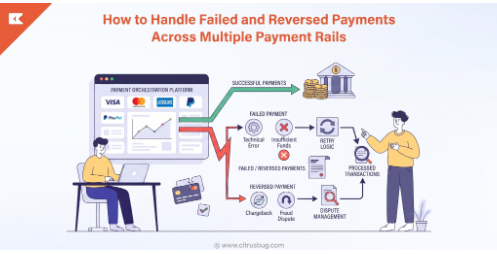
Handling payments across multiple payment rails sounds simple until a card declines, an ACH debit bounces three days later, and a wallet payment reverses after the order has shipped. Each rail fails in its own way, on its own schedule.
This guide shows how to classify failures, retry safely, handle reversals, and reconcile everything so your team stops guessing and customers stop getting charged twice.
Understand How Payment Failures Differ Across Payment Rails
A card decline is usually instant and comes with a reason code. A bank debit works differently: it can look successful for days and then return with a failure notice. Wallets and bank transfers add their own delays and customer steps, and more buyers now mix methods, as digital payment statistics show. Treating them alike breeds recovery bugs.
The practical takeaway is to design for timing, not just outcome. Ask how quickly each rail confirms a result, whether it can fail after confirmation, and who has to act next. Those answers decide your retry rules, your customer messaging, and how long an order can safely wait. Write them down per rail before you build anything.
Build a Unified Payment State Model
Every provider names things differently, so give your system one shared vocabulary. Define canonical states such as pending, authorized, captured, failed, reversed, refunded, and disputed. Checkout, support, and finance should all read from these states, never raw provider labels. That keeps the rest of your code simple as you add rails, even if you’re building custom payment gateway software.
Next, map each PSP status to an internal state in one place, and block invalid transitions. A refunded payment should never jump back to pending. Keep payment status separate from order and fulfillment status, and store the original transaction and provider references on every record. You’ll need them the first time someone asks what happened.
Classify Failures Before Retrying
Retrying everything is the fastest way to annoy customers and issuers. Retryable failures are usually temporary: network timeouts, issuer unavailable, processor errors, or rate limits. These often succeed on a second attempt, so they deserve automated retries with sensible limits. Log the reason code every time so you can see patterns.
Non-retryable failures need a different path. Think stolen card flags, closed accounts, expired cards, invalid credentials, or a hard do-not-honor. Retrying these wastes fees, adds noise to your metrics, and can hurt your standing with issuers. Route them to customer action instead, such as updating a payment method, and stop the automated loop early.
Some failures sit in a gray zone. A soft decline might clear on a second try, while an insufficient funds return on a bank debit may clear after payday. Set rules per rail and per reason code, review them monthly, and let the data move a code from one bucket to the other.
Design Safe Retry and Fallback Logic
First decide whether you’re retrying the same payment or creating a new attempt. A retry of the same payment reuses the original request, so idempotency keys are essential: they let the provider recognize a repeat and return the original result instead of charging again. A new attempt gets a new key and a new record.
- Retry limits: Set a maximum number of attempts and a retry window, such as three tries over 24 hours.
- Exponential backoff: Space out retries for transient errors so you don’t hammer a struggling provider.
- Fallback routing: Send eligible failures to another PSP or processor, a common goal in payment gateway software development.
- Duplicate protection: Skip fallback when the original transaction may already have succeeded, and confirm its status first.
- Authentication data: Carry over 3D Secure or other authentication results when moving between processors, so customers aren’t challenged twice.
Fallback deserves the most caution. The worst outcome is a double charge caused by a timeout that hid a successful payment.
When in doubt, query the original transaction before trying elsewhere. Teams doing payment app development with routing rules built in from the start tend to avoid this whole class of bug.
Handle Reversed Payments Correctly
A reversal isn’t a single event. An authorization reversal releases a hold before money moves. A refund returns money after capture, and a chargeback is a dispute the customer’s bank forces on you. Each has different timing, fees, and evidence needs, so your system should record which one it is.
Some payments succeed at first and fail later, which is common with bank debits and transfers. When that happens, update the payment state first, then the order or entitlement. Pause shipping, suspend access, or flag the account based on your risk rules. Decide early when funds must be returned or recovered from the customer.
Reversal handling also differs by rail. Card reversals follow network rules and dispute windows. Bank debit returns follow their own return codes and deadlines. Wallets often have their own buyer protection programs. Build rail-specific rules on top of your shared state model, and keep the differences documented where support and finance can find them.
Your support team needs the same truth. Give agents one view showing the payment state, the reason, and the next expected event, so they can answer in one message instead of three. Reversals generate angry tickets fast, and a clear refund or dispute timeline calms most of them before they escalate.
Use Webhooks as the Source of Payment Truth
Browser redirects and API responses can lie by omission. A customer closes the tab, a request times out, and your system never hears the final result. Webhooks close that gap because the provider tells you what actually happened.
Treat them as the source of truth for payment status, and update your state model from them.
Webhooks arrive late, twice, or out of order, so plan for that. Verify signatures, store every event, process each one idempotently, and ignore events that would cause an invalid state change.
Keep a scheduled polling job as a backup for missed deliveries. Security matters here too, and fintech app security practices apply directly to your webhook endpoints.
Reconcile Payments Across Multiple Rails
Reconciliation is where hidden problems show up. Match your internal transaction IDs to provider references, then compare attempts, captures, refunds, and reversals against what each provider reports. Remember that a transaction date and a settlement date rarely match, and that timing gap differs on every rail. Build your checks to expect it.
- Find the gaps: Flag missing, duplicated, or mismatched transactions every day.
- Track partials: Follow partial refunds and reversed refunds, since totals rarely line up otherwise.
- Use exception queues: Send unresolved items to a queue with an owner and a deadline.
- Feed the books: Connect reconciled results to your ledger and accounting system, ideally through custom accounting software development services built around your workflows.
Ownership matters as much as tooling. Assign each exception to a person, set a service level for resolving it, and review aging items every week. Old unresolved transactions are usually where refunds get missed and revenue is misreported, so they deserve regular attention from both finance and engineering, not just a scramble at month end.
Create a Cross-Rail Payment Recovery Workflow
Put the pieces in order. A recommended flow looks like this: Payment Attempt → Provider Response → Normalize Status → Classify Failure → Retry or Fallback → Webhook Confirmation → Update Ledger → Reconcile. Every step should write to a record, so support can trace one payment from start to finish without asking engineering.
- Where to stop retries: When you hit your attempt limit or get a non-retryable code.
- When to switch rails: When the failure is provider-specific and no charge may exist.
- When to ask the customer: When the fix needs a new method, authentication, or updated details.
- When to hold an order: When payment is unconfirmed on a rail that can fail late.
- When to investigate manually: When statuses conflict or the amount doesn’t match.
Customer communication belongs in this flow too. When you ask someone to act, say what failed in plain words and give one clear next step, such as updating a card or approving a bank authorization. Vague messages like “payment error” send people to support, and many of them never come back to pay.
Monitor Payment Failures Across Providers
You can’t fix what you can’t see. Track authorization and success rate by rail, failure rate by provider, and the reason codes behind each decline. A single blended success rate hides problems, so always slice by provider, rail, currency, and market. These are familiar challenges and solutions in fintech SaaS for product teams.
- Recovery metrics: Retry success rate, fallback recovery rate, and average recovery time.
- Reversal metrics: Reversal rate and refund failure rate.
- Operational health: Webhook processing failures and payment-to-settlement discrepancies.
Set alerts on sudden changes, not just fixed thresholds. A two-point drop in one provider’s success rate at 2 a.m. usually means an outage, not customer behavior.
Review the numbers weekly with both engineering and finance in the room, because each team spots different problems, and the fixes usually need both.
When Payment Orchestration Makes Sense
Orchestration isn’t for everyone. If you run one PSP in one market, direct integration is usually fine. It starts to pay off when you juggle multiple PSPs and processors, several currencies and markets, different payment rails, and retry or fallback rules that keep growing more complex. Those are the signs the setup has outgrown itself.
The benefits are practical. You get centralized routing and monitoring, less provider-specific integration code, and the freedom to tune payment performance without constantly touching core checkout. If you’re planning this kind of build, working with a fintech app development company early can save months of rework. Keep your own state model and ledger as the record.
Conclusion
Managing payments across multiple payment rails comes down to a few habits: one shared state model, careful failure classification, safe retries, webhook-driven updates, and steady reconciliation.
Get those right and failed or reversed payments become routine events instead of fire drills. Start with the rails causing you the most pain, measure the results, and expand from there as your volume grows.






Comment