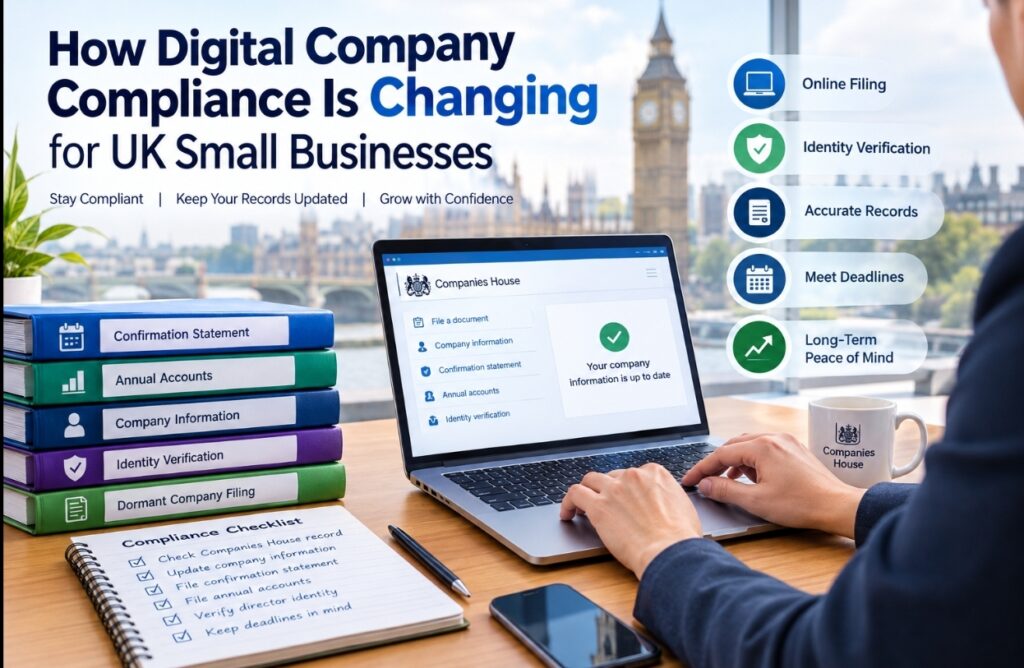
How Digital Company Compliance Is Changing for UK Small Businesses
Running a small business in the UK increasingly means managing more than customers, sales and finances. Directors also have to keep company information accurate, meet filing deadlines and stay aware of changes to Companies House requirements.
Much of this administration has moved online. While digital filing can make routine tasks more convenient, it also means business owners need a reliable system for keeping records and dealing with company obligations throughout the year.
For small businesses with limited administrative resources, understanding how these responsibilities fit together can make company compliance much easier to manage.
The Shift Towards Digital Company Administration
Company administration was once strongly associated with paper forms, physical records and postal correspondence. Today, many routine company tasks can be completed online.
Directors can check company information, submit filings and manage certain changes electronically. This can save time, particularly for small businesses where the director may also be responsible for finance, operations and customer relationships.
However, moving administration online does not remove the need for careful record keeping. Digital filing is only effective when the information being submitted is accurate.
A business owner who reviews company information regularly is less likely to discover unexpected problems when an annual filing deadline approaches.
Keeping Companies House Information Accurate
Companies House holds important information about UK companies, including details about directors, registered offices, shareholders and people with significant control.
Businesses should make sure this information remains accurate. Changes should generally be dealt with when they occur rather than waiting until the next annual filing.
This is particularly important because the confirmation statement is designed to confirm that the information held by Companies House is up to date.
Every company, including dormant and non-trading companies, must file a confirmation statement at least once every year. Companies House also requires certain information to be reviewed and updated before the statement is submitted.
For directors who want a straightforward way to handle this part of their annual administration, using an online service to file confirmation statement information can help make the process more manageable.
Understanding the Confirmation Statement
A confirmation statement is sometimes confused with annual accounts, but the two serve different purposes.
Annual accounts provide financial information about the company for its accounting period. A confirmation statement, by comparison, is primarily concerned with confirming company information held on the Companies House register.
This distinction is important for small business owners because completing one filing does not automatically satisfy every company requirement.
Before submitting a confirmation statement, directors should check relevant company details and make sure any required changes have been dealt with.
Companies House currently states that directors must also complete identity verification requirements and provide their Companies House personal codes as part of the confirmation statement process where applicable.
Identity Verification Adds Another Digital Responsibility
One of the significant recent changes to UK company administration is the introduction of mandatory identity verification for directors and people with significant control.
The requirement began being introduced from November 2025 and is being phased in over a 12-month period. Existing directors are required to verify their identity in connection with their confirmation statement during the transition period.
Once an individual successfully verifies their identity, Companies House provides a unique personal code. Directors need this code for certain company filings and appointments.
For small businesses, this means company administration is becoming more connected with digital identity, online filing and electronic record management.
Rather than treating these changes as isolated administrative tasks, directors can benefit from including them within their normal compliance routine.
Dormant Companies Still Have Responsibilities
Digital company administration is not only relevant to actively trading businesses.
A company may stop trading but still remain registered with Companies House. Being dormant does not automatically mean that all filing responsibilities disappear.
Companies House states that dormant companies generally still need to file a confirmation statement and annual accounts. A company that qualifies as small and is dormant for Companies House purposes may be able to file dormant accounts instead.
This distinction is important for directors who have retained a company for a future business project, investment opportunity or another purpose.
A dormant company may have very little financial activity, but its administrative obligations still need attention. Directors looking to file dormant accounts should therefore make sure they understand which accounts apply to their company’s circumstances.
Why Small Businesses Need a Filing Routine
One of the easiest ways to manage company compliance is to avoid treating it as a once-a-year task.
A small business can create a simple administrative routine that includes:
- checking the Companies House record regularly;
- monitoring the confirmation statement date;
- reviewing director and shareholder information;
- checking registered office and email details;
- keeping track of annual accounts deadlines;
- dealing with company changes promptly;
- monitoring identity verification requirements where applicable.
These tasks do not necessarily require complicated software.
A shared calendar, accounting system or simple compliance checklist can provide enough structure for many small businesses. The important point is consistency.
Digital Filing Does Not Mean Automatic Compliance
Online services have made company administration considerably more convenient, but they have not transferred responsibility away from directors.
A digital filing system can submit information quickly, but the director still needs to make sure that the information is correct and that the appropriate filing is being made.
This is why understanding the purpose of each filing matters.
For example, a confirmation statement is not the same as annual accounts. Similarly, dormant accounts do not replace every other company requirement that may apply to a dormant business.
Having a clear understanding of these differences can help directors avoid treating all Companies House paperwork as one single annual task.
Making Compliance Part of Normal Business Management
For a small company, administrative work can easily get pushed aside while the owner focuses on customers, sales and daily operations.
The problem is that company filing deadlines do not disappear when business becomes busy.
A more practical approach is to build compliance into the company’s normal management routine. Directors can schedule periodic checks, keep important company information organised and deal with changes as soon as they occur.
This approach can also make annual filings less stressful because the necessary information is already available.
A More Organised Approach to Digital Company Administration
The increasing use of online company administration has changed how UK small businesses manage compliance.
Confirmation statements, annual accounts, identity verification and company information can now involve a much more digital process than traditional paper-based administration.
For directors, the key is not simply knowing that online filing exists. It is understanding which obligations apply to the company and creating a simple system for keeping everything up to date.
Whether a company is actively trading, expanding or temporarily dormant, regular administration can prevent routine compliance tasks from becoming difficult problems later.
Digital company administration works best when it becomes part of everyday business management rather than something left until the last possible moment.