Most Triangle homeowners assume a tree removal quote comes down to height and trunk diameter. Kendrick Hunter, who runs Hunter Excavating out of Durham, says the bigger swing factor he sees is usually what’s hanging twelve feet above the tree, not the tree itself.
Power lines change the whole job. They change the equipment that rolls up. They change whether Duke Energy has to be involved. They change how long the work takes and when it can actually happen. In Durham, Cary, and Chapel Hill, where you’ve got everything from hundred-year-old oaks in Forest Hills to packed Cary subdivisions with rear-easement lines, that one variable can move a quote by a few thousand dollars on two trees that look identical on paper.
Here’s what Kendrick’s crew actually accounts for when a tree sits close to a service drop, a primary line, or transmission.
Three kinds of lines, and they don’t price the same
A service drop is the wire running from the pole to the side of the house. It’s usually insulated, lower voltage, and Duke will often disconnect it at the meter at no charge if the homeowner calls ahead. Trees near a service drop typically add maybe 10 to 20 percent over a clean job, because once the line is dropped, the crew can work normally.
A primary distribution line is the upper wire on the pole, the one feeding the whole street. Different category. Hunter’s crew can’t touch it. Duke has to send a line truck, and getting that scheduled is where the time and money show up.
Transmission lines are the big ones, less common in residential Durham but you’ll see them in parts of Chapel Hill near the bypass. If a tree is anywhere near transmission, it stops being a tree job and turns into a utility coordination project on a multi-week timeline.
Where the cost actually comes from
Kendrick has said in more than one consultation that the tree doesn’t cost more because of the line. The work around the tree does.
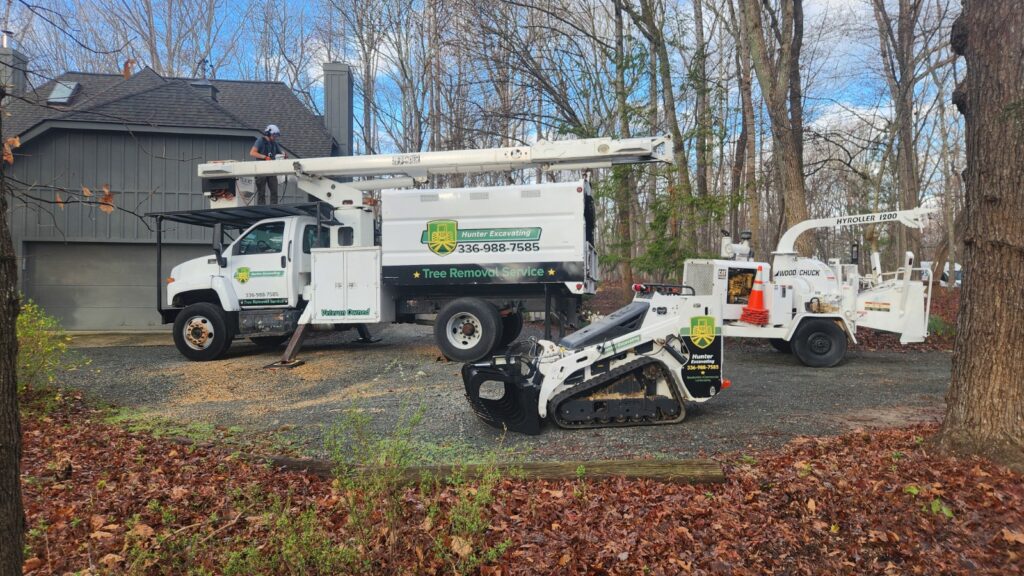
A 60-foot oak in an open yard might come down in a few hours with a chainsaw and a chipper. That same oak ten feet off a primary line needs a crane. Cranes in the Durham area run roughly $400 to $700 an hour with the operator, and most jobs hit a half-day minimum before you factor in the extra rigging, a spotter, and a bigger ground crew to pick pieces out instead of dropping them.
Then there’s Duke. If a line has to be de-energized, that gets scheduled a week or two out, and the homeowner usually has to make the request. Hunter Excavating can walk clients through that call but the utility sets the calendar. Storm emergencies are the exception. A tree on a live line gets a same-day truck because it’s a safety call.
Permits are another thing people don’t expect. Cary’s tree ordinance is stricter than Durham’s, and some protected species in or near a right-of-way need a town arborist to sign off before anything gets cut. Chapel Hill sits somewhere in the middle with Orange County rules that catch homeowners off guard who assumed they could get the work done the same week.
Why Cary and Chapel Hill often quote higher than Durham on the same tree
A few things stack up. Newer Cary developments have smaller lots, which means tight access for a crane and more cleanup of a neighbor’s landscaping when limbs come down. Chapel Hill has more mature canopy around older homes, so more trees grew up next to lines that went in decades after the tree did. That’s exactly the setup that needs the most careful rigging.
Durham has its own thing going on. Trinity Park and Forest Hills have oaks that are pushing a hundred years old, and the root systems make stump grinding harder even after the canopy is gone. Quotes in those neighborhoods often have a separate stump line that you wouldn’t see elsewhere.
The general rule Kendrick gives people: the further a tree is from any line, the more predictable the price. Anything inside ten feet of a primary line, expect the estimate to come back with conditions attached, usually a contingency on Duke’s schedule and a separate number for crane time.
What helps before you call
A couple of small things make the first quote tighter. Knowing whether the wire over the tree is the service drop or the primary saves a step. Two photos help, one of the tree and one that shows the line above it, before anyone walks the site. And if the tree is leaning toward a line after a storm, the first call should be Duke, not a tree company.
Hunter Excavating works across Durham, Cary, Chapel Hill, Hillsborough, Mebane, and Raleigh. The full list of what’s included in a standard job, plus the equipment Kendrick’s crew uses for line-adjacent work, is on the tree removal services page.