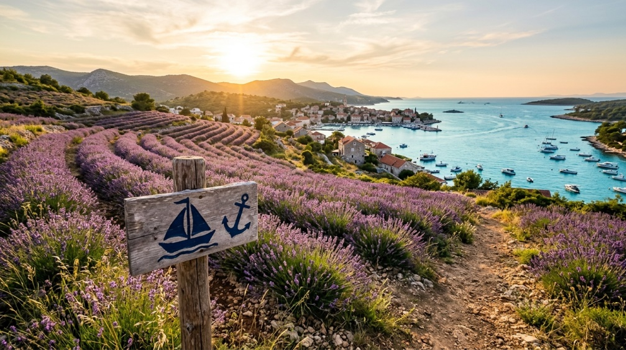
Few images capture Hvar’s identity as well as its purple-hued lavender fields, stretching across terraced hillsides and filling the summer air with a scent so distinctive it has become inseparable from the island’s brand. Though lavender cultivation has declined from its mid-20th-century peak, the plant remains woven into local culture, cuisine, and the small-scale economy of several villages.
A brief history
Lavender was introduced to Hvar in the early 1900s and flourished thanks to the island’s dry, rocky terrain and Mediterranean climate, conditions nearly identical to those found in Provence. By the 1960s and 70s, Hvar was among the world’s leading producers of lavender oil, with entire hillsides given over to cultivation, particularly around the village of Velo Grablje. A devastating wildfire in the late 1990s destroyed much of the crop, and many farmers never replanted at the same scale, but pockets of cultivation persist and a handful of dedicated growers have kept the tradition alive.
Velo Grablje: the heart of lavender country
This small, partly abandoned village in the island’s interior was once the center of Hvar’s lavender industry, and it remains the best place to learn about the plant’s history. A small ethnographic collection and occasional guided tours explain the traditional distillation process, using copper stills that have been passed down through generations. The village itself, with its stone houses and quiet, narrow lanes, has a slightly melancholic beauty, having lost much of its population over the decades to the coast.
When to visit for peak bloom
Lavender typically blooms from mid-June through mid-July, though exact timing shifts slightly year to year depending on spring weather. Visiting during this window rewards travelers with hillsides awash in purple and a fragrance that drifts across entire valleys. Local producers often hold small harvest festivals during this period, with hand-cutting demonstrations and opportunities to purchase fresh bundles directly from the field.
Lavender products worth bringing home
Local markets and small shops throughout Hvar Town and Stari Grad sell an array of lavender products: essential oil, soap, sachets, honey infused with lavender, and even lavender-flavored rakija, the region’s traditional grape brandy. Buying directly from small producers rather than tourist shops on the main square tends to yield better quality and more authentic products, and often a more interesting conversation about the plant’s local history.
Combining lavender with wine country
The interior valleys where lavender grows overlap significantly with Hvar’s vineyard regions, making it easy to combine a lavender-focused excursion with wine tasting at family-run cellars. A day spent driving or cycling through the central plateau, stopping at small producers along the way, offers a very different perspective on the island than the coastal beach-and-boat experience most visitors focus on exclusively.
A break from the coast
After days spent on the water exploring bays and beaches, many visitors find the interior a welcome change of pace. The scent of lavender, rosemary, and wild sage carried on the breeze through the hills is as much a part of Hvar’s character as its coastline, and skipping it means missing half the island’s story. Of course, rent a boat in Hvar options remain available for those who want to return to the coast afterward, since most lavender fields and villages sit within a short drive of the harbor towns where boats can be arranged.
Practical notes
Visiting the lavender fields is best done by rental car or scooter, as public transport to the interior villages is limited. Wear comfortable shoes for walking along the dirt paths between fields, and bring a hat, as the interior offers little shade during midday. Late afternoon light tends to make for the most striking photographs, with the low sun catching the purple fields at their most vivid.
Supporting the remaining producers
With lavender cultivation on Hvar far smaller in scale than it once was, the handful of remaining growers rely heavily on direct sales to visitors rather than large-scale export, which was once the norm. Buying a bottle of oil or a bundle of dried lavender directly from a small producer, rather than a generic souvenir shop in Hvar Town, does more to support the tradition’s survival and often comes with a far more interesting story about how the plant is grown, harvested, and distilled using methods that have changed little over the past century.