LAS VEGAS. The global jewelry and watch market keeps climbing, but one of its oldest weak spots has barely changed: getting the goods from one set of hands to another in one piece. While most of the industry has modernized, the physical movement of high-value assets has stayed stubbornly low-tech, and criminals have noticed. Organized cargo theft has grown more coordinated in recent years, with crews using signal jammers and staged “deceptive pickup” schemes to separate parcels from their owners.
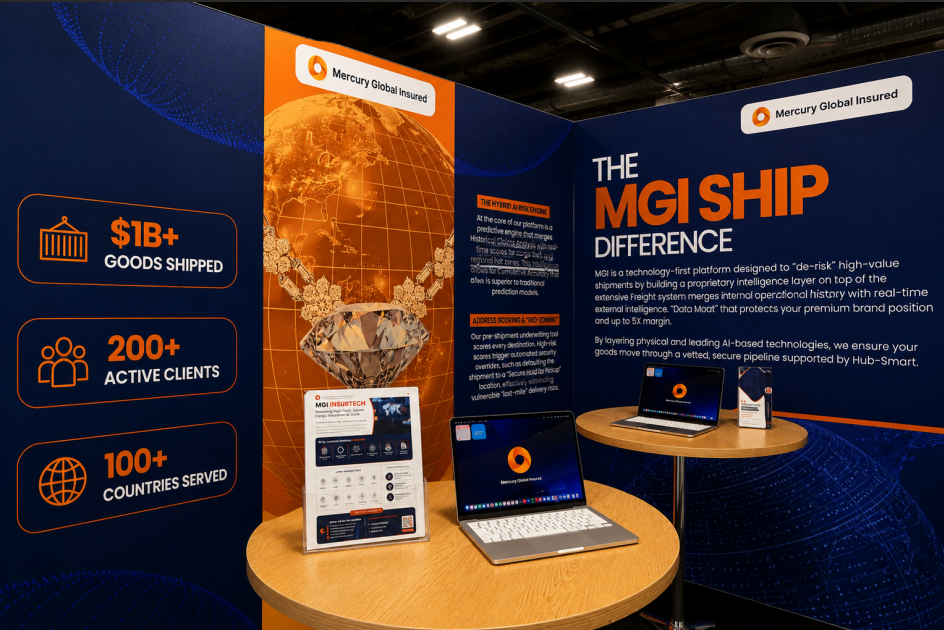
At JCK Las Vegas 2026, held May 29 to June 1 at The Venetian Expo, MGI used its debut appearance at the show to argue that this problem is solvable, and that the answer runs through software and data rather than thicker boxes. Exhibiting under the name Mercury Global Insured at Booth 48121, the company built its pitch around the gaps jewelers have quietly lived with for years.
The challenge: “operational debt” and tracking-number anxiety
For a lot of jewelers, the cost of shipping isn’t just postage. MGI calls the rest of it “operational debt”: the hours spent watching tracking numbers, the manual checks, the high insurance premiums, and the low hum of worry that follows a package until it’s confirmed delivered. The riskiest stretch tends to be the last mile, where a parcel left on a residential doorstep or signed for by the wrong person can turn into a loss, and then into a claim that drags on for months. For an audience that has spent years living with what the company describes as “tracking-number anxiety,” that was a familiar story.
The response: score the risk before the package ships
MGI’s answer starts before anything leaves the building. The company’s Hybrid AI Risk Engine, which it described as the core of its platform, scores each destination for risk by combining a shipper’s own claims history with outside threat data, including cargo-crime databases such as CargoNet. Addresses that land in what MGI calls a “Red-Zone” can trigger an automatic change of plan instead of a hopeful drop-off.
“If our engine sees a high risk of ‘signature release’ fraud at a specific zip code, the system doesn’t just flag it. It overrides the shipment,” said Daniel Kennedy, a senior account executive, during conversations at the show. “It reroutes the parcel to a secure, vetted hold location automatically. We are taking the decision-making out of human hands and putting it into a predictive framework.”
The innovation: a record that can’t be quietly changed
In high-value trade, the chain of custody is the whole game, and MGI used the booth to show where it wants to take that next. The company described a “digital twin” for each shipment: a Blockchain Digital Passport meant to log every scan, every address score, and every verification in a record that can’t be edited after the fact.
Backing that record, MGI pointed to IoT smart seals it says reach past a standard GPS tracker. The sensors are built to watch for:
- Light exposure, with an instant alert if a box is opened in transit
- Shock and G-force, which matters for watches and timepieces, where a single drop can ruin a movement
- Independent location “heartbeats,” a separate data stream so MGI’s own tracking holds up even when the carrier’s lags
The company framed these as capabilities still rolling out rather than features in full use today, but they point to the sealed, sensor-backed pipeline MGI says it’s building toward.
The guarantee: insurance you hope to never use
MGI’s take on insurance runs against the grain. Rather than leading with the policy, the team described a “zero-insurance mindset,” where the real goal is to prevent the loss so the coverage never has to kick in. When something does go wrong, the company says its underwriting runs through a master policy at Lloyd’s of London, with zero-deductible protection on shipments valued up to $200,000 and recent six-figure international payouts to point to.
“We protect the 50% gross margins that define our clients’ businesses,” said Jellie Lopez, an account executive. “When you remove the threat of a $50k loss being tied up in a six-month claims battle, you give a retailer the freedom to scale.”
What it added up to at Booth 48121
By the end of the show, the conversation had less to do with shipping in the old sense and more to do with what MGI calls asset orchestration: treating each package as something to be scored, tracked, sealed, and insured from pickup to final delivery. CEO Sam Kalra, along with Lopez and Kennedy, spent the show walking jewelry professionals through that framework.
“MGI isn’t just another service provider; we are building a proprietary AI platform that creates a ‘data moat’ for our clients,” Kalra said.
The company, founded in Los Angeles in 2023, builds this for businesses moving diamonds, gemstones, jewelry, watches and timepieces, luxury fashion and accessories, and other high-value goods. On its booth’s stat wall, MGI cited more than $1 billion in goods shipped, more than 200 active clients, and service across more than 100 countries, and the team said it is scaling toward roughly 2,500 secure packages a week.
The takeaway from Las Vegas was a simple one. In luxury, confidence in delivery should count for as much as the goods themselves, and MGI’s first JCK showing was its bid to make that the standard rather than the exception.
MGI exhibited at Booth 48121, Level 1, at JCK Las Vegas 2026. More information is available at mgiship.com.
Read More From Techbullion