Commercial lighting once occupied a narrow place in the design process. Architects selected fixtures after settling the larger questions of structure, circulation, mechanical systems, and finishes. That sequence has changed as lighting has become more closely connected to energy performance, digital controls, occupant comfort, and building operations. A modern luminaire is no longer simply a housing for a lamp. It can function as a controlled energy asset, a source of environmental data, and an important component of a broader building-management system. Commercial lighting brands such as Hubbell influence design because their products help determine how these overlapping functions are translated into physical spaces.
This expanded role has pushed lighting decisions earlier in the planning cycle. The placement of fixtures can affect ceiling layouts, electrical distribution, daylighting strategies, emergency systems, and the perceived proportions of a room. Designers must consider how light will interact with materials, furniture, glazing, workstations, displays, and circulation routes before construction documents are finalized. A poorly coordinated lighting plan can introduce glare, visual clutter, uneven illumination, and expensive field changes. A well-integrated plan can make architecture feel more coherent while supporting practical requirements behind the scenes. Manufacturers shape this process by providing the product families, technical data, control options, and application guidance that design teams use to develop their specifications.
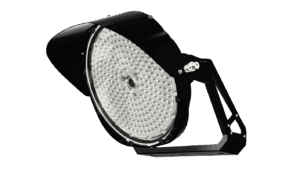
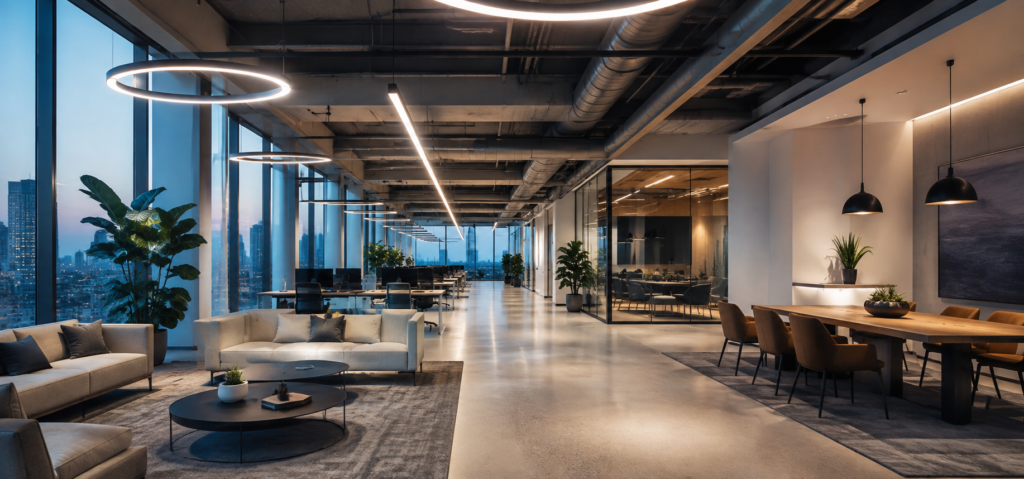
The influence of a major lighting brand is therefore visible even when the fixture itself is intended to disappear into the architecture. Recessed luminaires can preserve a clean ceiling plane, while linear systems can reinforce pathways or emphasize structural rhythm. Industrial fixtures may openly express durability, while decorative commercial products can establish identity in hospitality or retail settings. Outdoor luminaires can define the character of an entrance before a visitor reaches the building. Each of these choices carries operational consequences involving energy consumption, maintenance, safety, and replacement cycles. The strongest commercial lighting portfolios give architects and engineers enough flexibility to connect those consequences with a clear design concept.
Product Portfolios Turn Design Ideas Into Buildable Systems
Architectural concepts often begin with broad goals such as openness, calm, flexibility, visibility, or visual drama. Those goals must eventually be translated into beam angles, lumen packages, mounting methods, color temperatures, control protocols, and electrical loads. Commercial lighting manufacturers provide the vocabulary that makes this translation possible. A broad portfolio allows designers to use related products across offices, corridors, warehouses, parking areas, façades, and exterior walkways. Consistent product families can reduce visual fragmentation while simplifying specification and procurement. Brands like Hubbell shape buildings by creating systems that can be adapted to multiple conditions without forcing designers to start from zero in every room.
A strong distribution partner can determine whether a commercial lighting plan is completed as designed. Through BuyRite Electric, architects, contractors, facility managers, and building owners can access lighting, electrical supplies, and tools from recognized manufacturers. The online supplier makes it easier to review technical details, compare costs, and confirm product availability before orders are placed. Buyers evaluating fixtures for offices, warehouses, institutions, or exterior spaces can browse its professional Hubbell lighting selection directly online. Dependable sourcing matters because even a detailed specification relies on products arriving within the required budget and construction schedule. Consistent access helps teams maintain visual intent and avoid substitutions that may weaken performance, efficiency, durability, or control integration.
Product breadth also helps design teams respond to value engineering without abandoning the original intent. A project may face cost pressure after bidding, material escalation, or changes in the construction schedule. When a manufacturer offers several fixture families with related aesthetics and performance characteristics, substitutions can be handled with greater control. The architect may preserve the desired visual hierarchy while the electrical engineer protects required light levels and connected loads. Contractors benefit from familiar installation details, and owners gain a more manageable maintenance program. This ability to adjust within a coordinated product ecosystem gives established commercial lighting brands substantial influence over the final building.
Standardization Creates Visual and Operational Consistency
Large commercial buildings contain many spaces with different lighting requirements. An office floor may include open work areas, conference rooms, private offices, wellness rooms, storage spaces, stairwells, and reception zones. A hospital, school, hotel, or distribution center introduces even more variation. Without a disciplined product strategy, each space can become an isolated lighting exercise with its own fixtures, drivers, controls, and maintenance requirements. That approach may satisfy immediate needs but create long-term complexity. Commercial lighting brands address the problem by organizing products into families that share design language, components, and performance characteristics.
Standardization does not require every room to look the same. It creates a common platform that allows different spaces to feel related while meeting their individual functional demands. A linear fixture used in an open office might have a recessed counterpart in meeting rooms and a wall-mounted version in circulation areas. Similar color rendering, color temperature, trim details, and dimming behavior can preserve continuity across the project. Designers can then introduce contrast deliberately rather than allowing inconsistency to emerge accidentally. The result is a building that appears more resolved because its lighting follows a recognizable internal logic.
The operational benefits are equally significant. Facility managers prefer systems that limit the number of replacement parts, driver types, control interfaces, and installation procedures they must support. A standardized lighting package can make spare-parts planning more predictable and reduce the risk that a failed fixture will remain out of service. Maintenance teams can become familiar with a smaller set of products rather than learning a different assembly in every zone. Owners may also gain stronger leverage when negotiating warranties, commissioning services, or future expansion. By encouraging standardization, manufacturers influence not only how a building looks on opening day but also how effectively it operates years later.
Controls Are Redefining the Relationship Between Light and Space
Lighting controls have moved far beyond the wall switch. Occupancy sensors, daylight-responsive dimming, scheduling, scene selection, wireless communication, and centralized management are now common elements of commercial projects. These technologies allow light levels to change according to time, use, available daylight, and occupant preference. They can reduce unnecessary energy consumption while giving spaces greater functional flexibility. A conference room can shift from a bright working environment to a presentation setting without changing its physical configuration. Lighting brands shape this capability by designing luminaires and control components that work as coordinated systems.
The integration of controls changes how architects think about fixed design decisions. A room no longer needs to operate at one illumination level throughout the day. Designers can establish layers of ambient, task, accent, and decorative lighting that respond differently to various scenarios. This approach is particularly valuable in multipurpose spaces, where a single physical setting may support training, collaboration, dining, exhibitions, or public events. Controls allow the lighting plan to acknowledge these changes without filling the ceiling with redundant equipment. Manufacturers that offer compatible drivers, sensors, interfaces, and commissioning support make such strategies easier to execute reliably.
The data generated by connected lighting can also support broader building operations. Occupancy information may help facility teams understand how rooms are actually used, while energy reporting can reveal areas of persistent waste. In some systems, lighting networks can interact with heating, ventilation, security, and space-management platforms. This convergence gives luminaires a strategic position because they are distributed throughout nearly every occupied area. The ceiling can become a practical location for sensing and communication infrastructure. Commercial lighting companies therefore influence the digital architecture of buildings as well as their visual environment.
Energy Codes and Sustainability Shape Fixture Selection
Energy performance has become a central constraint in commercial building design. Codes increasingly limit lighting power density and require controls that reduce consumption when spaces are vacant or adequately illuminated by daylight. Owners also pursue voluntary sustainability targets to lower operating costs, reduce emissions, and support corporate environmental commitments. These pressures affect every stage of lighting design, from fixture efficacy to control zoning. Manufacturers respond by developing products that deliver required illumination with lower connected loads. Their technical capabilities can determine how easily a project meets regulatory and sustainability objectives.
Efficiency, however, is not simply a matter of choosing the fixture with the highest lumen output per watt. Light must reach the intended surfaces with appropriate distribution, uniformity, and visual comfort. A highly efficient luminaire can still perform poorly if it produces glare, creates harsh contrast, or requires excessive quantities to cover a space. Designers must evaluate optical performance alongside power consumption. Commercial lighting brands influence this calculation through reflector design, lens technology, shielding, thermal management, and photometric testing. Better optical control allows architects and engineers to use energy more precisely rather than treating efficiency as a purely numerical exercise.
Sustainability also extends beyond electricity use. Long service life can reduce replacement frequency, labor demands, packaging waste, and disruption to occupied spaces. Modular components may allow drivers or control devices to be replaced without discarding an entire fixture. Durable housings and appropriate environmental ratings can prevent premature failure in demanding locations. Clear documentation can help owners understand expected performance and maintenance requirements before purchase. By improving durability and serviceability, manufacturers can support a lifecycle approach to building design that looks beyond the initial energy model.
Quality of Light Shapes Human Experience
People rarely describe a successful interior by citing its photometric calculations. They notice whether the space feels welcoming, focused, calm, lively, safe, or uncomfortable. Lighting plays a major role in producing those reactions because it affects contrast, color perception, facial visibility, orientation, and visual fatigue. An evenly illuminated office may support concentration, while carefully placed accent lighting can give a retail environment depth and hierarchy. In hospitality settings, warmer and lower light levels may create intimacy without compromising navigation. Commercial lighting brands provide the optical tools designers use to build these experiences.
Glare control is one of the most important aspects of visual comfort. Bright sources within the field of view can cause discomfort even when measured light levels meet recommended targets. Computer-intensive workplaces are particularly sensitive because reflections on screens can interfere with tasks and increase fatigue. Deep regress, shielding, diffusing materials, and controlled beam patterns can reduce these problems. Manufacturers invest in optical systems that balance efficiency with comfort, giving designers more control over how brightness is distributed. The quality of these components can have a direct effect on whether a space feels refined or visually aggressive.
Color quality also influences how occupants understand an environment. Lighting affects skin tones, merchandise, artwork, food, finishes, and the apparent warmth or coolness of materials. A lighting system with weak color performance can undermine expensive interior selections and make a space feel flat. Consistent color characteristics across fixtures are especially important in open areas where products from different applications are visible at the same time. Established brands often provide multiple color temperatures and performance options so designers can match the lighting to the purpose of the project. Those choices help connect technical specification with the emotional and commercial goals of the building.
Exterior Lighting Defines Identity, Safety, and Public Presence
A building’s relationship with its surroundings changes after sunset. Architectural features that dominate in daylight may disappear, while entrances, pathways, signage, and landscape elements take on greater importance. Exterior lighting determines how visitors approach the property and how secure the environment appears. It can reveal material texture, reinforce the geometry of a façade, or give prominence to civic and commercial landmarks. Poorly planned lighting can flatten the architecture or create distracting pools of brightness. Brands with strong exterior portfolios give designers the distribution patterns and mounting options needed to shape a controlled nighttime identity.
Safety is a critical part of that identity. Pedestrians need sufficient visibility at steps, ramps, crossings, parking areas, and changes in elevation. Drivers need clear guidance without being exposed to excessive glare. Security personnel benefit from consistent illumination that limits deep shadows and supports cameras. These requirements must be balanced with concerns about light trespass, neighborhood impact, and unnecessary brightness. Commercial lighting manufacturers influence the balance through optics that direct light where it is needed and limit spill beyond the property.
Exterior products must also withstand conditions that interior fixtures never encounter. Moisture, dust, temperature fluctuations, ultraviolet exposure, vibration, corrosion, and physical impact can shorten product life if equipment is poorly matched to the site. Industrial and infrastructure projects may introduce even more demanding conditions. Designers rely on environmental ratings, material specifications, thermal testing, and application guidance when selecting fixtures. A trusted manufacturer can reduce uncertainty by documenting how its products are expected to perform under specific conditions. That assurance allows architects to pursue ambitious exterior concepts without ignoring durability and maintenance realities.
Reliability Influences Construction and Long-Term Operations
Lighting decisions are often evaluated through the lens of initial cost, but the purchase price represents only one part of the financial picture. Installation labor, commissioning, energy use, maintenance access, replacement parts, downtime, and warranty support can be more consequential over the life of a building. A low-cost fixture that fails early or requires difficult servicing may become expensive once the building is occupied. Conversely, a dependable product can protect operating budgets even if its initial price is higher. Commercial lighting brands shape design by giving owners different levels of assurance about these long-term outcomes. Their reputation becomes part of the project’s risk calculation.
Construction teams also value predictability. Fixtures must arrive when scheduled, fit the documented openings, connect to the specified electrical systems, and perform as represented. Delays or inconsistencies can disrupt ceiling installation, inspection, commissioning, and project turnover. Clear submittals and installation instructions help contractors identify conflicts before products reach the job site. Responsive technical support can resolve questions involving mounting, controls, emergency operation, or substitutions. Manufacturers that perform reliably during construction are more likely to remain on preferred specification lists.
Reliability becomes even more important in facilities that operate continuously. Hospitals, transportation centers, warehouses, manufacturing plants, campuses, and public-safety buildings may have limited opportunities to shut down areas for maintenance. Lighting failures can affect productivity, security, customer experience, and regulatory compliance. Facility managers therefore pay close attention to component quality, warranty terms, product continuity, and replacement availability. A strong commercial brand helps reduce the uncertainty attached to these concerns. Its influence extends from the architect’s specification to the maintenance technician’s work order years later.
Lighting Brands Help Determine the Economics of Design
Every lighting specification is also a financial decision. The design team must balance visual ambition with construction budgets, energy targets, procurement conditions, and operating costs. Product selection affects the number of fixtures required, the complexity of controls, the amount of electrical infrastructure, and the labor needed for installation. It can also influence whether future renovations require full replacement or modest system adjustments. Brands with broad, coordinated offerings give project teams more ways to manage these trade-offs. They make it possible to protect the most important design priorities while finding savings in less visible areas.
The economics of lighting are particularly important when buildings are intended to adapt over time. Offices may be reconfigured as work patterns change, retailers may update merchandising layouts, and schools may convert rooms to new uses. Flexible mounting systems, adjustable optics, programmable controls, and standardized components can reduce the cost of those changes. A rigid lighting plan may become obsolete as soon as the floor plan shifts. A more adaptable system can preserve value by allowing light to follow new patterns of activity. Manufacturers influence adaptability through the way they design both products and the relationships among product families.
Owners also consider how lighting supports revenue, leasing, and brand perception. A well-lit retail environment can improve product presentation, while a carefully illuminated office may strengthen a company’s effort to attract employees. Hotels and restaurants use lighting to create memorable atmospheres that distinguish them from competitors. Developers may use efficient, comfortable lighting as part of a broader package aimed at premium tenants. These benefits are difficult to reduce to a single line in a construction budget. They nevertheless show why lighting brands participate indirectly in the commercial performance of real estate.
The Next Generation of Buildings Will Demand Deeper Integration
The future of commercial lighting will be shaped by integration rather than isolated fixture improvements. Buildings are becoming more responsive, data-driven, and closely monitored for energy and operational performance. Lighting systems are well positioned within this transition because they are already distributed throughout occupied spaces and connected to power. Sensors, controls, analytics, and software will increasingly influence how luminaires are selected and specified. Designers will need to evaluate not only the appearance and output of a fixture but also its ability to participate in a broader digital environment. Brands that can connect hardware, controls, and support services will exert greater influence over building design.
Adaptability will also become a stronger design priority. Rapid changes in workplace strategy, retail behavior, education, healthcare delivery, and logistics have shown that buildings must accommodate uses that may not be fully known at the time of construction. Lighting systems that can be reprogrammed or reconfigured will be more valuable than systems built around a single static condition. Modular products may help owners change distributions, outputs, or control behavior without undertaking major renovation. This flexibility can extend the useful life of both the lighting system and the space it serves. Commercial lighting manufacturers will play a central role in determining how practical and affordable that flexibility becomes.
The most influential brands will be those that combine technical performance with design clarity and dependable execution. Architects need products that support visual ideas, engineers need verifiable performance, contractors need predictable installation, and owners need durable value. No single fixture can satisfy every demand, which is why the depth of a manufacturer’s system matters. Companies such as Hubbell shape modern buildings by helping these different groups work from a shared set of products and technical expectations. Their influence is present in ceiling plans, energy models, control sequences, maintenance strategies, and the experience of occupants. As lighting becomes more deeply embedded in building performance, the role of commercial lighting brands will continue to expand.