A playbook for founders and leaders of service agencies in high-trust industries – Global Mobility, legal tech, finance consulting, HR compliance – who want to transition to a product-led model, scale revenue without bloating teams, and maintain client trust.
Nearly every service agency dreams of building its own digital product. One powered by AI. One that scales without burning out the team and doesn’t depend on a single star employee.
But wanting to go product-led is not the same as being ready for it.
I learned this not from a business school case study – but from doing it. I joined a licensed educational agency in the EU market that had been operating since 2009 with over 1,800 successful admissions to 34 universities. When I arrived, it was a classic service business: no digital infrastructure, no product, no automation. Revenue depended entirely on high-ticket consulting contracts delivered manually by consultants. Every case felt unique. Every answer lived in someone’s head.
Then COVID hit. Demand fell sharply. The single sales model became unsustainable. And it became clear that without a fundamental change in business logic, the company would not survive.
What followed was a full digital transformation – from a traditional consulting firm into a product-led business with proprietary technology, state recognition, and international scale. Here’s what I learned along the way.
Three Business Models – And Why Most Companies Get Stuck in the Middle
Service-Led (Traditional Agency)
You sell long-term consulting packages. Revenue comes from people. Growth means hiring more people. The sales cycle is: lead → call → contract → value delivery. Clients buy trust in a person. Value is delivered after the sale. Information is a protected asset – hoarded, not shared.
Hybrid (The Transitional Model)
You sell micro-products + single consultations + packages. Growth comes from standardization, not headcount. The sales cycle shifts: free entry → paid micro-product → upsell → package.
In my case, the first thing I changed was the entry point. Instead of opening with a large consulting package, I introduced a paid mini-consultation. Conversion started being measured at every micro-step – and overall conversions to large contracts nearly doubled.
That was the first sign of product-led thinking: delivering value before requiring a big commitment.
Product-Led
You sell access to results. Growth comes from distribution and self-serve. The product sells itself – or a manager offers it to prospects not yet ready for consulting.
In our case, I packaged years of accumulated expertise into a digital platform that allowed students to independently navigate the entire university admission process. The system mapped over 300 content modules into personalized pathways of approximately 70 steps per user – automatically generated based on citizenship, prior education, target programme, and university. Each step included structured video content, written guidance, compliance documentation, and procedural checklists.
No similar solution existed in the market at the time. Development quotes were unaffordable for a company of our size. We built it ourselves using a no-code stack. Today, the entire platform per year costs less than the monthly allowance of a part-time manager. It also requires no continuous technical support.
The result: clients no longer chose between us and a competitor. They chose between:
- A full-service consulting package
- A digital product
- A hybrid approach (product + 1–3 consulting sessions)
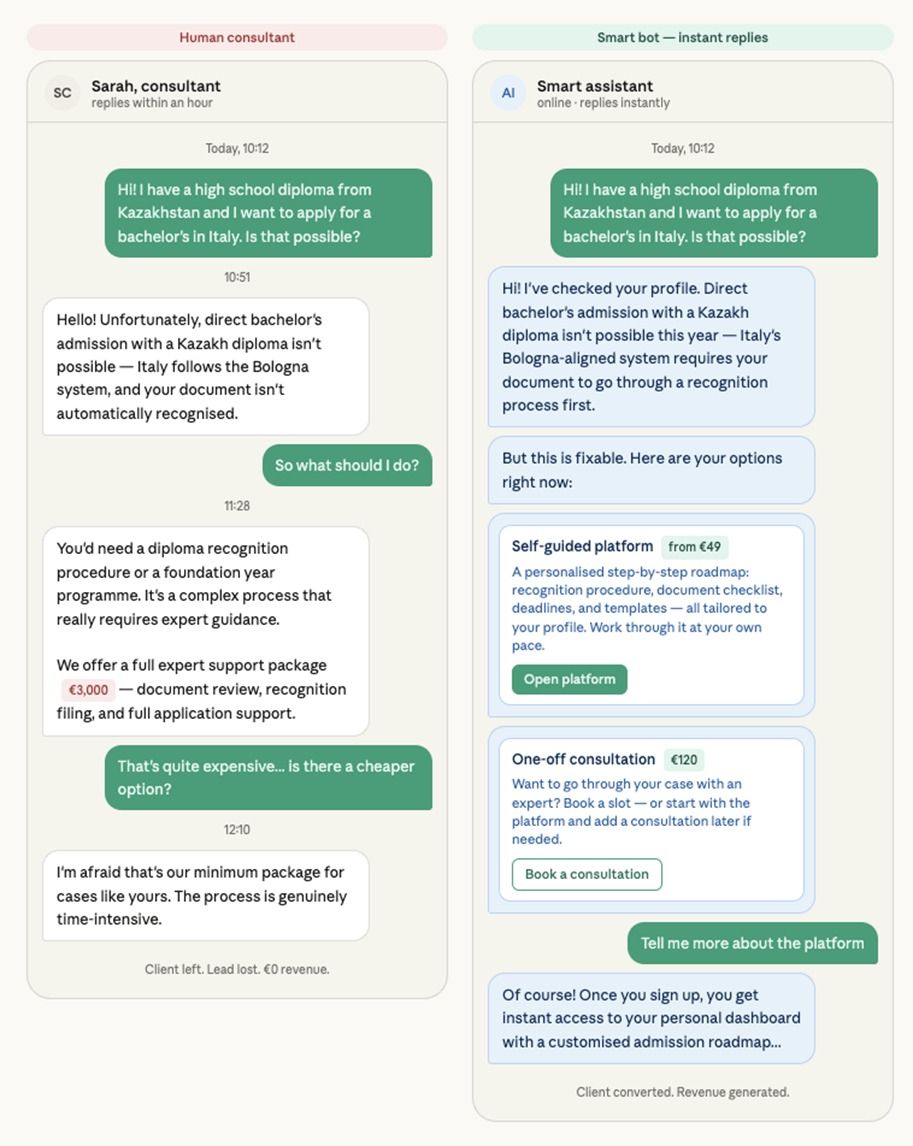
The product became the primary revenue driver. Consulting still exists – but it’s now premium. Prices nearly doubled because the offer differentiation justified it. Previously, a client considering our services chose between us and our competitors. Now the choice is between our digital product and our premium consulting.
What Actually Changes When You Go Product-Led
In a service-led culture: the sale comes before value delivery. “Free” feels devaluing. Staff meet KPIs and check boxes.
In a product-led culture: value comes before the sale. “Free” is a growth mechanism. There are fewer employees, but each has a greater impact.
The hardest part for traditional agencies is the fear of giving away expertise: “If we share information for free, nobody will buy from us.”
Product-led thinking flips this: “If we don’t give value early, nobody will buy from us at all.”
Today, information is already free – AI, forums, YouTube, Telegram. Clients don’t pay for information. They pay for structure, a clear path, navigation, and confidence. That’s exactly what your product must deliver.
Our model revealed something counterintuitive: many clients purchased the digital product plus a consultation – and never came back for the consult. User interviews showed the product had already solved their pain point. During the purchase, people crave emotional safety. During use, they want a rational solution. If your product genuinely works, the consultant becomes optional.
“No” Is an Expert Answer – And It Should Make You Money
Here’s something my years in consulting taught me that most agencies still get wrong.
In high-trust industries like Global Mobility, “no” is often the most valuable answer you can give. An expert “no” – delivered clearly, with reasoning – can save a client enormous time, money, and emotional energy. It builds more trust than a vague “maybe” ever could.
But most agencies give that “no” away for free.
A candidate doesn’t qualify for a visa today. The CRM marks the lead as cold. The consultant moves on. The agency earns nothing. The candidate disappears – confused, unserved, and likely to return to a competitor six months later with the same question.
That’s a revenue leak hiding in plain sight.
The framework: monetize the “no.”
“No” comes in three forms – and each one is a product opportunity:
“No, not yet” – the candidate doesn’t qualify today, but could in 12 months. Sell them a consultation or a product: here’s exactly what needs to change, and here’s a roadmap to get there. They leave with clarity and a next step. You earn revenue. The relationship continues.
“No, not this way” – this visa path is closed, but another one isn’t. Sell the alternative: a different category, a different country, a different strategy. An expert “no” in Global Mobility is almost always “yes, but differently” – and that reframe is worth paying for.
“No” from the algorithm – the lead didn’t qualify through the chatbot because the phrasing didn’t match the system’s parameters. The candidate had real intent and a real budget. The agency never found out. This is the most invisible revenue leak of all – and it lives in your funnel design, not your consulting quality.
The principle: if you’re going to tell someone “no,” sell them the explanation. Package the reasoning. Make it a product. Agencies that master this stop losing money at the top of the funnel – and start converting rejections into revenue.
Why 100% of Agencies Want to Go Product-Led – And Only a Few Will
In Global Mobility, nearly every agency says the same things:
- “We want to automate processes.”
- “We want to implement AI.”
- “We want to scale without growing the team.”
But most stall – not at the technology stage, but when they have to fundamentally rethink their logic. That’s usually when money or energy runs out.
You can’t build a product without repeatability. A product requires standardization. If your company handles every case as unique, relies on specific team members, and is ruled by team mood swings – you have nothing to package.
Look for where your team gets lazy. What documents do they copy-paste? What templates sit unused in your internal database? Where do people go when they’re short on time? Those are your first product opportunities.
For me, building a product only became feasible after the company had accumulated hundreds of nearly identical cases along specific pathways. But the first version came from my own knowledge base – documents and templates I’d been copy-pasting for years. Those “confidential” internal shortcuts became the core of a standardized, self-serve tool.
Turn your hidden shortcuts into scalable assets.
You also can’t transition while the service side is breaking. Many agencies suffered reputation damage in 2022–23 by rushing to build automated solutions – and losing real clients who were willing to pay for service, but didn’t want to wait for automation to catch up. One well-known example in our market: a company that faced a 500%+ increase in client flow, invested heavily in building a digital platform simultaneously, and ended up with a reputation backlog that still affects their sales today. The lesson: don’t sacrifice service quality to fund a product that isn’t ready yet.
Crisis as Catalyst – And Why Timing Matters
Our digital transformation began under COVID pressure. But from 2022 onward, the business faced an even greater challenge.
Our clients (and employees) were predominantly from Russia and Ukraine – approximately 75% of our base. Geopolitics reshaped everything overnight. Hundreds of thousands of people were suddenly navigating emigration, relocation, and education abroad under crisis conditions – often without access to physical offices, in-person advisors, or reliable information.
Without our digital ecosystem, we would not have been able to serve them. The platform I started building earlier – not knowing this crisis was coming – became the infrastructure that allowed us to grow exponentially while competitors collapsed under manual workload.
We didn’t lay off a single employee. We expanded the team. We maintained top-tier brand positioning and zero negative reviews – because the product handled scale, and the team handled quality.
The launch of our product ecosystem was a strategic decision. We could not fully anticipate how decisive it would become. But that’s the nature of building the right infrastructure before you need it.
Where to Introduce AI First
The most common mistake: companies want AI to interact with clients first. But in trust-based industries, clients choose you to avoid impersonal, automated interactions. If you disrupt this balance too early, growth stalls and trust breaks.
Start AI inside your operations – not in client-facing functions.
Ask yourself:
- Where does your team spend the most energy on repetitive tasks?
- Where does burnout actually come from?
- What gets copy-pasted instead of thought through?
In our case, the main internal pain points were: CRM and pipeline control, task management, deadline tracking, repetitive administrative tasks (document checklists, manually sent emails), and internal analytics.
AI in operations delivers reduced manual workload – and more importantly, reduced emotional burnout. A burned-out team member just closes the call and checks a box. An engaged team member brings client pain points, market insights, and product ideas.
A product-led company cannot run on an exhausted team.
Only once operations are stable should you think about client-facing AI. Even then – clients don’t trust AI because it’s efficient. They trust it when they see clear processes, transparent tracking, and structured systems. Trust transfers from person to system gradually, through experience.
AI is not a consultant replacement. It’s a way to package accumulated expertise into a scalable form.
Fully Product-Led in High-Trust Industries: It Already Exists
While high-stakes decisions like migration demand caution, fully product-led companies already thrive in this space.
Fragomen Connect offers a self-service portal where clients upload documents, get personalized task checklists, real-time status updates, and automated compliance checks. Xmobility.ai automates visa workflows with AI, cutting paperwork through eligibility assessments and document parsing. Deel Immigration provides end-to-end self-serve across 20 countries with automated reminders and real-time tracking.
None of these platforms emerged as pure tech companies from scratch. They evolved from traditional service businesses – law firms that digitized their consulting expertise, HR platforms that added immigration as a scalable layer, manual processes that became AI-driven workflows.
That evolution is the journey. Not a leap.
Service as Luxury, Product as the Scalable Standard
To turn a service agency into a product-led company, you don’t have to abandon service.
Service stops being the only revenue stream and becomes:
- A premium offering for complex, non-standard cases
- The “human layer” on top of a working system
- A product in itself – chosen consciously, priced accordingly
Go all-in on product only when: you have a large volume of repeatable cases, your processes are fully standardized, your brand is established, and the market is ready for self-serve solutions.
In all other cases, a sharp break from service is a strategic mistake. The product should earn the right to lead – by proving it can deliver, before the service model is dismantled.
The Takeaway
Product-led doesn’t mean ditching your people. It means ditching dependency on any one person.
The transition happens not when you “launch a digital product” – but when clients can genuinely choose between product and service, within one company, with no pressure either way.
The path there runs through several uncomfortable truths most service agencies avoid:
Your “no” is worth money. Every unmonetized rejection, every cold lead dismissed by an algorithm, every free expert answer given to someone not yet ready – that’s revenue left on the table.
Your internal shortcuts are your first product. The templates your team copy-pastes, the checklists that never made it into the CRM, the knowledge that lives only in one person’s head – that’s the raw material of a scalable digital product.
Free value is a growth mechanism, not a threat. Clients in 2024 don’t pay for information. They pay for structure, confidence, and a system they can trust.
Build the product. Standardize the expertise. Monetize the “no.”
And then watch service become what it was always meant to be: a premium choice, not a default dependency.
If you’re leading a service agency through this kind of transition – or thinking about it – I’d love to hear where you’re stuck. The hardest part is rarely the technology.