
Can Small Businesses Survive the City of Stuart’s $87 Million Brightline Development? Is your Property Safe?

Every city dreams of prosperity.
New investment. New jobs. New infrastructure. New life.
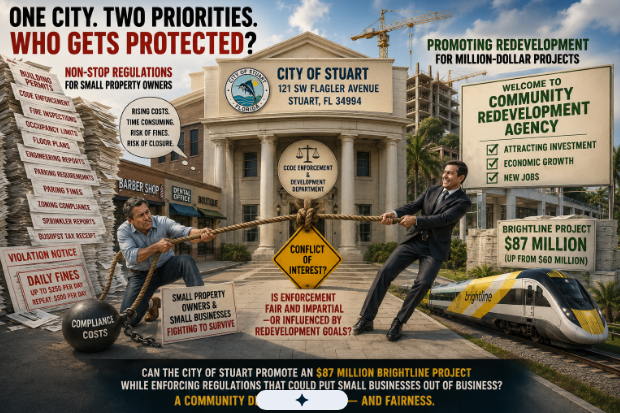
In Stuart, Florida, that vision is embodied by the proposed Brightline station and surrounding redevelopment. Public estimates for the project have grown from approximately $60 million to $87 million, reflecting the scale of the City’s ambitions. At the same time, the City’s Community Redevelopment Agency actively encourages private investment through programs such as the Real Estate Development Accelerator, which is available for qualifying redevelopment projects involving at least $1 million in capital investment.
None of that is unusual.
Cities around the world compete for investment.
The more important question is this:
Who protects the businesses that are already there?
I own a commercial office building within Stuart’s Community Redevelopment Area (CRA) that provides affordable space for nearly thirty small businesses. The tenants include healthcare providers, therapists, salons, professional service firms, women-owned businesses, minority-owned businesses, and other local entrepreneurs whose livelihoods depend on remaining open.
Since 2025, the property has been subject to a series of evolving code compliance requirements, including engineering reports, revised floor plans, occupancy calculations, parking modifications, tenant documentation, and Business Tax Receipt issues. The cumulative cost of these requirements has placed significant financial pressure on the property and the small businesses that operate there, raising broader questions about how redevelopment policies and regulatory enforcement affect existing businesses within the CRA.
The City states that these actions are intended to achieve code compliance. Whether those actions are appropriate is ultimately a matter for the law.
But another question deserves public discussion.
Should the same government that recruits million-dollar redevelopment projects also control the regulatory process that can determine whether existing businesses survive?
This is not a new dilemma.
In Los Angeles, the story of Chávez Ravine became one of the most recognized examples of redevelopment controversy. Families were displaced through a redevelopment process that ultimately gave way to the construction of Dodger Stadium. Decades later, the case remains a symbol of the tension between public development goals and the rights of existing communities.
In Kelo v. City of New London, one of the most controversial property-rights decisions in U.S. history, homes were taken for an economic development project that was expected to revitalize the area. Much of the planned redevelopment never materialized, and the case continues to influence debates about redevelopment, property rights, and public trust.
These examples do not prove that the City of Stuart has acted improperly.
They demonstrate something else:
When governments simultaneously promote redevelopment and regulate existing property owners, transparency, consistency, and public confidence become essential.
Around the world, cities increasingly recognize that successful redevelopment is not measured only by cranes, new buildings, or rising property values. It is also measured by whether the people and businesses that built the community have a meaningful opportunity to remain part of its future. Researchers now document anti-displacement strategies precisely because redevelopment can unintentionally burden existing businesses if safeguards are not in place.
It is a question every growing city should ask:
Can government be both the promoter of redevelopment and the regulator of existing businesses without creating the appearance of a conflict of interest?
The answer matters not only for Stuart, but for every community trying to balance growth with fairness.
Where Can Small Property Owners and Small Businesses Get Help?
If you believe your business has been harmed by excessive or inconsistent government regulation, you are not without options. Depending on the facts of your situation, the following organizations may be able to assist:
U.S. Department of Justice – Civil Rights Division
Florida Commission on Human Relations (FCHR)
Florida Attorney General
Questions Every Small Property Owner Should Ask
- Have I compared my treatment with similar properties?
- Has the City clearly identified the specific code section I allegedly violated?
- Have the requirements changed repeatedly during the compliance process?
- Have I documented every inspection, notice, email, and meeting?
- Have I consulted an attorney before making expensive compliance decisions?
Growth and redevelopment are important goals. But long-established small businesses are also part of a community’s economic fabric. Transparent, consistent, and impartial regulation is essential to maintaining public confidence that redevelopment benefits the entire community—not only future investment.
Share your story: [email protected]
Your information may help identify broader patterns affecting property owners and small businesses in Stuart. With your permission, your experience may also assist journalists, researchers, policymakers, or attorneys investigating redevelopment, code enforcement, or property-rights issues.






Comment