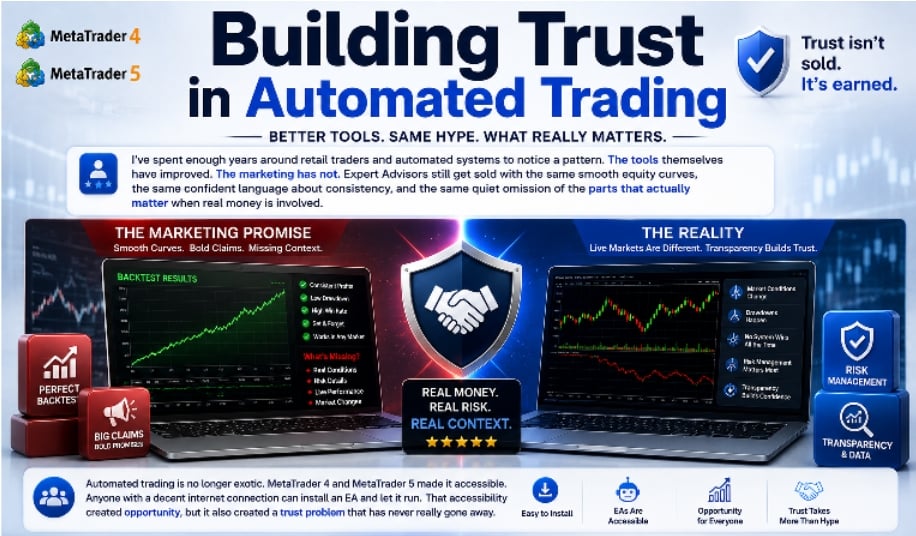
I’ve spent enough years around retail traders and automated systems to notice a pattern. The tools themselves have improved. The marketing has not. Expert Advisors still get sold with the same smooth equity curves, the same confident language about consistency, and the same quiet omission of the parts that actually matter when real money is involved.
Automated trading is no longer exotic. MetaTrader 4 and MetaTrader 5 made it accessible. Anyone with a decent internet connection can install an EA and let it run. That accessibility created opportunity, but it also created a trust problem that has never really gone away.
Where the trust breaks down
Most traders I speak with don’t object to automation itself. They object to the gap between what is promised and what shows up in a live account. A backtest that looks almost too clean. A win rate that seems detached from any real market noise. Drawdown figures that appear only in the fine print, if at all.
The issue is rarely that every system is fraudulent. Some are simply overfitted. Others worked in a particular volatility regime and then stopped. A few are decent but poorly explained. The common thread is that the buyer is left guessing. When information is incomplete, people fill the gaps with hope. That rarely ends well.
I’ve watched traders abandon automation altogether after one or two bad experiences. Not because the concept is flawed, but because they felt they had been sold a black box. Once that feeling sets in, it is hard to reverse.
What transparency actually looks like
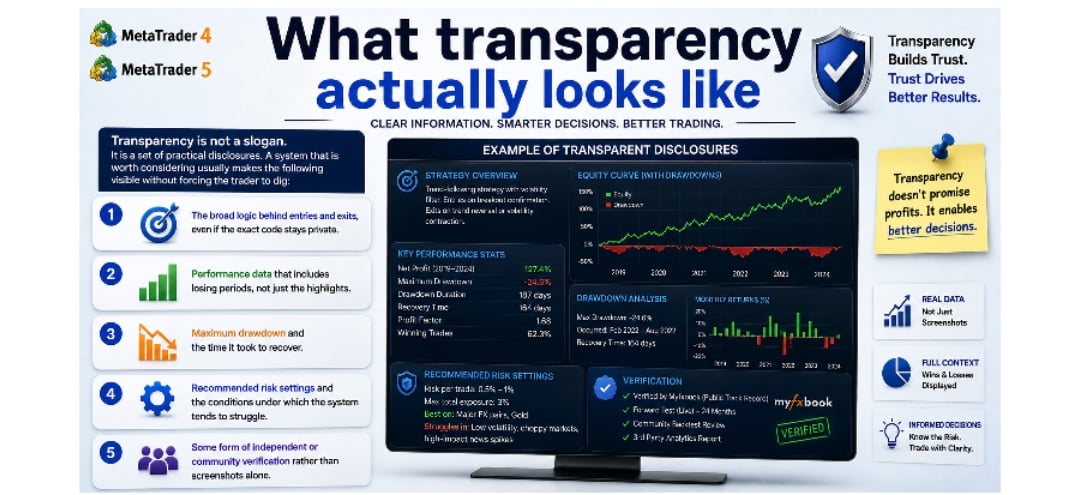
Transparency is not a slogan. It is a set of practical disclosures. A system that is worth considering usually makes the following visible without forcing the trader to dig:
- The broad logic behind entries and exits, even if the exact code stays private.
- Performance data that includes losing periods, not just the highlights.
- Maximum drawdown and the time it took to recover.
- Recommended risk settings and the conditions under which the system tends to struggle.
- Some form of independent or community verification rather than screenshots alone.
None of this guarantees future profits. Markets change. Strategies decay. What transparency does is give the trader enough information to decide whether the risk profile matches their own. That decision is impossible when the only material available is a sales page and a carefully chosen equity curve.
How platforms can raise the baseline
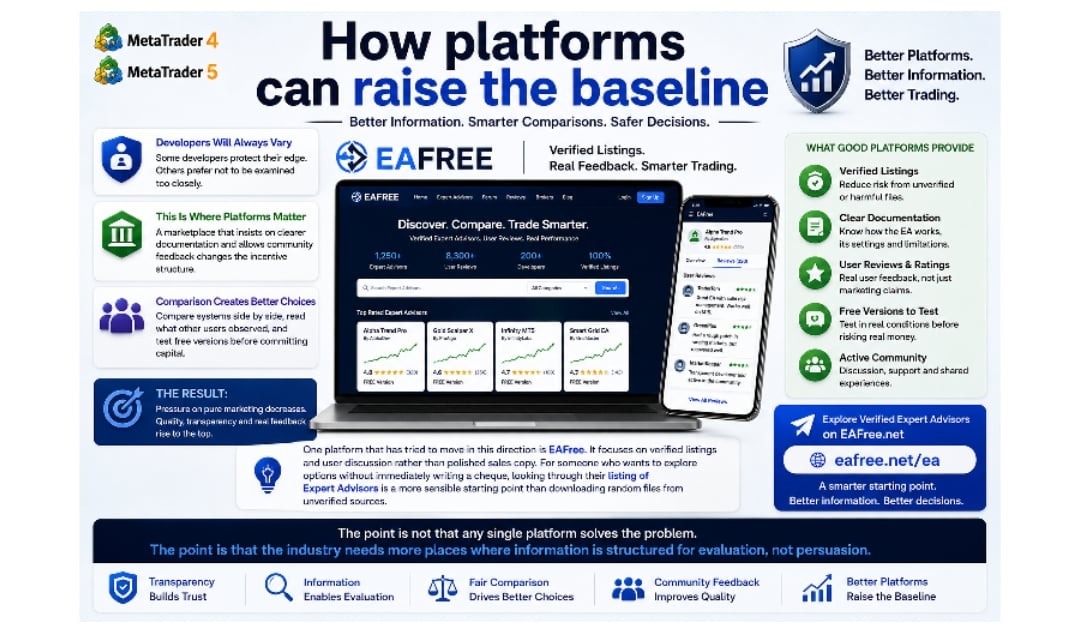
Individual developers will always vary in how much they choose to reveal. Some are genuinely protective of their edge. Others simply prefer not to be examined too closely. This is where platforms matter. A marketplace or listing site that insists on clearer documentation and allows community feedback changes the incentive structure.
When traders can compare systems side by side, read what other users observed, and test free versions before committing capital, the pressure on pure marketing decreases. One platform that has tried to move in this direction is EAFree. It focuses on verified listings and user discussion rather than polished sales copy. For someone who wants to explore options without immediately writing a cheque, looking through their listing of Expert Advisors is a more sensible starting point than downloading random files from unverified sources.
The point is not that any single platform solves the problem. The point is that the industry needs more places where information is structured for evaluation rather than persuasion.
The practical cost of opacity
Opaque systems create three predictable problems. First, traders take on more risk than they realise. Second, they keep systems running longer than they should because they lack clear benchmarks for when to stop. Third, the entire category of automated tools gets tarred by association. Good developers and careful users end up paying for the excesses of the rest.
I have seen this cycle repeat. A wave of new EAs appears with strong claims. A portion of users get burned. Trust drops. Then the conversation shifts to whether automation is even suitable for retail traders. The better question is whether the current standards of disclosure are suitable.
What a careful trader can do right now
Even in the current environment, there are practical steps that reduce the chance of unpleasant surprises:
Start with systems whose logic is at least partially explained. Complete black boxes leave you with no way to interpret sudden changes in behaviour.
Treat every backtest as a hypothesis, not evidence. Forward testing on a demo account under current spreads and latency remains one of the few reliable filters.
Pay attention to drawdown more than peak profit. A system that makes money but spends long periods deep in the red may not suit your psychology or account size.
Keep position sizes small until the system has been observed through different market conditions. Automation does not remove the need for gradual scaling.
Review results periodically. Markets shift. A strategy that worked last year may need adjustment or retirement this year. Leaving an EA completely unsupervised for months is rarely wise.
These habits sound basic. They are also the ones most often skipped when the marketing feels convincing.
A more durable path forward
Automated trading will keep evolving. The tools will become more sophisticated. Data sources will expand. Machine learning techniques will find their way into more retail products. None of that progress matters much if traders cannot tell the difference between a carefully built system and a well-packaged story.
Trust is built slowly. It comes from consistent disclosure, realistic performance reporting, and platforms that make comparison possible. Developers who treat transparency as part of the product tend to attract more durable users. Traders who insist on clearer information push the market in a healthier direction.
I do not believe every Expert Advisor needs to publish its full source code. Proprietary edges exist for a reason. What I do believe is that the current level of opacity in much of the retail space is unnecessary and counterproductive. Better information does not eliminate risk. It simply allows risk to be chosen rather than stumbled into.
For those who want to examine automated tools with fewer illusions, resources that emphasise verification and open feedback remain useful. Their approach to transparency is one example of an attempt to prioritise clarity over hype. The larger requirement is cultural: an expectation that claims should be accompanied by enough context to be evaluated.
Automated trading can be a practical tool. It becomes a reliable one only when the people using it are given the information they need to decide for themselves.