Introduction: The Hidden Dangers of Night Driving
Let’s be real for a second. How many times have you white-knuckled the steering wheel driving down a pitch-black country road? Or had your retinas scorched by some lifted truck’s LED light bar coming the opposite way? We’ve all been there. You squint, you slow down, but you’re still essentially driving on faith—faith that there isn’t a deer or a pedestrian in a dark hoodie just beyond the reach of your headlights.
If you’ve been Googling “Best thermal night vision camera for car” lately, you’re not looking for a gadget. You’re looking for peace of mind. You’re looking for that extra layer of safety that used to be reserved for S-Class Mercedes or Cadillacs. Today, we’re putting the Robofinity Car Thermal Night Vision AI System under the microscope. This isn’t just a dash cam; it’s a copilot that sees heat. Let’s find out if this is the Best thermal night vision camera for car safety in 2026.
Why Standard Headlights Fail (And Why Thermal Wins)
Before we dive into the specs, let’s address the elephant in the room: physics. Headlights, even the best LEDs, project light that reflects off objects back to your eyes. What happens when it’s foggy? The light scatters in the water droplets, creating a white wall. What happens in rain? Reflections on the wet pavement create massive glare.
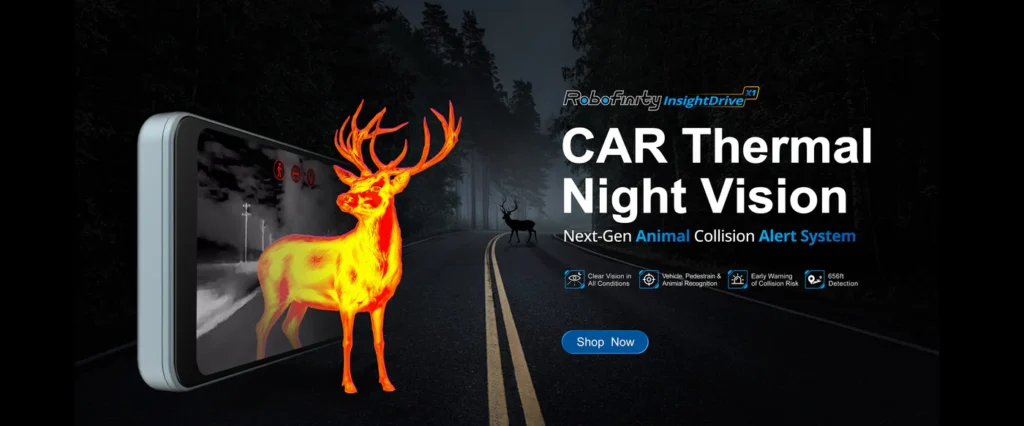
A Best thermal night vision camera for car bypasses this entirely. It operates in the 8~14um wavelength band. It doesn’t need light; it needs heat. The Robofinity system detects temperature differences as small as 50mK (that’s 0.05 degrees Celsius). A human body, a warm car engine, even a recently parked vehicle—they all glow like beacons on the 6.25-inch display, even when your headlights are showing you nothing but darkness.
Unboxing and Setup: Simple and Discreet
The Robofinity kit comes with everything you need for a clean install. The camera itself is a marvel of miniaturization—just 55.3mm wide. It’s shockingly small. You can tuck it behind your rearview mirror or mount it flush in the grille.
Installation:
It’s a standalone system. Power is via the 12V cigarette lighter socket. No splicing wires, no reprogramming your car’s computer. It’s literally plug-and-play.
Durability:
With an IP67 rating and a high-strength protective window, you don’t have to baby it. This camera is built to take a beating from road salt, gravel, and pressure washers.
Field Test: Is This Truly the Best Thermal Night Vision Camera for Car Owners?
I tested this unit over two weeks in a mix of suburban gloom and pitch-black rural highways. Here’s the unfiltered truth.
1. Detection Range: The 656ft (200m) Promise
The marketing claims a 200m detection range. In my testing on a dead-straight stretch of highway at midnight, I spotted the heat signature of a coyote on the shoulder long before my high beams even illuminated the road that far. The system provided a visual alert roughly 3-5 seconds before any visual contact was possible. At 65 mph, that’s a football field of extra stopping distance. If you’re searching for the Best thermal night vision camera for car to avoid animal collisions, this range is the gold standard.
2. AI Recognition: The Brain Behind the Sight
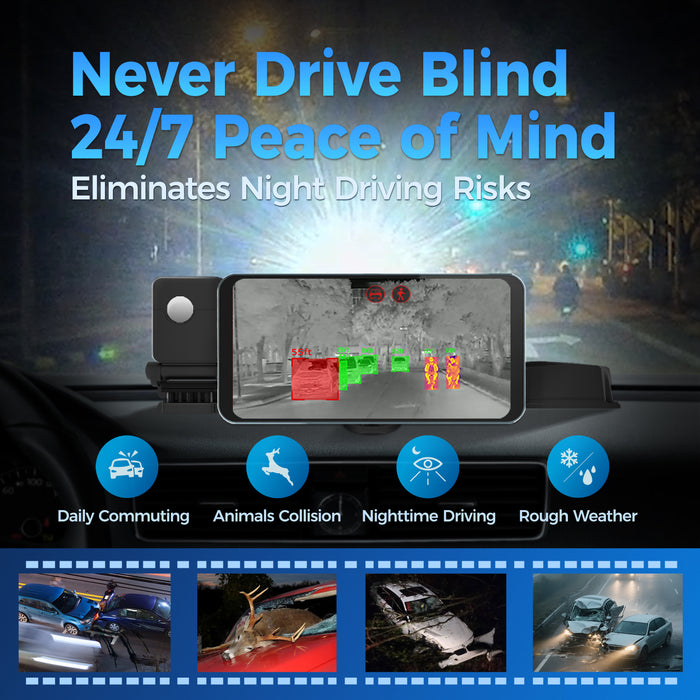
Here’s where Robofinity separates itself from generic thermal camera setups. It has a 2 TOPS AI chip onboard. It’s not just showing you a blobby heatmap. It’s actively thinking:
- Color Box: Pedestrian or Animal detected.
- Red Box: Vehicle detected.
The Instant Alert feature is no joke. During a right turn in the city, a cyclist with no lights came flying up the inside lane. The screen flashed red and beeped before they entered my mirror blind spot. This is the kind of proactive safety that makes a Best thermal night vision camera for car a necessity rather than a luxury.
3. Weather Performance: Fog, Rain, and Glare
This is the true test of any Best thermal night vision camera for car. We had a night with dense fog advisory—visibility down to maybe 60 feet. I flipped on the Robofinity screen. The fog didn’t exist in the thermal image. The taillights of the car 150 feet ahead were faint in reality, but its exhaust system glowed clear as day on the screen.
Also, high-beam glare from oncoming traffic is completely negated. Since thermal cameras don’t read visible light, you can stare at the screen while an oncoming truck blasts you with LEDs, and you’ll still see the road edges and any potential hazards near the shoulder.
Deep Dive: Technical Specifications That Matter
If you’re trying to compare specs to find the Best thermal night vision camera for car, don’t just look at “thermal resolution.” Here’s what you need to scrutinize based on the Robofinity build:
Frame Rate (25Hz):
This is critical. Many industrial thermal cameras run at 9Hz. In a moving car, 9Hz looks like a laggy PowerPoint presentation. 25Hz is real-time video. You need this smoothness to accurately judge the trajectory of a moving pedestrian.
AI Super Resolution (1024×768):
The native sensor might be 384×512, but the onboard AI upscales the output to a much cleaner 1024×768 on a crisp 1560720 screen. This makes identifying objects at the edge of the detection range far easier.
Field of View (40°):
This is a smart design choice. It’s a sweet spot. Wider lenses (like 60°) reduce effective detection range. 40° gives you a focused, long-range view that matches the stopping distance concerns of highway driving.
Buying Guide: How to Spot the Real Best Thermal Night Vision Camera for Car
Don’t get duped by cheap knockoffs. If you want the real Best thermal night vision camera for car, look for these three non-negotiables:
High Frame Rate (≥25Hz):
If the spec sheet doesn’t say 25Hz or 30Hz, it’s useless for driving.
Onboard AI with Alerts:
A raw thermal image is tiring to interpret. You will get fatigue. You need the AI boxes and audio alerts.
Lens Protection:
A bare germanium lens is soft and expensive. If the camera doesn’t have a replaceable or robust protective window (like the high-strength glass on the Robofinity), a single highway pebble will end your investment.
Verdict: Is Robofinity the One?
After weeks of testing, I can confidently say that when I type “Best thermal night vision camera for car” into a search engine, the Robofinity system represents exactly what I expect that search result to look like.
It’s not the cheapest option on the market, but it’s the most complete. It combines military-grade detection range with consumer-friendly AI alerts and a ruggedized, weatherproof build. It bridges the gap between expensive factory options and inadequate dashcams.
If you value arriving alive over saving a few hundred bucks, this is the upgrade you didn’t know you absolutely needed. It turns every dark road from a nerve-wracking guessing game into a predictable, manageable drive. This is, without a doubt, the benchmark for the Best thermal night vision camera for car category in 2026.
FAQs about the Best Thermal Night Vision Camera for Car
Q: Will this replace my regular dash cam?
A: No, and it shouldn’t. This is a safety detection system. It records thermal video, but it doesn’t read license plates in the dark (it reads heat, not text). You should use it alongside a standard visible-light dash cam for evidence and plate capture.
Q: Does it work through windshield glass?
A: No. Glass blocks the specific infrared spectrum (8-14um) that thermal cameras need to see. The Robofinity camera must be mounted outside the vehicle cabin (e.g., in the grille) or behind a specific germanium window. This is why the IP67 rating and protective lens are so important.
Q: Is the 6.25-inch screen distracting?
A: I found it less distracting than looking into the pitch-black void. You use it like a rearview mirror—a quick glance to verify the path ahead is clear. The audio alerts ensure you don’t have to stare at it constantly.