
How Snapchat Monetization Is Changing Social Media in 2026

Social media built its entire empire on one thing. Advertising. Show ads, collect money, repeat.
That model worked for years. Then it started cracking.
Snapchat saw the problem early. It quietly built something different. Today that decision is paying off in ways that are forcing every major platform to rethink how they make money.
Snapchat now reaches 946 million monthly active users globally. Beyond its core advertising business, the platform has built a subscription ecosystem that generates features like Snapchat planets and a FriendSolar System that ranks your closest connections visually. These engagement tools are not just fun extras. They are part of a larger revenue strategy that is reshaping what social media businesses look like.
When users explore Snapchat more deeply, they often notice smaller details that pull them back in. For example, many wonder what does the purple circle mean on Snapchat when they see it next to a friend’s name. It signals new story content, and it is one of many small design decisions Snapchat uses to increase daily engagement. More engagement means more subscription value. More subscription value means more predictable revenue.
That connection between product features and business model is exactly what makes Snapchat’s approach worth studying.
Why the Old Advertising Model Stopped Working
Digital advertising is not reliable income. It moves with the economy.
When brands cut budgets, platforms suffer. Snap felt this directly. Advertising accounted for over 90% of its total revenue for years. One slow quarter from large advertisers could damage the entire business.
Meta faces the same problem. So does YouTube. The entire industry built itself on a foundation that wobbles when economic conditions shift.
Snapchat decided it needed a second engine.
Snapchat+ Became That Second Engine
Snapchat launched its premium subscription in 2022. It costs $3.99 per month.
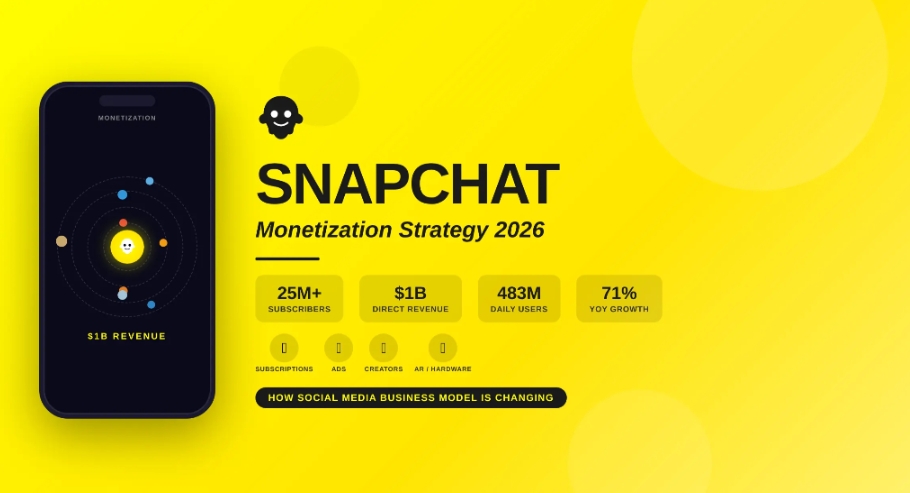
In February 2026, Snap announced something significant. Its direct revenue business crossed the $1 billion annualized revenue run rate. Snapchat+ subscriptions crossed 25 million users. Subscriber growth happened every single quarter since launch.
That is not luck. That is product strategy working.
Snapchat+ grew 71% year over year in its most recent reporting period. It is now considered one of the fastest-growing consumer subscription services globally. Even Meta noticed and began testing paid subscription tiers across Instagram and Facebook.
What Does Snapchat Subscription Actually Offer?
This is where most analysis stops too early.
Snapchat+ is not just an ad-free experience. That is the easy answer competitors copy. Snapchat built something more personal.
Subscribers get early access to new features before they go public. They get custom app icons, chat backgrounds, and Bitmoji pets inside conversations. They see who rewatched their stories. They access exclusive AI-powered lenses through Lens+.
These features sound small. But they are designed to deepen the daily experience. When your phone shows your spouse’s photo as your chat wallpaper, or your family pet appears next to your Bitmoji in a conversation, the app feels personal in a way that standard social media does not.
That emotional connection is what drives retention. And retention is what drives subscription revenue.
Is Snapchat Profitable in 2026?
Snap posted a $45.21 million quarterly profit in Q4 of its most recent results. That marked a meaningful shift for a company that previously posted consistent losses. Q1 2026 revenue reached $1.53 billion, up 12% year over year. Net loss reduced to $89 million while operating cash flow improved significantly.
Profitability remains a work in progress. But the direction changed.
Creator Subscriptions Opened a Third Revenue Lane
Snap introduced Creator Subscriptions in February 2026. This is a separate product from Snapchat+.
Creators set their own subscription price between $4.99 and $19.99 per month. After platform fees, creators receive approximately 60% of all subscription revenue. Snap takes the rest.
This matters for the business model because it creates a revenue share system. Snap earns from creator subscriptions without producing any content itself. Creators like David Dobrik and Catherine Paiz joined early testing phases.
The creator subscription model mirrors what Patreon and Substack built. Snapchat is bringing that model inside a social app used daily by nearly 500 million people.
How Much Does Snapchat+ Cost?
Snapchat+ costs $3.99 per month in the United States. Some markets have different pricing. The subscription renews monthly and can be cancelled anytime through account settings. Snap has also introduced Snapchat Platinum and Memories Storage Plans as additional paid tiers beyond the core subscription.
Advertising Did Not Die It Got Smarter
Subscriptions get the attention. But advertising still drives the majority of Snapchat’s revenue.
The difference now is how advertising works. Nearly 70% of all ad spend on Snapchat runs through at least one AI-powered automation feature. Smart Audience, Smart Budget, and Smart Placement tools allow advertisers to optimize campaigns without manual management.
Dynamic Product Ads grew over 30% year over year. These ads generate themselves from a business’s product catalog and automatically target relevant users. Small and medium businesses drove significant growth in this category.
Sponsored Snaps placed inside Chat conversations produced a 226% higher click-through rate compared to standard ad placements. That number is significant. It means conversational advertising outperforms traditional feed-based ads by a wide margin.
Snapchat is betting that private conversations will become the next major advertising surface. Not feed. Not stories. Conversations.
Can Creators Actually Make Money on Snapchat?
Yes. Snapchat offers multiple earning paths.
The Monetization Program places ads inside eligible public Stories and Spotlight videos. Revenue is shared based on views, watch time, and engagement. Spotlight videos must be at least one minute long to qualify.
Creator Subscriptions allow direct fan support. Brand partnerships are available through Snapchat’s creator discovery tools. Affiliate marketing through Snapchat links is also common among established creators.
Creators who post consistently to Stories and Spotlight and maintain 100 hours of Spotlight view time over 28 days qualify for maximum Creator Rewards.
Augmented Reality Is Now a Business Platform
Snapchat processes over 6 billion Snaps daily. More than 250 million users engage with AR features every single day.
That scale makes AR commercially valuable beyond entertainment.
Brands like Nike, Disney, and Coca-Cola use Snapchat AR lenses as campaign tools. Some of these lenses have exceeded 1 billion views during active campaign periods. Companies pay premium rates for this type of branded AR experience.
Snapchat also licenses its AR technology through the Camera Kit SDK. Over 300 companies including Poshmark and Zenni Optical have integrated Snapchat AR into their own apps. This creates a B2B revenue stream that exists entirely outside the consumer app.
Snap’s Spectacles AR glasses are planned for consumer launch in 2026. They represent a hardware revenue category that did not exist before.
Is Snapchat Growing or Declining?
Snapchat added 9 million daily active users in Q1 2026, reaching 483 million. Monthly active users touched 956 million globally. India is now Snapchat’s largest single market with 214 million users.
User growth slowed in some Western markets due to competition from TikTok and Instagram Reels. However, emerging markets are expanding the user base consistently each quarter.
Snap’s CEO Evan Spiegel identified subscriber growth as a critical input metric going forward. The platform is no longer measured only by daily active user counts.
How This Is Changing the Broader Social Media Industry
Every major platform is watching what Snapchat built.
Meta announced subscription testing across Instagram, Facebook, and WhatsApp shortly after Snapchat’s revenue milestone. TikTok has experimented with creator subscription tools in select markets. YouTube has offered channel memberships for years but is now expanding monetization options.
Snapchat did not invent the subscription model. But it proved that a social media app built primarily around messaging and disappearing content can convert engaged users into paying subscribers at scale.
That proof matters. It changes how every platform thinks about product development, feature gating, and revenue diversification.
What This Means for Brands and Marketers
Snapchat’s subscriber base represents a high-value advertising audience.
Users who pay $3.99 per month for an app are more invested in it. They open it more often. They engage more deeply. Advertisers targeting Snapchat+ subscribers are reaching users with demonstrated platform commitment.
Snapchat’s minimum daily ad spend starts at just $5. The average cost per link click ranges from $0.90 to $1.02. CPMs range from $4 to $10 depending on targeting and format. These rates are accessible to small businesses, not just enterprise advertisers.
North America generates 60% of Snapchat’s total advertising revenue. The average revenue per user in North America is approximately $8 per quarter. That makes the North American Snapchat user among the most monetizable audiences on any social platform.
Why Snapchat’s Model Is Worth Studying
Most social platforms built one revenue model and defended it.
Snapchat built advertising first, then added subscriptions, then added creator monetization, then added AR licensing, and is now entering hardware. Each layer reinforces the others.
Subscribers engage more, which makes advertising more valuable. Creators attract subscribers, which grows the subscriber base. AR features retain users, which keeps both pools growing.
This is not a single business model. It is a monetization ecosystem. And it is the direction the entire social media industry is moving.
Frequently Asked Questions
Why Did Snapchat Start Charging for Features?
Snap needed stable revenue that did not depend on advertising cycles. Subscriptions provide predictable monthly income. They also give Snapchat a reason to keep building features that justify the ongoing cost, which improves the product for all users.
How Does Snapchat Make Money Without Ads?
Through Snapchat+ subscriptions, Lens+ subscriptions, Memories Storage Plans, Snapchat Platinum, Creator Subscription fees, Camera Kit SDK licensing, and AR commerce partnerships. These non-advertising revenue streams grew 87% year over year in Q1 2026.
Is Snapchat a Good Platform for Small Business Advertising?
Yes. Minimum daily spend is $5. CPMs range from $4 to $10. Dynamic Product Ads automate campaign creation from product catalogs. Snapchat reaches 90% of 13 to 24 year olds in key markets, making it effective for brands targeting younger consumers.
How Is Snapchat Different From Other Social Media Subscriptions?
Most platform subscriptions remove ads or add verification badges. Snapchat focuses on personalization, friendship features, early access, and AI-powered creative tools. This approach is closer to how apps like Spotify and Duolingo structure their premium tiers, rewarding engagement rather than just removing friction.
Final Word
Snapchat started as an app for disappearing photos. It became something more complex.
The platform now operates multiple revenue streams simultaneously. Subscriptions, advertising, creator monetization, AR licensing, and hardware are all part of the same business. Each one supports the others.
The $1 billion direct revenue milestone in February 2026 is not just a number. It signals that social media users will pay for features they genuinely value. And it signals that platforms building subscription ecosystems will be more resilient than those relying on advertising alone.
Every major platform is studying what Snapchat built. That alone tells you how significant this shift actually is.





Comment