Cloud computing in 2026 looks nothing like it did three years ago. Generative AI workloads have flooded enterprise infrastructure teams. Multi-cloud strategies have become the default, not the exception. And somewhere in that shift, AWS quietly became the backbone of over half the internet’s workload—a position reinforced by Synergy Research Group’s 2025 cloud market share data—not by coincidence but by design.
Yet despite AWS’s dominance, the gap between organizations that want certified cloud professionals and the actual number available keeps widening. Hiring managers are not struggling to find people who have heard of AWS. They are struggling to find people who can prove, on paper and in practice, that they know how to architect, automate, and secure production-grade systems on it.
That is where AWS certifications enter the picture—not as career decoration, but as a concrete signal in a market that has grown too noisy to trust self-reported skills alone.
This article breaks down the AWS certification landscape in 2026, which credentials carry the most weight, what has actually changed in the exam structure, and how serverless architecture is reshaping what hiring teams expect candidates to know.
Why 2026 Is a Different Market for Cloud Professionals
The post-pandemic cloud migration wave has largely played out. Most enterprises have already moved workloads to the cloud. The question they face now is not “should we migrate?”—it is “how do we run this efficiently, securely, and at scale?”
That shift in question changes what skills employers value. In 2021 and 2022, companies needed people who could move things to the cloud. In 2026, they need people who can optimize, govern, and innovate on top of cloud infrastructure that already exists. That is a more technical, more nuanced requirement — and it means certifications that once seemed like entry-level credentials now carry a much higher bar of practical expectation behind them.
Three specific trends define the 2026 AWS hiring landscape:
Serverless-first architecture is now standard. Functions-as-a-service, event-driven pipelines, and serverless frameworks are no longer advanced topics—they appear in junior-level job descriptions. This raises the baseline of what any AWS professional is expected to know.
Security is no longer a specialty—it is a shared responsibility. Organizations that suffered cloud security incidents in 2024 and 2025 have restructured their hiring to require baseline security fluency from every cloud role, not just dedicated security engineers.
Automation is the price of entry. Manual provisioning and configuration are largely considered signs of an outdated workflow. Infrastructure-as-code, CI/CD pipelines, and automated compliance checks are now table stakes in most enterprise cloud teams.
Each of these trends maps directly onto specific AWS certifications—and understanding that connection is how you choose the right one.
The AWS Certification Tier Structure: What Actually Matters in Practice
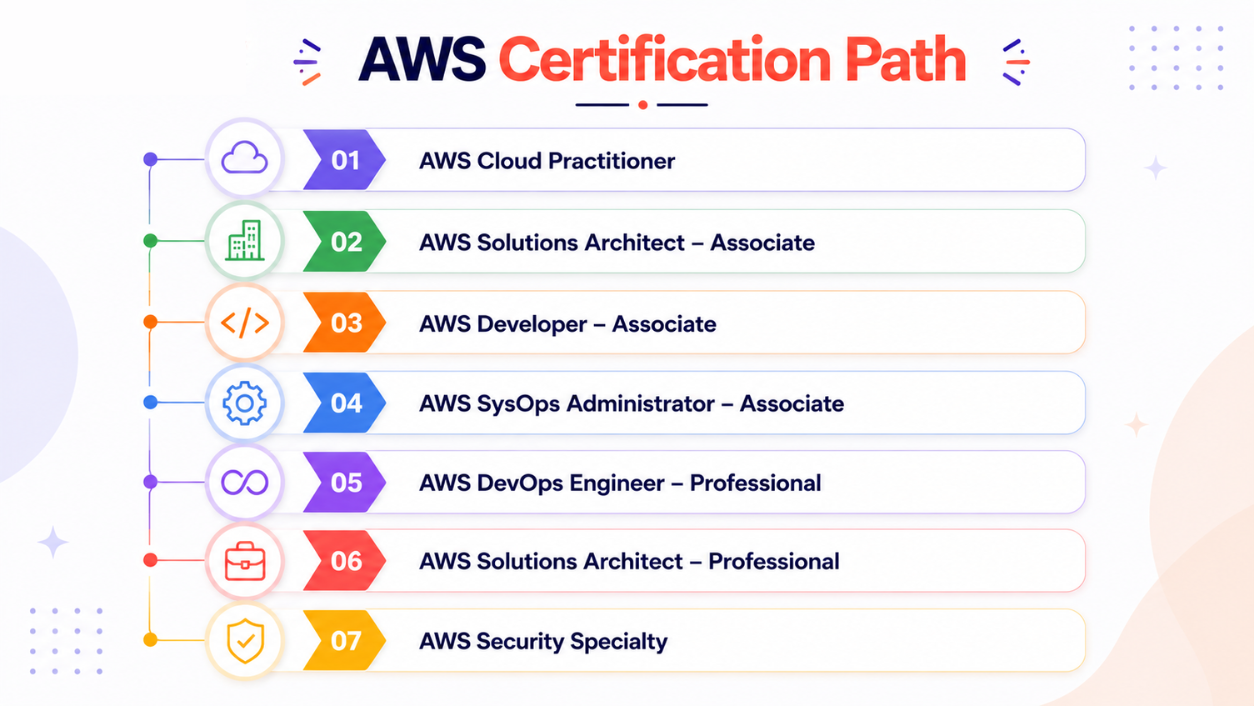
AWS organizes its certifications into four tiers. On paper, they represent progression. In practice, they represent different types of professional roles — and not every tier makes sense for every career path. The Foundational tier is useful for non-technical stakeholders—project managers, sales engineers, or business analysts who work alongside cloud teams. It rarely carries weight in technical hiring decisions on its own.
The Associate tier is where most engineers should start. The Solutions Architect Associate remains the most recognized credential across the widest range of roles. The Professional and Specialty tiers demonstrate depth, which matters more for senior and leadership positions.
AWS Solutions Architect Certification: Still the Most Versatile Credential
The AWS Solutions Architect – Associate remains the most commonly requested certification in cloud job postings, and that has held true through 2025 and into 2026. The reason is straightforward — it tests a candidate’s ability to make real architectural decisions, not just recall definitions.
The current SAA-C03 version of the exam evaluates four domains:
Secure Architecture Design covers IAM policy construction, VPC segmentation, encryption at rest and in transit, and least-privilege access patterns. Candidates are expected to reason through trade-offs, not just identify services.
Resilient Architecture Design focuses on fault tolerance, disaster recovery strategies, multi-AZ and multi-region setups, and backup architecture. The 2024 update to the exam increased the weight of this domain, reflecting how expensive downtime has become.
| Certification | Tier | Best Suited For |
| AWS Cloud Practitioner | Foundational | Non-technical roles, career switchers |
| AWS Solutions Architect – Associate | Associate | Aspiring architects, generalist engineers |
| AWS Developer – Associate | Associate | Software developers moving into cloud |
| AWS SysOps Administrator – Associate | Associate | System and operations administrators |
| AWS DevOps Engineer – Professional | Professional | Engineers with 2+ years AWS hands-on experience |
| AWS Solutions Architect – Professional | Professional | Senior architects, enterprise roles |
| AWS Security Specialty | Specialty | Security-focused cloud engineers |
High-Performance Architecture tests service selection for throughput, latency optimization, caching strategies (ElastiCache, CloudFront), and database choice across RDS, Aurora, DynamoDB, and Redshift.
Cost-Optimized Architecture covers Reserved Instances, Savings Plans, Spot Instance strategy, and architectural decisions that reduce unnecessary compute spend.
What separates candidates who pass from those who struggle is not memorization — it is scenario reasoning. The exam presents real-world situations and asks which combination of services and configurations produces the best outcome. That requires actual hands-on familiarity, not just theoretical knowledge.
The SAA-C03 has a reputation for being challenging enough to mean something but accessible enough that engineers with genuine AWS exposure can pass it with focused preparation.
AWS DevOps Certification: The Credential That Reflects How Teams Actually Work
The AWS DevOps Engineer – Professional certification sits at a different point in the career arc. It is not a starting credential — it is a validation of operational maturity.
What makes this certification significant in 2026 is that it directly maps to how modern engineering teams are structured. The line between development and operations has blurred almost entirely in cloud-native organizations. Engineers are expected to own their deployment pipelines, write infrastructure code, monitor their own services, and respond to incidents. The DOP-C01 exam covers exactly that workflow.
The six domains tested include:
- SDLC Automation — Building and managing CI/CD pipelines using CodePipeline, CodeBuild, and CodeDeploy
- Configuration Management and IaC — CloudFormation, Systems Manager, OpsWorks
- Monitoring and Observability — CloudWatch dashboards, X-Ray tracing, CloudTrail audit logs
- Policies and Standards Automation — AWS Config rules, Security Hub, automated compliance
- Incident and Event Response — Auto-scaling triggers, runbook automation, Systems Manager automation
- High Availability and DR — Multi-region failover, RTO/RPO design, chaos engineering principles
The AWS Certified DevOps Engineer is a Professional-level exam, which means AWS expects candidates to bring real-world experience to the test. Engineers who attempt it without prior Associate-level certification or genuine hands-on AWS work tend to find the scenario complexity difficult to navigate.
That said, for engineers who are ready, this credential is one of the clearest differentiators available. It is not easy to fake preparation for a Professional-tier exam—and hiring managers know that.
AWS Lambda in 2026: Why Serverless Knowledge Is No Longer Optional

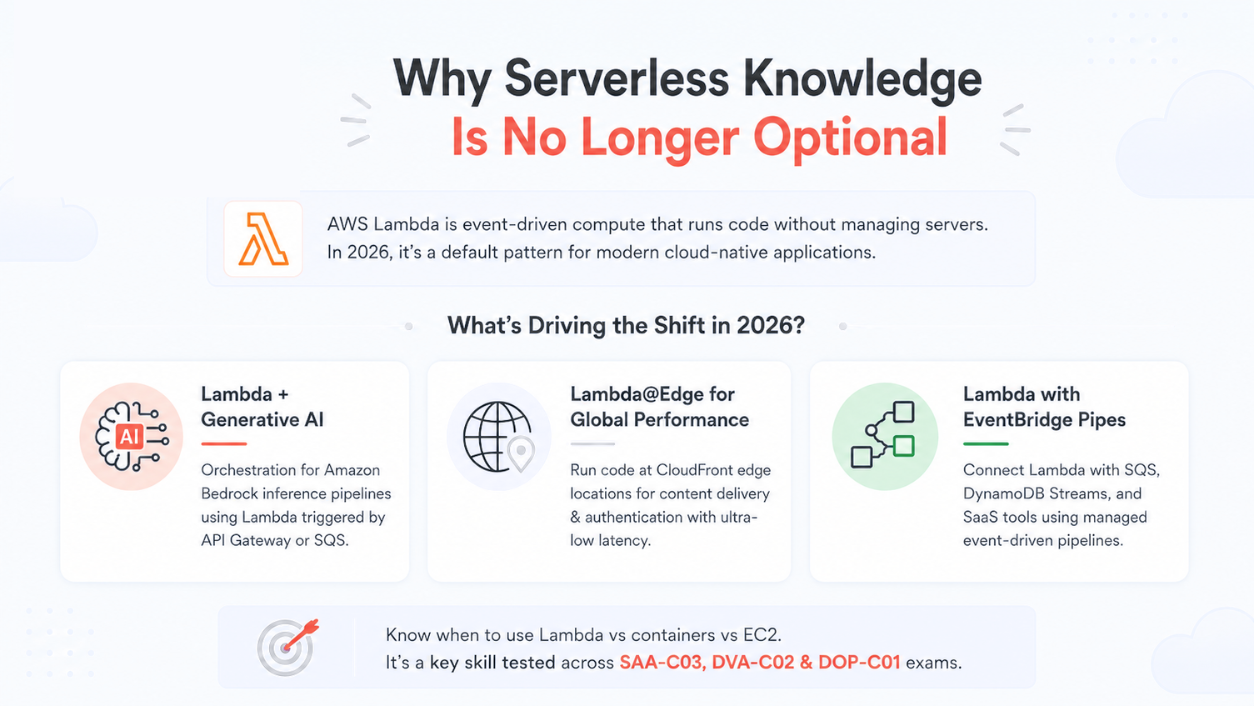
Three years ago, serverless was a forward-looking architectural choice. In 2026, it is a default pattern across a wide range of production workloads. Understanding AWS Lambda is no longer a nice-to-have for cloud professionals — it is the minimum required to work on modern cloud-native applications.
Lambda is AWS’s event-driven compute service. It executes code in response to triggers without requiring any server management. The operational model is radically different from traditional EC2-based architectures—there is no instance to patch, no capacity to provision, and no idle compute to pay for.
What has changed in 2026 is the scale and sophistication of how Lambda is being used:
Lambda and generative AI workloads—Organizations running inference pipelines on Amazon Bedrock increasingly route orchestration logic through Lambda functions. Lightweight, stateless compute that triggers on API Gateway requests or SQS messages is a natural fit for AI-driven microservices.
Lambda@Edge for latency-sensitive applications — Running code at CloudFront edge locations allows teams to customize content delivery and authentication without adding round-trip latency back to a central region. This pattern has accelerated as global user bases became the norm rather than the exception.
Lambda with EventBridge Pipes — The 2023 introduction of EventBridge Pipes matured significantly by 2025, allowing engineers to build sophisticated event-driven architectures connecting Lambda, SQS, DynamoDB Streams, and third-party SaaS tools with minimal custom glue code.
For certification candidates, Lambda appears across multiple exams—SAA-C03, DVA-C02, and DOP-C01 all test serverless patterns in different contexts. Understanding not just what Lambda does, but when to use it versus a container-based approach versus EC2, is where exam questions actually live.
What Hiring Managers Look for Beyond the Certificate
A credential opens the door. What happens in the interview determines whether you walk through it.
Several patterns emerge when looking at what cloud engineering hiring managers across the US prioritize in 2026:
Scenario-based reasoning over service recall. No one in an interview will ask you to recite what S3 is. They will describe an architecture problem and ask how you would solve it. Certification candidates who studied through hands-on labs consistently perform better in these conversations than those who studied through reading alone.
Cost awareness as a professional competency. Cloud bills at enterprise scale are a board-level concern. Engineers who can speak to right-sizing decisions, Reserved Instance strategy, and architectural choices that reduce spend stand out significantly from those who treat cost as someone else’s problem.
Security as a default mindset, not a checklist. The expectation in 2026 is that every architect and DevOps engineer builds with the AWS shared responsibility model in mind — not as a compliance exercise, but as a natural part of design thinking.
Demonstrated experience with automation. Being able to write a CloudFormation template or a Terraform module matters. Being able to articulate why infrastructure-as-code reduces drift, enables rollback, and supports audit trails matters even more.
Choosing Your Certification Path: A Practical Framework
The biggest mistake candidates make is choosing a certification based on which one sounds most impressive rather than which one aligns with their current skills and target role.
Here is an honest framework for making that decision:
If you work in software development and want to expand into cloud architecture, the Solutions Architect Associate is the right starting point. It builds the system-design vocabulary that translates directly into senior engineering conversations.
If you are already managing AWS infrastructure and want to formalize your deployment and automation expertise, the DevOps Engineer Professional is where the investment pays off most clearly. It is a harder exam, but it addresses a more specific and high-demand skill set.
If you are newer to cloud and need a foundational credential to anchor further learning, the Cloud Practitioner establishes the vocabulary but should not be treated as a career-level achievement on its own. Pair it with a plan to reach Associate level within six to twelve months.
If you want to specialize, Security Specialty and Database Specialty are the most consistently requested niche credentials. They reward depth over breadth and are best pursued after earning at least one Associate certification.
Preparation Principles That Hold Up in Practice
Exam preparation strategies vary widely in quality. These four principles consistently separate candidates who pass from those who sit the exam underprepared:
Build something real. The AWS Free Tier gives access to most core services at no cost. Building a three-tier application, configuring IAM policies from scratch, and setting up a basic CI/CD pipeline teaches more per hour than reading documentation. Hands-on contact with real services changes how questions read.
Understand the “why” behind wrong answers. Practice exams are most valuable when you treat wrong answers as the actual lesson. Each incorrect choice represents a gap in architectural reasoning, not just a gap in knowledge. Reviewing why each distractor is wrong builds the same mental model the exam is actually testing.
Map services to use cases, not just definitions. The exam rarely tests whether you know what a service is. It tests whether you know when to use it over competing options. Building a personal reference — even a simple spreadsheet — of services grouped by the problem they solve is more useful than any flashcard deck.
Simulate exam conditions early. Time pressure is a real factor in AWS exams, especially at the Professional level. Taking timed mock exams from the start of preparation, not just at the end, builds the pacing habits that prevent running out of time on test day.
Final Assessment: What the Certification Landscape Signals About Where Cloud Is Heading
The more useful question is not which certification to earn—it is what the current demand for these certifications reveals about where enterprise cloud work is actually going.
AWS is quietly pushing its ecosystem toward abstraction. More managed services, more serverless defaults, more AI-assisted infrastructure tooling. The practical implication is that future cloud roles will require less low-level infrastructure management and more architectural judgment — knowing which abstraction layer to use, where it breaks down, and how to design around its limits. That is precisely the skill set the Solutions Architect exam is built to test, which is one reason it has held its value longer than most credentials in a field that moves this fast.
At the same time, the DevOps Engineer certification is evolving in response to platform engineering becoming its own discipline. Organizations are building internal developer platforms on top of AWS — standardized environments that abstract cloud complexity away from application teams. The engineers who design and govern those platforms need exactly the automation, governance, and observability depth that DOP-C01 validates.
The most credible signal from the 2026 job market is this: certifications that test reasoning and judgment are gaining ground on certifications that test recall. That trend rewards candidates who prepare through hands-on practice and penalizes those who rely on passive study alone. The credential matters — but what it reflects about how you actually prepared matters just as much to anyone who will interview you for a senior role.
For engineers actively preparing for the AWS Solutions Architect exam, this structured study guide covers the SAA-C03 domain breakdown and preparation strategy in detail. Those targeting the DevOps track can explore the AWS DevOps certification path and what the DOP-C01 exam expects at the Professional level. A broader look at cloud career resources and course offerings is available at ThinkCloudly.