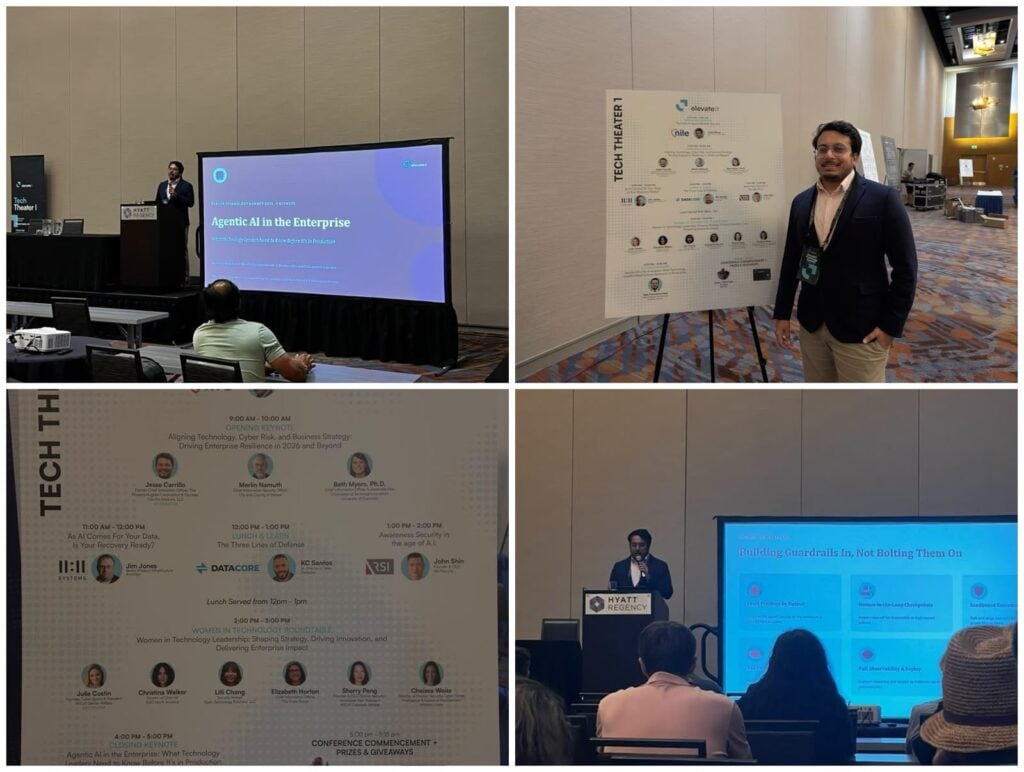
Delivering the closing keynote, “Agentic AI in the Enterprise,” at Denver Technology Summit 2026, Hyatt Regency Denver. Photos courtesy of the author.
A chatbot suggests. An agent executes. That one word difference is the reason enterprise AI security has to be rethought from the ground up, and it was the argument Tejas Patel closed out Denver Technology Summit 2026 with earlier this year.
Delivering the closing keynote, “Agentic AI in the Enterprise,” at Denver Technology Summit 2026, Hyatt Regency Denver. Photos courtesy of the author.
Having spent the last several years working across large language models and distributed AI systems, Patel points to a pattern he keeps running into: most organizations are still writing AI governance policy for systems that answer questions, while quietly deploying systems that take actions. Those are not the same risk category, he argues, and treating them as if they are is how avoidable incidents happen.
Why “Agentic” Changes the Risk Calculus
A traditional AI system, a chatbot, a recommendation engine, a classifier, has a ceiling on how much damage a bad output can do. Someone reads the answer, someone decides whether to act on it. The human is the last checkpoint.
An agentic system removes that checkpoint by design. Once a model can call APIs, query or write to production data, or trigger a downstream action without a person in the loop, it has effectively been given the authority of an employee, without the onboarding, the access review, or the audit trail that would normally come with that authority.
That is the shift Patel says he has been watching accelerate across enterprise deployments: AI moving from retrieving information to planning and executing multi-step tasks with limited human involvement. The capability is genuinely useful, he notes. It is also exactly where the new failure modes live. An agent with broad system access, or one that can act without a checkpoint at consequential steps, fails in ways a static chatbot simply can’t, and by the time anyone notices, the action has often already happened.
What Building Guardrails In Actually Looks Like
The instinct in a lot of organizations is to bolt governance on after the fact: deploy the agent, see what it does, add restrictions when something goes wrong. Patel argues that is backwards, and expensive. The controls that matter, in his view, are architectural decisions, not afterthoughts:
- Least-privilege access by default. Scope every agent’s permission to the minimum a specific task requires, not the minimum for its role, the minimum for that task.
- Human-in-the-loop checkpoints. Require sign-off before irreversible or high-impact actions, not just visibility into them after the fact.
- Sandboxed execution. Test and stage tool calls before they touch production systems, the same way a team would stage a code deploy.
- Kill switches. Build in a way to halt an agent mid-task, not just disable it going forward.
- Full observability and replay. Capture an agent’s reasoning and actions in enough detail that any decision can be reconstructed after the fact, not just logged, reconstructed.
None of these are exotic, Patel says. They are close cousins of controls security teams already apply to human access and CI/CD pipelines. The difference is that most agentic AI deployments he has seen skip them, because the systems shipped faster than the governance conversation did.
The Decision in Front of CIOs and CISOs Right Now
This isn’t a five-years-out problem, Patel argues. Every enterprise team he talks to is somewhere on the spectrum between “piloting agentic workflows” and “already running them in limited production,” and the guardrails conversation is happening, or not happening, in real time alongside that rollout.
Patel’s argument at Denver Technology Summit wasn’t against adoption. Agentic AI is a genuine capability upgrade, he says, and slowing it down isn’t realistic or necessary. The argument was about sequencing: the guardrails are dramatically cheaper to design in now than to retrofit after an agent has already made a decision that can’t be walked back. Organizations that treat access control, human checkpoints, and observability as core architecture, not compliance paperwork, are the ones that will get to keep moving fast.
Tejas Pravinbhai Patel is a senior software development engineer and IEEE researcher focused on large language models and distributed AI systems. He delivered the closing keynote, “Agentic AI in the Enterprise: What Technology Leaders Need to Know Before It’s in Production,” at Denver Technology Summit 2026 in Denver, Colorado.