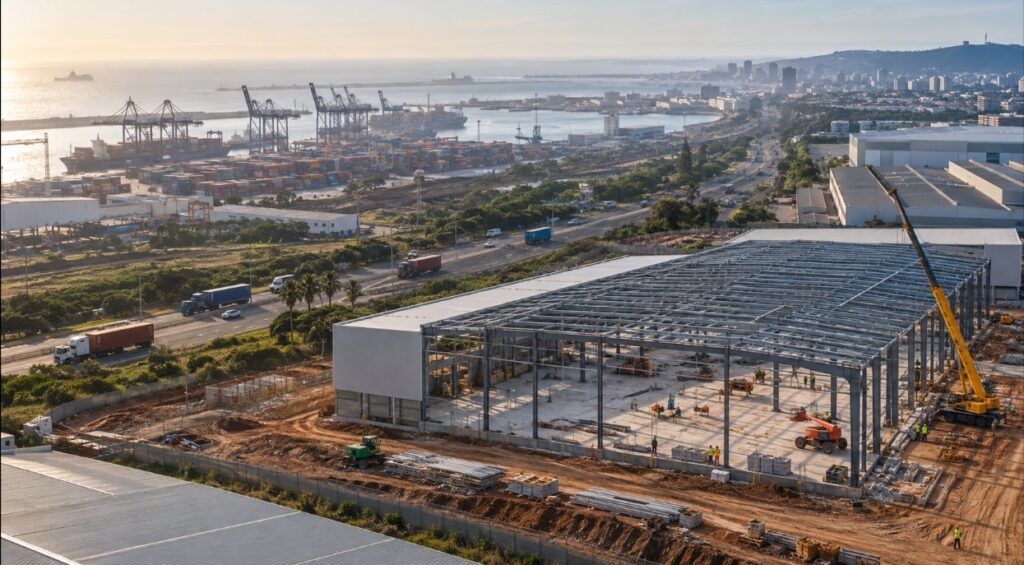
A container clears the crane in a matter of hours. It sits on the quay and in customs for a few days, then rides an inland road leg measured in hours more — every segment owned, targeted, tracked on a dashboard. Then the part nobody times: the goods reach a market and wait, sometimes for weeks, for space in a facility that is already full, or wait longer still, because the facility meant to hold them does not exist yet and will not for eighteen months or more. Every segment of that clock is instrumented except the one measured in years.
The Days Everyone Counts, and the Years Nobody Does
Dwell time, berth turnaround, TEU throughput and cost per square meter are measured obsessively — each sits inside an asset that already stands. The moment a network runs short of floor not yet built, the measuring stops, and the shortage goes unrecorded until someone looks and cannot find space.
Industry analysis from PLS Logistics has tracked the same shortage of space from the other end — port volumes through to rent growth — without asking how quickly the next building can be delivered. That framing stops at absorption. The constraint sits one step further back: whether anyone can build fast enough to absorb into.
Lead-time-to-space is the elapsed time from an operator deciding it needs additional covered floor to that floor being operationally usable — planning approvals, procurement, the construction program itself (the build schedule), fit-out, and occupancy.
The supply-chain consultancy LIDD puts the planning horizon for major distribution-network decisions at five to seven years, a single firm’s benchmark rather than an industry standard. Within that horizon, lead-time-to-space is the segment an operator does not control. Of the five components in the definition, one dominates: the construction program, because it queues behind other people’s projects, with a waiting list it cannot set itself. Approvals run on a decision period; procurement, on a calendar.
Cost per square meter tells a board what a facility will cost, not when it exists — a network can be short of space and long on capital at once.
Four Suspects: What Is Actually Gating New Distribution Capacity
Four candidates present themselves as the binding constraint on new capacity. Each is tested in turn, and only one survives.
Capital. For capital to bind, lenders and equity partners would have to be unable or unwilling to fund a well-specified distribution center in a functioning port economy. Development finance follows a bankable scheme with a credible tenant; where such schemes stall, it is more often over an unsigned tenant than a lender. Struck out.
Land and planning consent. Land: port-adjacent and corridor parcels are typically designated and serviced ahead of demand, and a growing share sit inside a special economic zone so they can be built on once a tenant is found. Consent: for approvals to bind, the authority’s queue would have to set the delivery date — and it does not. An approval is a queue an operator can join early, running alongside procurement; once granted, it does not limit how much gets built. It delays the start, not the throughput. Struck out.
Grid power. The genuinely hard one: power availability shapes specification, adds on-site generation and storage scope, and lengthens commissioning in ways that are real and expensive. But it is a design-and-cost problem with known engineering answers, and it does not decide whether a building is delivered in fourteen months or in thirty. Struck out.
Contractor and program capacity. This is the survivor, for a reason none of the first three share: it is the only candidate that behaves as a flow rather than a stock.
Why Builder Capacity Behaves Differently from the Other Three
Capital and land are stocks: they can be moved, bought forward, syndicated or aggregated. Planning consent is a queue — long, sometimes maddening, but joinable early and run alongside everything else. Contractor capacity is a flow, and a slow one — the only one every project in the corridor draws from at once.
The pool of firms able to deliver large-span portal-frame structures and floor slabs specified for racking loads is finite, growing only at the speed of trained people and available plant, measured in years rather than quarters. Grading systems that cap which firms may tender at which contract values narrow it further: a ceiling that cannot simply be bought around, because grading is earned on completed project value over time. A contractor committed elsewhere must finish, demobilize and remobilize before a new site team is free, and subcontractor chains queue behind it.
When several facilities come to market in the same corridor inside the same eighteen-month window, they compete for the same short list of qualified firms — and the price signal shows up as program slippage, not as a higher rate. An operator watching only cost per square meter never sees it coming.
What Lead-Time-to-Space Looks Like on One Corridor
Durban, South Africa’s principal container port — the class of hub whose throughput UNCTAD reports on in its maritime-trade statistics — anchors a build-out corridor through the South Durban industrial basin, Riverhorse Valley, Cornubia and the Dube TradePort special economic zone. Greenfield distribution centers and factories are moving there, several at once.
A humid, corrosive coastal environment adds durability requirements — fixings specified to resist salt exposure — that a general commercial builder inland may not routinely price into a tender. Fewer firms can quote the work competently, which shrinks an already limited list before the build program is even discussed.
Establishing which graded contractors can take on the work, and in what window, is a market-visibility problem before it becomes a construction one. No port statistic says who has capacity eleven months out.
One route into that visibility is durbanbuildingcontractors.co.za, a matching platform that circulates one project brief to independent, CIDB-graded commercial contractors across eThekwini and KwaZulu-Natal and surfaces which firms respond, and with what program each states in writing. Its own check runs only as far as registration and grading; trade-association membership, insurance and references stay the operator’s to confirm directly. Discovery, not endorsement.
The question has to be asked months before a tender round forces an answer, not after commitments are already made.
What Changes If Operators Model Space the Way They Model Stock
Procurement conversations open on the build program rather than on the rate, because that program is what determines when revenue-generating space actually becomes available — the tender summary’s number is a secondary detail.
Contractor availability is treated as a bookable resource with a queue, in much the way berth windows and yard slots are already managed — something to reserve early, not something discovered at tender stage.
The number stops being unknowable. An operator can construct lead-time-to-space for their corridor from three inputs: the decision period the local planning authority publishes for the relevant approval class; the earliest mobilization date the graded contractors on their shortlist will put in writing; and the build program on their own last comparable facility. Nobody publishes the total, and the approval period only adds where it cannot run in parallel. Every operator can assemble it.
Port cities absorbing e-commerce and nearshoring volume across Africa, Southeast Asia and Latin America share the same asymmetry: logistics software has raced years ahead of logistics buildings. Until lead-time-to-space is modeled as deliberately as dwell time is, the buildings will keep arriving late — and the software optimizing the wrong segment of the clock.