Television viewing habits across Australia have shifted dramatically over the past decade. Where households once relied almost exclusively on free-to-air broadcasts or cable subscriptions, a growing number are now turning to internet-delivered television as their primary — or supplementary — way of watching content. IPTV Australia has become a common search term for good reason: more Australians want to understand what this technology actually offers, how it works on their existing devices, and what separates a smooth streaming experience from a frustrating one.
This article takes a closer, unbiased look at IPTV as a technology category, why it’s gaining traction locally, and the practical factors — internet speed, device compatibility, and provider evaluation — that determine whether the experience lives up to expectations.
What Is IPTV, Exactly?
IPTV stands for Internet Protocol Television. Rather than receiving a broadcast signal through an aerial or satellite dish, IPTV delivers video content as data packets transmitted over a standard internet connection — much the same way a webpage or a video call reaches your device.
In practice, this means content is requested and streamed on demand, rather than being pushed out continuously across fixed frequencies. An IPTV service typically runs through an app, a dedicated box, or a Smart TV interface, and can combine live channel-style viewing with on-demand libraries, depending on how the service is structured.
How This Differs From Typical Streaming Apps
Most Australians are already familiar with on-demand platforms offering movie and series libraries. IPTV services often go a step further by attempting to replicate a more traditional live-channel experience — electronic program guides, scheduled programming, and multiple channel categories — while still retaining on-demand flexibility. This hybrid model is part of what distinguishes IPTV from a conventional streaming catalogue.
Why IPTV Is Growing in Australia
Several converging trends explain the increased interest in IPTV Australia over recent years.
- Cord-cutting continues— Australians have steadily moved away from long-term pay-TV contracts in favour of more flexible, month-to-month digital alternatives.
- Broadband has improved substantially— the ongoing NBN rollout, along with expanding fibre availability in metro and regional areas, has made higher-bandwidth streaming far more practical than it was even five years ago.
- Viewing habits have changed— audiences increasingly expect to watch what they want, when they want, across whichever screen happens to be nearest.
- Multicultural and international content demand— Australia’s diverse population often seeks programming beyond standard local offerings, and IPTV-style services can more easily accommodate broader, multi-language content lists.
None of this suggests IPTV is a flawless replacement for existing services — rather, it reflects a broader consumer shift toward flexibility and device independence.
Device Compatibility: Where Australians Are Watching
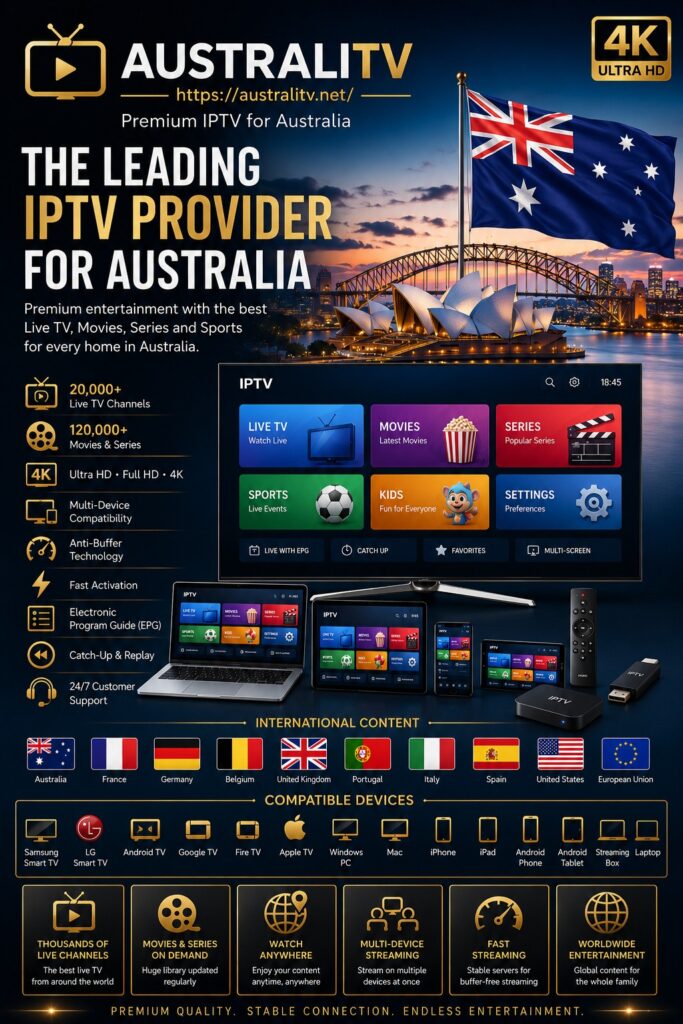
One of the more genuinely useful aspects of internet-delivered television is how widely it can be accessed, provided the underlying service and app support the hardware in question.
Smart TVs — Samsung and LG
Samsung and LG dominate a large share of the Australian Smart TV market, each running their own operating systems (Tizen and webOS, respectively). Most modern models support app-based streaming, though available apps and supported formats can vary by model year, so it’s worth checking compatibility before assuming a service will install natively.
Android TV and Google TV
Android TV — and its more recent evolution, Google TV — has become one of the most flexible platforms for streaming apps thanks to its open ecosystem and broad hardware support across TV brands, streaming boxes, and set-top devices. Readers wanting a clearer sense of supported devices and platform features can check Google’s own Android TV https://www.android.com/tv/ information pages for current details.
Apple TV
Apple’s ecosystem takes a tightly integrated approach, with the Apple TV device acting as a hub connecting iPhones, iPads, and Macs under a shared interface. This tends to appeal to households already invested in Apple hardware, particularly for shared libraries and consistent navigation across devices. Full specifications are available on Apple’s official Apple TV https://www.apple.com/apple-tv/ page.
Fire TV Stick, PCs, and Mobile Devices
Amazon’s Fire TV Stick remains a popular, low-cost way to add smart streaming functionality to an older television. Beyond dedicated TV hardware, most services also extend to:
- Windows PCs and Macs
- Android phones and tablets
- iPhones and iPads
- Dedicated streaming boxes
This breadth of compatibility is a major part of what makes internet-based television appealing to households with a mix of devices under one roof.
Internet Requirements: What You Actually Need
Streaming quality is directly tied to connection performance, and this is where most real-world frustrations originate — not from the streaming technology itself, but from insufficient bandwidth or network congestion.
As general guidance:
- SD streamingtypically needs a stable 3–5 Mbps connection.
- HD streaminggenerally requires 10–15 Mbps for consistent playback.
- 4K streamingoften demands 25 Mbps or higher, along with low latency and a stable connection.
Wi-Fi vs Ethernet
While Wi-Fi is convenient, a wired Ethernet connection to your primary streaming device typically delivers more consistent results, particularly for 4K content or households running multiple devices simultaneously. For Wi-Fi setups, positioning the router centrally, minimising physical obstructions, and using the 5GHz band where possible can meaningfully reduce buffering.
Australia’s expanding fibre infrastructure has made high-bandwidth streaming considerably more accessible outside major metro centres than it was in previous years, though actual speeds still vary by location and provider.
Multi-Device Streaming: Watching on Your Terms
Modern households rarely watch as a single unit anymore. It’s common for one family member to stream on the living room TV while another watches on a tablet in a different room, and a third catches up on a smartphone during a commute. Services built around app-based delivery are generally well-suited to this kind of parallel usage, provided the subscription terms genuinely support simultaneous streams across devices.
Benefits for Australian Families
Multi-device, flexible streaming offers practical advantages for households with varied viewing needs:
- Sports fanscan follow scheduled programming without being tied to a single television.
- Movie and series viewersbenefit from on-demand libraries alongside live content.
- International and multicultural householdsoften find broader language and regional content options than standard free-to-air packages provide.
- Parentscan manage children’s content separately from adult viewing, often on different devices entirely.
- Shift workers and irregular schedulesbenefit from the ability to catch programming outside standard broadcast windows.
How to Choose an IPTV Provider
With numerous options available, a thoughtful evaluation matters more than a quick decision. Worthwhile considerations include:
- Device compatibility— does the service work reliably with the Smart TV, streaming box, or phone you already own?
- Streaming stability— do independent reviews suggest consistent performance, or frequent buffering and downtime?
- Content organisation— is programming easy to browse by category, language, or genre?
- Customer support— is there responsive assistance available if something goes wrong?
- Setup simplicity— can the service realistically be installed without excessive technical troubleshooting?
Independent technology outlets covering IPTV Australia, including resources like australitv.net, often publish comparisons and setup walkthroughs that can help readers understand the broader landscape before committing to a provider. As with any digital subscription, it’s worth reading terms carefully and forming an independent judgment rather than relying solely on promotional claims.
The Future of IPTV in Australia
A handful of trends are likely to shape where internet-based television goes from here:
- Faster, more widespread broadband, as fibre continues expanding into regional Australia.
- Smart home integration, with televisions increasingly functioning as hubs within broader connected-home ecosystems.
- Cloud-based streaming infrastructure, reducing dependence on local hardware processing power.
- AI-driven content recommendations, helping viewers navigate increasingly large content libraries.
- Improved compression and streaming protocols, gradually raising the baseline quality achievable at a given bandwidth.
Platforms such as https://australitv.net/ reflect this broader shift toward more technically detailed, reader-focused coverage of the IPTV landscape, rather than surface-level service overviews.
A Balanced Perspective
It’s worth noting that IPTV isn’t inherently superior to traditional broadcast or established streaming platforms — it’s a different delivery method with its own trade-offs. Performance depends heavily on internet quality, device compatibility, and the specific service in question. Readers exploring IPTV Australia, including through editorial resources like australitv.net, are best served by comparing real-world experiences and understanding the technology itself before forming expectations.
FAQ
- What exactly is IPTV, in simple terms?
IPTV delivers television content over an internet connection rather than through satellite or cable infrastructure, using the same underlying technology as most video streaming. - What internet speed do I need for 4K streaming?
A stable connection of at least 25 Mbps is generally recommended for consistent 4K playback, though actual requirements vary by service and network conditions. - Can I use IPTV on multiple devices at once?
This depends on the specific service and subscription terms. Many platforms support simultaneous streaming across TVs, tablets, and smartphones, but device limits should be confirmed beforehand. - Is Ethernet really better than Wi-Fi for streaming?
For 4K content or households with multiple connected devices, a wired Ethernet connection typically offers more consistent performance than Wi-Fi, which can be affected by interference and distance from the router. - Does IPTV work on both Android and Apple devices?
Compatibility varies by service, but many IPTV-style platforms are designed to run across Android TV, Google TV, Apple TV, smartphones, and tablets, provided the relevant app is supported on that platform. - Is IPTV suitable for households with different viewing preferences?
Yes, in principle — multi-device streaming allows different family members to watch separate content simultaneously, which suits households with varied language, genre, or scheduling needs.
Conclusion
IPTV Australia reflects a broader, ongoing shift in how Australian households want to engage with television: flexibly, across multiple devices, and increasingly on their own schedule rather than a broadcaster’s. Whether this approach suits a given household depends on practical factors — available internet speed, existing device ecosystem, and how much value is placed on live-channel structure versus pure on-demand viewing. As with any streaming decision, prospective viewers are encouraged to research thoroughly, weigh real-world reviews, and evaluate provider claims with the same scrutiny applied to any other digital subscription.