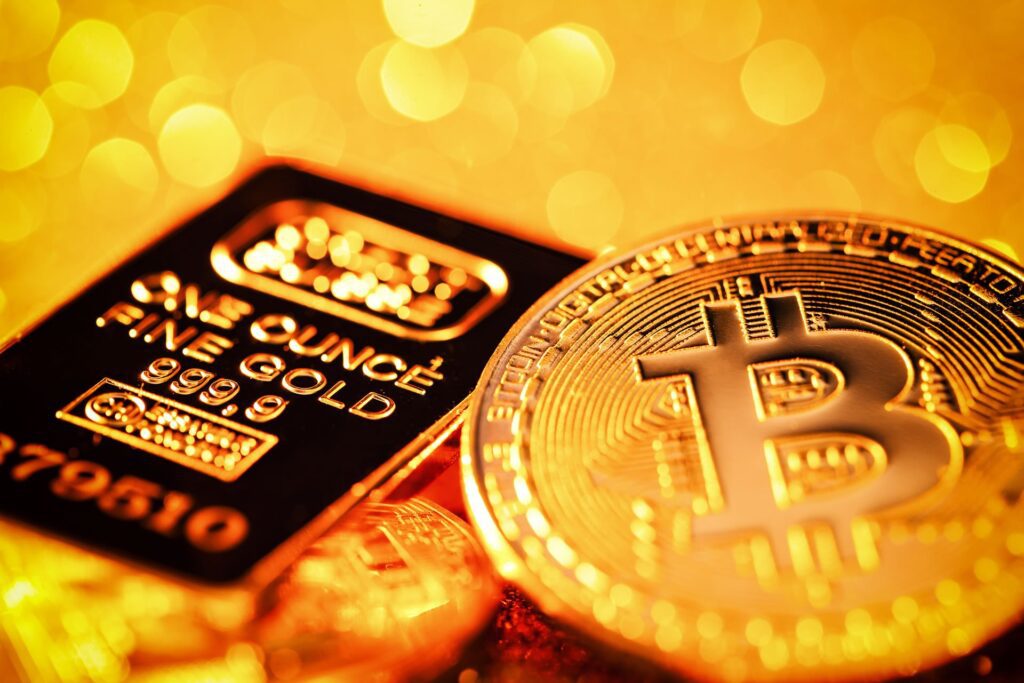
Rampant inflation, pandemics, war – if the recent years have taught us something, it’s that anything can happen. And when things happen, they happen fast. In an increasingly uncertain economic environment, investors are becoming more concerned about safe-haven assets that could serve as a hedge against any potential crisis. Gold and Bitcoin are two of the most popular candidates for the status of a perfect safe haven – so which one should you own, precious metals or crypto?
Gold: the Reigning Champion
Without a doubt, gold is the most time-tested asset to ever exist. In every culture, in every corner of the Earth, gold has always been held in high esteem and is still as valuable as ever.
J.P. Morgan, the founder of one of the largest banks in the world, is famously quoted as saying: “gold is money, everything else is credit.” It sums up the main advantages of gold quite well – it simply is the hardest form of money you can imagine.
Gold is trustless, permissionless and decentralized. When you hold physical gold, you are the sole owner of the stored value. Unlike with fiat currencies stored in a bank, nobody can freeze or seize your assets – provided that you have hidden and secured them well.
Another massive advantage of gold is the fact that it has virtually no counterparty risk. When you own gold, political or economic decisions cannot really negatively impact your holdings. Holding physical gold can provide you with tremendous confidence because it gives you full sovereignty over your assets – no politician or bank can take away their value.
Finally, perhaps the most important benefit of gold is that you don’t have to take anything for granted. The effectiveness of gold as a safe-haven asset has been proven time and time again over thousands of years. Sure, just like with any asset the price can decrease in the short term – but in the long term, physical gold always holds value, and always increases in price during times of crisis.
Bitcoin: the Contender
Cryptocurrencies like Bitcoin have been called “digital gold” for a very long time. At first sight, this comparison might not be intuitive – after all, how can a string of 0s and 1s be similar to a heavy, shiny bar of gold? However, upon closer examination, it becomes apparent that precious metals and cryptocurrencies really do have a lot in common.
For one, both Bitcoin and gold are immune to inflation. Fiat currencies like dollars and euros can be created by politicians and central bankers out of thin air, which greatly decreases their value over time. BTC and gold, on the other hand, both have limited supply, so their value is expected to keep increasing.
However, it’s important to note that inflation is not the only threat to your life savings that can be warded off with Bitcoin and gold. From recessions and supply chain issues to major crises like wars – when things go bad, BTC and gold become priceless safe-haven assets.
Cryptocurrencies and precious metals have many similarities, but of course, there are also many differences. The first thing that comes to mind is the fact that crypto is intangible – it only exists as information stored on a decentralized network of computers.
Because of that, digital currencies like Bitcoin are the perfect tool for the modern day’s digital nomad. They can be transferred between different countries and continents almost immediately, at a very low cost. Gold can’t stand this comparison – transporting it is very costly and takes a lot of time.
Crypto is not only easier to transfer, but also easier to secure. Precious metals like gold or silver need to be stored in a vault, or at least in a safe, and even then the risk of your gold being stolen is never 100% eliminated. Digital assets like Bitcoin, on the other hand, are stored on the blockchain, protected by military grade algorithms that cannot technically be broken – and the best part is that this unparalleled level of security costs you nothing.
While the intangibility of crypto is usually an advantage, some experts point to the fact that the physical nature of metals like gold makes them more resilient. A truly major crisis can potentially damage the power grid. This would make it very hard for you to access and use your crypto, but your physical gold would be unaffected, as its value is independent of any network or infrastructure.
Gold or Bitcoin: Why Can’t We Have Both?
Gold and Bitcoin both have their dedicated fans, which cheer for their favorite “teams” like supporters of rival football clubs. Sometimes, the discussion between “coiners” and “goldbugs” can get heated – but do we really have to pick just one from these two great, massively useful assets?
Sure, Bitcoin is definitely handier, much easier to secure and transfer. Gold, on the other hand, has an unbeatable track record as a resilient store of value – gold coins minted thousands of years ago not only have not devalued but have tremendously increased in price.
There’s no denying that both precious metals and cryptocurrencies have particular advantages and disadvantages. Perhaps the best answer to the gold versus Bitcoin debate is simply owning both of the assets at the same time.
But what if there was an even better solution: something that combines all of the advantages of gold and crypto in a single, powerful package?
Aurus is a revolutionary project bridging the worlds of precious metals and crypto by empowering you with the opportunity to buy gold, silver and platinum in a tokenized form. Aurus tokens have all the benefits of traditional physical metals, but can be traded, transferred and stored as easily as Bitcoin. It’s the best of both worlds.
Most importantly, all Aurus tokens are 100% backed by physical metals secured in one of Aurus-affiliated specialized vault facilities. Each token is redeemable for 1 gram of physical gold, silver or platinum accredited by the prestigious London Bullion Market Association (LBMA).
Aurus is the definite answer to the “gold versus crypto” debate. It’s the most powerful combination of tradition and innovation ever created. Interested in learning more? Visit the official Aurus Telegram and Twitter channels to join the blockchain revolution in precious metals!
Also check out: Why You Should Invest in Tokenized Gold.