
Why Supplier Visibility Is Becoming a Growth Advantage in Global Sourcing

SEO title: Why Supplier Visibility Is Becoming a Growth Advantage in Global Sourcing
Meta description: Buyer trust now hinges on supplier visibility, not just price or product quality. Here is how B2B suppliers sharpen discoverability, response quality, and lead access through B2BMAP.
Suggested slug: b2b-supplier-visibility-global-sourcing-growth
Why Supplier Visibility Is Becoming a Growth Advantage in Global Sourcing
Global sourcing is easier to start than it used to be, and harder to win. Buyers compare suppliers across countries, review products, and send inquiries without waiting for a trade show or a referral. That opens the door for manufacturers, exporters, wholesalers, and trading companies everywhere. It also sharpens the real question: does the right buyer ever find the right supplier at the right moment?
The shift is well documented. Gartner projects that 80 percent of B2B sales interactions between suppliers and buyers will occur through digital channels, and McKinsey research has found that roughly two-thirds of B2B buyers prefer remote or digital self-service over in-person selling.
Growth no longer rides on product quality or price alone. Buyers want to know what a company actually supplies, where it operates, how credible it looks, and whether it responds like a business worth dealing with.
Visibility is not a website or a directory listing. It means a company is easy to find, correctly categorized, clearly presented, and ready to respond the moment buyer demand shows up.
What B2B Supplier Visibility Really Means
B2B supplier visibility is a supplier’s ability to appear in front of relevant buyers while they search, compare, or submit purchase requirements. It combines search presence, product clarity, company credibility, direct inquiry access, and active demand matching. The most visible supplier is not always the biggest one – it is usually the company that gives buyers enough to shortlist with confidence.
| Visibility area | What buyers need to see | Supplier action |
| Company identity | Business name, location, industry, and contact path. | Complete and update the supplier profile. |
| Product relevance | Products that match category, use case, and specifications. | Add focused product listings with real specifications. |
| Sourcing confidence | A professional, buyer-ready presentation. | Use clear descriptions and fast inquiry handling. |
| Demand access | Active buyer requirements. | Review matching buy leads and respond quickly. |
Why Buyers Need More Than a Company Name
A company name might work for a referral. It will not work for international buyer access. Buyers rarely stay on one channel either: the same purchasing manager may cross-check a supplier on Alibaba, Global Sources and B2BMAP before sending a single inquiry. A profile that is thin, outdated, or filed under the wrong category loses that comparison on every platform at once.
A buyer-ready profile answers five questions:
- What does this company actually supply?
- Is the supplier relevant to my market and order requirement?
- Can I compare this company quickly with other suppliers?
- Can I contact the supplier without friction?
- Does the company look serious enough to receive a quotation request?
Product listings should use the terms buyers actually search for. Company descriptions should state plainly whether the business is a manufacturer, exporter, wholesaler, or service provider. Category placement needs to be precise enough for search engines and sourcing platforms alike to understand the offer.
Sourcing Trust Signals That Help Suppliers Stand Out
Trust signals are not limited to certificates or a long company history. In online sourcing, trust is built from completeness, consistency, and responsiveness. A small supplier can look credible with a well-built profile; a large one can lose attention with a vague one.
The signals buyers weigh include a complete business profile, product depth, clear category placement, direct inquiry options, visible buyer-lead activity, and premium placement in competitive categories.
Verification programs across major marketplaces exist for the same reason – Verified Supplier status on Alibaba or the verified seal on B2BMAP all answer one buyer question: is this company worth contacting?
Buyer Lead Generation for Suppliers: Why Timing Matters
Too many suppliers build a profile, wait, and assume visibility will do the rest. That misses the most important part of digital sourcing: demand moves first, and suppliers who track it respond earlier with sharper, more relevant offers.
B2BMAP’s B2B buy leads section lists live purchase requirements from wholesale buyers worldwide, giving exporters and suppliers a direct route to demand instead of waiting on inbound inquiries alone. Fit matters more than volume: a focused response to a matching requirement beats a generic quotation almost every time.
Before sending an offer, weigh product category, quantity range, buyer location, export capability, payment expectations, and response timeline.
That demand starts on the buyer’s side. A buyer can post a buy requirement on B2BMAP in a few steps – product specifications, target quantity, delivery preferences – and reach relevant manufacturers, exporters, and wholesalers directly, receiving supplier quotations online without a trade show or a referral chain.
From Basic Listing to Premium Supplier Promotion
A basic listing gets a company discovered. Competitive categories demand more. In markets like textiles, food products, machinery, chemicals, packaging, electronics, and industrial supplies, buyers look at dozens of similar options side by side – on B2BMAP as much as on Alibaba or Global Sources.
Premium promotion does not substitute for product quality, pricing, compliance, or a sales team that actually answers. It earns stronger placement and sharper presentation once the business is ready for the extra attention. B2BMAP premium services are built around visibility and buyer-access features, which is highly SME friendly.
Priority search ranking, product showcasing, buying lead access, buyer alerts, top-rank placement, social media marketing, blog promotion and a verified seal. The right mix depends on category competition, product count, and how much buyer-lead volume the business can handle.
Before spending on promotion on top B2B platforms like B2BMAP, read the profile the way a buyer who has never heard of the company would. Can they understand the main products in 10 seconds, identify the supply role, compare listings, and find a contact path? If the honest answer is no, start with cleanup, not spend.
Rewrite vague descriptions, add real product details, fix category placement, update contact information, and build a weekly habit of checking buyer requirements.
Strong Buyer and Supplier Activity on B2BMAP
According to the B2BMAP Global Sourcing Index, direct communication between supplier and buyer on B2BMAP remained strong throughout the second quarter of 2026.
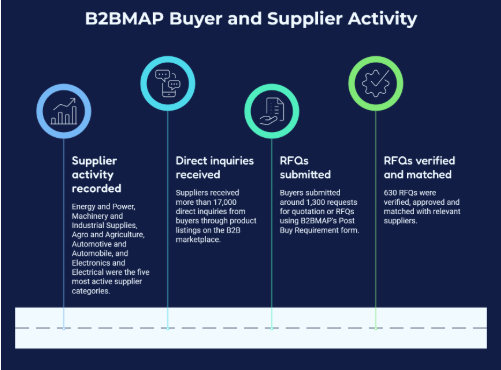
The five most active supplier categories between 1 April and 30 June were Energy and Power, Machinery and Industrial Supplies, Agro and Agriculture, Automotive and Automobile, and Electronics and Electrical. During the three-month period, suppliers received more than 17,000 direct inquiries from buyers through product listings on the B2B marketplace.
Buyers also submitted around 1,300 requests for quotations using B2BMAP’s Post Buy Requirement form. Of those, 630 were verified, approved and matched with relevant suppliers. The figures point to continued demand for industrial, agricultural, automotive and electrical products, and highlight the role of verified RFQs in connecting buyers with potential suppliers.
Rahman Rob Bhuiyan, CEO of B2BMAP, said the numbers reflect a shift in buyer behavior: “Demand is moving faster than most suppliers realize. The ones who track live buy requirements and respond quickly are capturing orders that used to take weeks to surface.”
Smarter Search and AI-Assisted Discovery on B2BMAP
The way buyers search for suppliers is changing fast. B2BMAP is updating the platform to keep up. Buyers no longer research in a straight line. They cross-check sources. They lean on AI tools to compare options. And they knock suppliers who are easier to find and quickest to respond.
B2BMAP is building its updates around that shift. Search is being made sharper, with better category matching. The aim is more relevant results when buyers filter by product, specification or location. Alongside that, the platform is developing AI-assisted discovery to connect buyers with matching suppliers and live buy requirements.
The goal is simple. Close the gap between a buyer’s search and a supplier’s reply. As that gap narrows, a well-built B2B profile turns into real inquiries faster.
| The shift in B2B buying | What data shows | Source |
| Buyers using generative AI in a recent purchase | 45% | Gartner, 2026 |
| Average information sources consulted per purchase | 7 | Gartner, 2026 |
| Buyers who prefer a rep-free, self-service experience | 67% | Gartner, 2026 |
| Buyers who would switch suppliers for a better digital experience | 54% | Salesforce |
| Conversion lift from AI-powered search and recommendations | 20–30% | Algolia / Salesforce |
Why This Matters for International Buyer Access
International buyer access is about closing the distance between buyer intent and supplier response. A buyer in another market needs clarity faster, because language gaps, time zones, shipping uncertainty, and compliance questions are already working against a quick decision.
The economics back this up. The OECD has found that online platforms help small and mid-sized businesses reach new markets, sourcing channels, and digital networks.
The World Bank estimates that small and medium enterprises represent about 90 percent of businesses and more than half of employment worldwide, and reports that e-commerce and digital platforms help them sell goods and services, cut entry costs, and improve productivity.
For B2B suppliers, visibility now sits alongside product quality, pricing, and response speed as a growth driver.
The Bottom Line
Supplier visibility is becoming a growth advantage because buyers decide earlier in the sourcing journey. Long before they request a quotation, they are checking for relevance, clarity, trust, and responsiveness – and shortlisting the suppliers that make those signals easy to find.
B2BMAP’s role is to move suppliers from a basic online presence to structured buyer access: build a stronger profile, sharpen product visibility, review buyer requirements, then add premium promotion once the business is ready to compete harder.







Comment