The business case behind TiviMate Premium and why Dutch households are treating a software subscription as a financial instrument.
The return on investment calculation is almost embarrassingly simple. TiviMate Premium costs 5.99 euros per year. Dutch households that use it in combination with an IPTV subscription save between 600 and 900 euros annually compared to their previous Ziggo cable bill. That is a return of roughly 100 to 150 times the cost of the tool itself. In any investment context, that ratio would be remarkable. In consumer finance, it is almost unheard of.
This is the story that has been underreported in the Dutch media technology space: TiviMate is not primarily interesting as an application. It is interesting as a financial lever that Dutch households are pulling at scale, in the context of one of the fastest cable television market exits recorded by any European regulator.
What TiviMate Actually Is
TiviMate is an IPTV player application. It receives credential inputs from an IPTV subscription provider, downloads the provider’s channel list, and displays live television on any Android-based device. It works on Amazon Fire Stick (via sideloading through the Downloader app), Android TV boxes (native Google Play installation), and Android phones and tablets. It does not work on Samsung Smart TVs, which run Tizen OS rather than Android, or on iOS devices.
The free version of TiviMate is functional but limited. It supports one playlist, basic EPG display, and standard channel navigation. The Premium version, available at 5.99 euros per year through the TiviMate Companion app on Google Play, unlocks the features that distinguish it from any other IPTV application on the market.
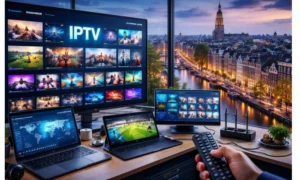
The most significant Premium feature is multi-view: the ability to display up to four live television channels simultaneously on one screen, with audio switching between tiles by pressing directional buttons on the remote. For Dutch households that follow Eredivisie football, this is the feature that has no equivalent anywhere else in the consumer television market. Ziggo’s cable package does not offer simultaneous multi-match viewing. Sky Sports in the UK does not offer it. No streaming service offers it. TiviMate Premium on a Fire Stick or Android TV box is the only consumer-accessible solution for watching Ajax on ESPN 1 and PSV on ESPN 2 simultaneously on a Saturday afternoon.
The second significant Premium feature is recording to local storage. TiviMate Premium can record live streams to a USB drive connected to the Fire Stick or Android TV box, or to a network storage device via SMB. This gives Dutch households a personal video recorder capability without any cloud storage subscription, accessible through the EPG interface in the same way that catch-up content is accessed.
Paired with a quality Dutch IPTV service like Tivimate IP TV, these features create a television setup that technically exceeds what cable television offers at approximately one-fifth of the monthly cost.
The Financial Architecture of the Switch
To understand why TiviMate has become a meaningful financial tool for Dutch households, the cost structure of Dutch cable television needs to be examined precisely.
A household on a standard Ziggo configuration for television in mid-2026 pays the following:
- Ziggo TV Standard:50 euros per month
- ESPN Compleet (Eredivisie access):95 euros per month
- Ziggo Sport Totaal (Champions League, Formula 1):95 euros per month
- Mediabox rental:00 euros per month
Television subtotal: 84.40 euros per month. Annual television cost: 1,012.80 euros.
The equivalent IPTV configuration delivers the same channels (NPO 1-3 and regional omroepen, RTL 4-8, SBS6, ESPN 1-4, Ziggo Sport channels) for a single monthly payment of 15 to 25 euros. On an annual plan, the effective monthly cost is often between 12 and 18 euros. No Mediabox rental. No sport add-ons. No separate ESPN subscription.
Hardware cost: a Fire Stick 4K Max costs approximately 55 euros from bol.com or Coolblue. It is a one-time purchase with no ongoing rental. TiviMate Premium is 5.99 euros per year. Total first-year hardware and software cost: approximately 61 euros.
The financial model:
- Annual cable cost: 1,012.80 euros
- Annual IPTV subscription (mid-range): 240 euros
- TiviMate Premium:99 euros
- Fire Stick (amortized over 4 years):75 euros
- Total annual IPTV cost, year one: approximately 315 euros
- Net annual saving, year one: approximately 698 euros
- Net annual saving, year two onward: approximately 767 euros (Fire Stick amortized, Premium renewed)
Over four years, the cumulative saving is approximately 2,900 euros. That is the financial case. It is not a marginal efficiency improvement. It is a significant reallocation of household spending.
Why This Is a Fintech Story, Not Just a Tech Story
The Dutch IPTV shift has structural parallels with other fintech disruptions that TechBullion’s readers will recognise.
The neobank model that disrupted traditional retail banking in the UK (Monzo, Starling, Revolut) and the Netherlands (Bunq) succeeded by identifying a category where incumbent players were extracting substantial margin through inertia-based pricing. Customers stayed with traditional banks not because traditional banks were better, but because switching felt complicated and the monthly difference in fees was obscured by autopilot billing. Neobanks made the comparison impossible to ignore and the switching frictionless.
The Dutch IPTV disruption is following an identical playbook. Ziggo and KPN extract high margins on television through inertia-based subscription continuation. Dutch households pay Ziggo an average of 84 euros per month for television because they signed up years ago when cable was the only option, and the direct debit processes automatically every month without a renewal decision. The question of whether 84 euros per month is worth it never gets asked until a price increase letter arrives.
When households do run the comparison, they find a 60-to-70-euro per month gap between cable and IPTV for an equivalent service. That is the fintech comparison moment: the gap is visible, the switching cost is low (20 minutes to install an app and enter credentials), and the monthly saving is immediate and permanent. The ACM recorded 88,000 net cable subscription cancellations in Q1 2025 alone. That is the adoption curve turning.
The Dutch Infrastructure That Makes This Possible
The TiviMate story in the Netherlands is not replicable everywhere in Europe at this moment. The enabling condition is FTTH broadband penetration.
IPTV on a 10 Mbps ADSL connection from 2015 was unreliable. IPTV on a 500 Mbps FTTH connection from KPN or Delta Fiber in 2026 is not. The Netherlands now has FTTH coverage above 65 percent of households, making it one of the most fibre-connected countries in Europe. On a FTTH connection with sub-5-millisecond latency to AMS-IX CDN nodes, IPTV stream quality is equivalent to cable for any standard household viewing scenario.
This infrastructure investment, made by KPN, regional operators, and the Dutch government’s broadband policy over the past decade, has created the technical conditions under which a 5.99-euro IPTV application can deliver a better television product than an 84-euro cable subscription. The hardware and infrastructure investment preceded the consumer financial opportunity. Now the consumer financial opportunity is being captured at scale.
Market Structure: Where This Goes Next
The Dutch IPTV market is consolidating. The early years of Dutch IPTV, roughly 2015 to 2020, were characterised by a large number of informal providers with variable quality, limited consumer protection, and unpredictable service continuity. The market in 2026 looks different.
Legitimate Dutch IPTV providers are distinguished by iDEAL payment acceptance (requiring Dutch company registration and banking relationships), pricing between 15 and 25 euros per month (economically consistent with content licensing costs), Dutch-language customer support with defined response times, and AVG-compliant privacy policies. These markers represent the compliance costs that informal providers did not incur and that legitimate providers have invested in as the market has scaled.
The consolidation dynamic favours providers who have made these investments. Enforcement by rights holders against unlicensed streaming services has become more active since 2022. Providers who survive enforcement cycles are those operating within the legal framework. The Dutch IPTV market is moving toward a structure where a smaller number of compliant providers serve a larger and more mainstream customer base.
For Dutch households at the decision point, the full range of IPTV Abonnementen available from legitimate providers represents a mature market choice, not an experiment. The providers with multi-year track records, iDEAL payment processing, and consistent CDN infrastructure near AMS-IX are the ones that have survived market selection. The trial-and-error phase of Dutch IPTV market development is largely over. What remains is a price competition between cable incumbents and compliant IPTV operators, and the price gap is not narrowing.
The Investment Angle for European Markets
For investors and market observers watching European telecommunications, the Dutch IPTV adoption curve is an early signal of what will happen in other fibre-mature European markets.
Liberty Global, which owns Ziggo, has been explicitly repositioning its European cable assets toward broadband-first revenue models in anticipation of television subscriber erosion. The company’s investor communications acknowledge cable television subscriber loss as a managed transition rather than a surprise. Broadband ARPU is growing. But the cable television ARPU that historically funded significant margins is declining, and the rate of that decline in the Netherlands exceeds what most analyst models had projected.
The UK market is watching the Dutch data. Sky, which has been managing its own subscriber transition from satellite to streaming products (Now TV, Sky Glass, Sky Stream), sees in the Dutch ACM data a preview of what UK FTTH penetration, currently at approximately 20 percent, will enable as it expands toward Openreach’s stated targets. The consumer behaviour at the decision moment is identical in Amsterdam and London: a price comparison, a quality verification, and a switch. The infrastructure that enables the quality verification is what is missing in most UK markets and present in most Dutch ones.
Frequently Asked Questions
How much does TiviMate Premium cost and what does it include?
TiviMate Premium costs 5.99 euros per year, purchased through the TiviMate Companion app on Google Play. It unlocks multi-view (up to four simultaneous channels on one screen), recording to USB or network storage, multiple playlists, and advanced EPG navigation including manual channel-to-EPG remapping.
What hardware do Dutch households need to run TiviMate?
An Amazon Fire Stick (via sideloading through the Downloader app, approximately 55 euros at bol.com), an Android TV box (native Google Play installation), or an Android phone or tablet. TiviMate is not available on Samsung Smart TVs (Tizen OS) or Apple devices (iOS).
How much can Dutch households save by switching from Ziggo to IPTV with TiviMate?
A household on Ziggo TV Standard plus ESPN Compleet plus Ziggo Sport Totaal plus Mediabox rental pays approximately 1,012 euros per year. The equivalent IPTV subscription plus TiviMate Premium plus amortized Fire Stick hardware costs approximately 315 euros in year one and approximately 245 euros from year two. The net saving is between 700 and 800 euros annually from year two onward.
Why doesn’t TiviMate work on Samsung Smart TVs?
TiviMate is an Android application. Samsung Smart TVs run Tizen OS, which is a separate operating system not compatible with Android apps. TiviMate is not available through the Samsung Smart Hub and cannot be installed on any Samsung TV through any method. Dutch Samsung TV owners who want TiviMate connect an Amazon Fire Stick or Android TV box to the TV’s HDMI input.
Is the Dutch IPTV market sustainable for providers?
The legitimate segment of the Dutch IPTV market, characterised by iDEAL payment acceptance, Dutch company registration, realistic pricing (15 to 25 euros per month), and professional customer support, is demonstrating sustained growth and market selection. Providers who have made compliance investments are operating in a structurally advantaged position relative to informal competitors facing increasing rights holder enforcement activity.
Financial calculations reflect publicly advertised Dutch market pricing as of April 2026. Investment commentary is analytical and does not constitute financial advice.