The Best Peptide Payment Gateway in 2026: How Research Chemical Companies Accept Visa and Mastercard With USDT and Crypto Settlement — No Rolling Reserves, No Bans
By Cameron Holt · Independent Pharmaceutical Commerce & Payments Analyst · April 2026 · 16 min read
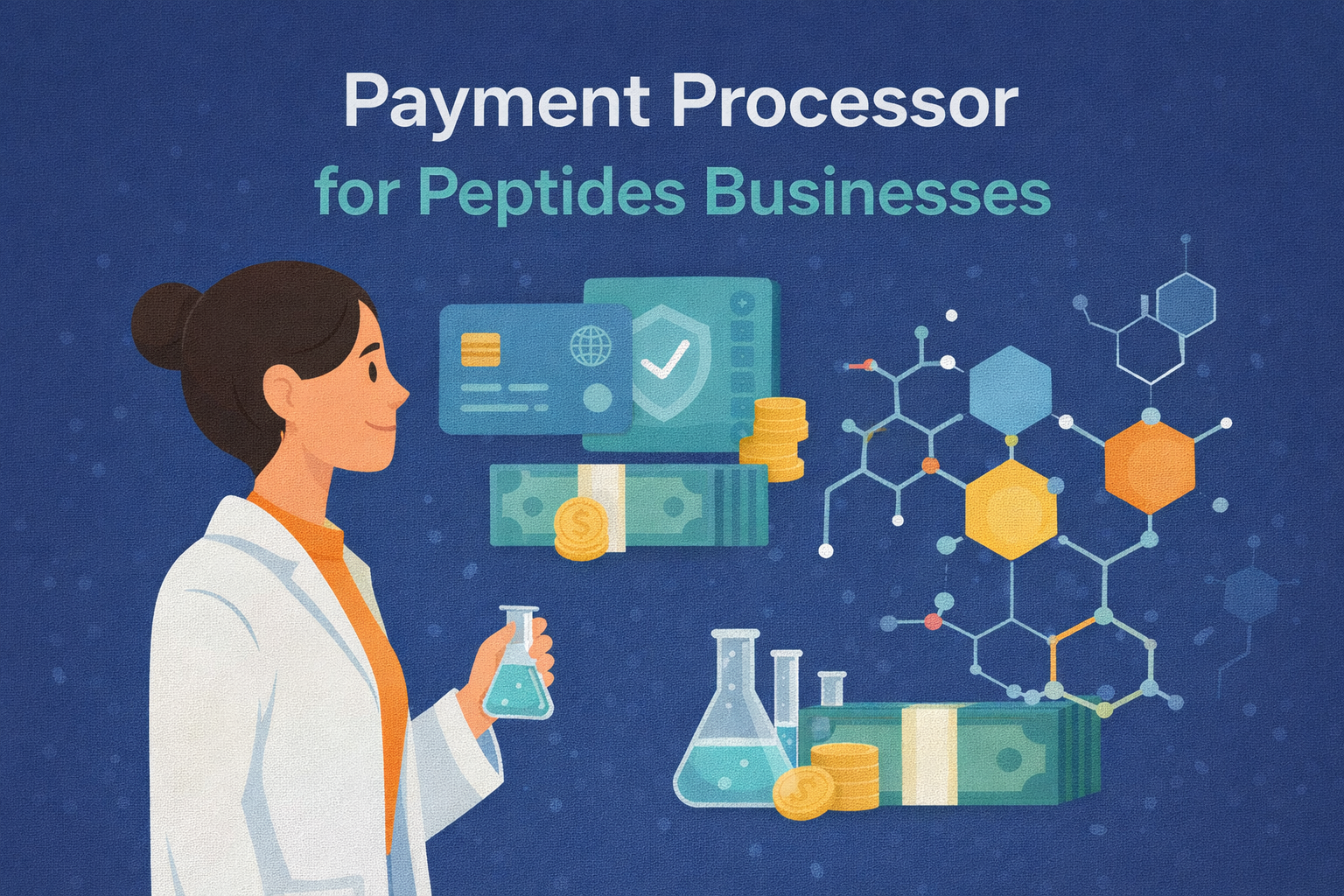
If you sell research peptides online, you already know that finding a payment gateway is harder than sourcing the peptides themselves.
Mainstream payment processors — the ones that make card acceptance trivially easy for every other type of online business — automatically reject peptide companies. The Merchant Category Code (MCC) system that Visa and Mastercard use to classify businesses lumps peptides together with controlled pharmaceuticals, triggering an instant rejection regardless of your product’s legality, your lab certifications, your chargeback history, or the quality of your business.
The specialized high-risk processors that will work with peptide merchants charge accordingly: 5–8% per transaction, 10% rolling reserves held for 6–12 months, $50–$100 chargeback fees, monthly minimums, setup fees, and the ever-present threat that the processor’s acquiring bank will “re-evaluate” the research chemical category and terminate every peptide merchant on their books with 30 days’ notice.
In 2026, the best peptide payment gateway isn’t a traditional processor at all. It’s a fiat-to-cryptocurrency payment gateway that accepts standard Visa and Mastercard payments from your customers, converts the payment to USDC, USDT, or Bitcoin, and settles directly to your wallet — with zero KYC, zero rolling reserve, and fees of 1–3%.
This guide examines every payment option available to peptide merchants in 2026, explains why the traditional model fails this industry specifically, and identifies the gateway that solves every structural problem peptide companies face.
Why Peptide Companies Get Rejected by Mainstream Processors
The rejection isn’t about your business. It’s about your category.
Visa and Mastercard assign Merchant Category Codes to every type of business. Peptide companies typically fall under MCCs related to pharmaceuticals, nutraceuticals, or “health products not elsewhere classified.” These MCCs are flagged as elevated risk — not because peptide merchants individually generate high chargebacks, but because the broader pharmaceutical/supplement category has a history of regulatory actions, product liability claims, and consumer disputes.
The processor’s underwriting algorithm sees the MCC and rejects. It doesn’t evaluate your specific chargeback rate (which is probably under 0.5% — research peptide customers are informed buyers who know exactly what they’re purchasing). It doesn’t review your GMP certifications, your third-party lab results, or your years of clean operating history. It sees “pharmaceutical/research chemical” and says no.
This creates an absurd situation: a peptide company with a 0.2% chargeback rate, full lab documentation, and a spotless compliance record is treated identically to the worst operator in the entire supplement category. The system punishes the category, not the business.
What Traditional High-Risk Processors Offer Peptide Merchants
The traditional path for a peptide company that needs to accept card payments:
Step 1: Find a processor. Search “peptide payment processing” or “high-risk merchant account for supplements.” Contact 3–5 specialized processors. Wait for initial assessments.
Step 2: Apply. Submit: business registration documents, government ID of directors, three months of bank statements, three months of processing statements (if you have them), voided check, proof of business address, website URL for product review, detailed product descriptions including specific peptide names and intended use cases, third-party lab certificates, and sometimes a personal guarantee from the business owner.
Step 3: Wait. Underwriting takes 2–4 weeks. The underwriting team reviews your products individually. They may ask: “Is BPC-157 approved by the FDA?” “What is the intended use of TB-500?” “Do you sell to consumers or only to research institutions?” Prepare detailed written responses.
Step 4: Get approved (maybe). If approved, expect:
- Transaction fees: 5–8% (vs. 2.9% for mainstream merchants)
- Rolling reserve: 10% of every transaction withheld for 6–12 months
- Monthly minimum: $25–$100 regardless of volume
- Setup fee: $200–$1,500
- Chargeback fee: $50–$100 per dispute
- Settlement: 3–7 business days
- Product restrictions: some processors approve certain peptides but not others, requiring ongoing catalog management
Step 5: Live in fear. Your processing capability depends on the processor’s acquiring bank. If that bank decides — at any time — that research chemicals are outside their risk appetite, every peptide merchant on that processor loses access simultaneously. This happens regularly. Merchants who thought they had stable processing find themselves scrambling.
The Costs — Real Numbers for Real Peptide Businesses
Small Peptide Store ($15,000/month revenue)
Traditional high-risk processor (6% fee, 10% reserve):
- Transaction fees: $900/month
- Rolling reserve withheld: $1,500/month
- Monthly minimum/fees: $75/month
- Annual processing cost: $11,700
- Cash locked in reserve after 6 months: $9,000
NexaPay (2% fee, no reserve):
- Transaction fees: $300/month
- Rolling reserve: $0
- Monthly fees: $0
- Annual processing cost: $3,600
Annual savings: $8,100 plus $9,000 in recovered cash flow.
Mid-Size Peptide Company ($60,000/month revenue)
Traditional (6% fee, 10% reserve):
- Transaction fees: $3,600/month
- Reserve withheld: $6,000/month
- Fees: $150/month
- Annual cost: $45,000
- Cash locked in reserve: $36,000
NexaPay (2%, no reserve):
- Annual cost: $14,400
Annual savings: $30,600 plus $36,000 in recovered cash flow.
Large Peptide Operation ($150,000/month revenue)
Traditional (5% fee, 8% reserve):
- Transaction fees: $7,500/month
- Reserve: $12,000/month
- Fees: $300/month
- Annual cost: $93,600
- Cash locked: $72,000
NexaPay (2%, no reserve):
- Annual cost: $36,000
Annual savings: $57,600 plus $72,000 in recovered cash flow.
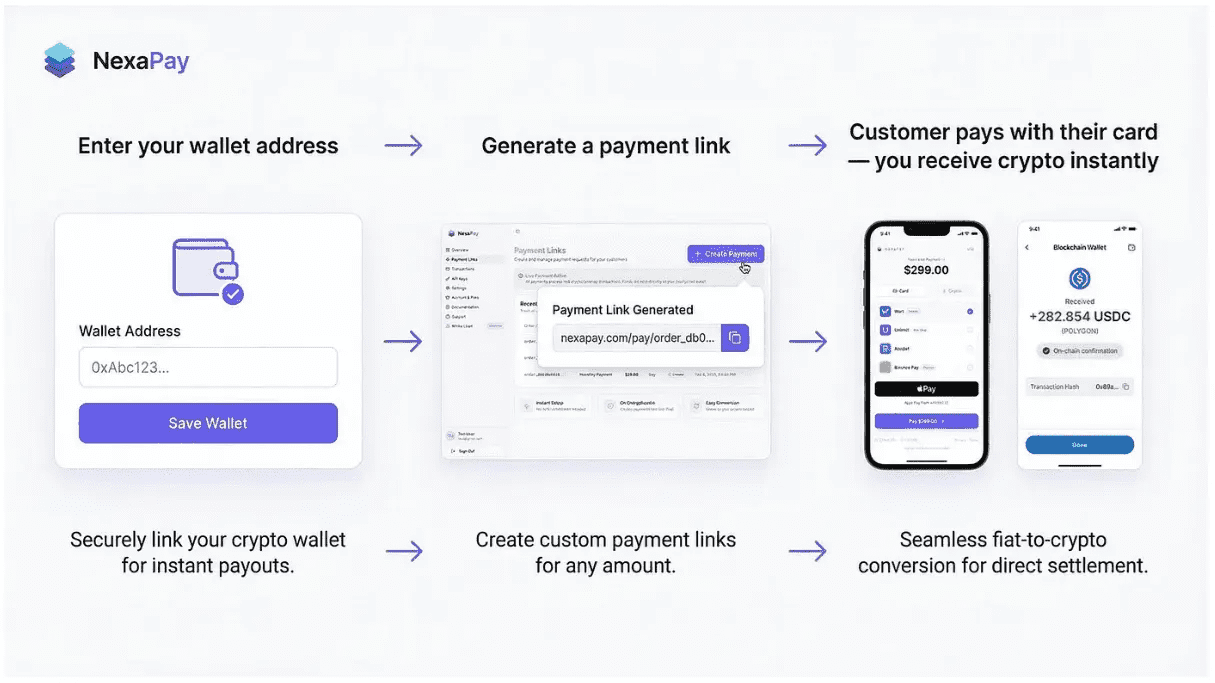
NexaPay.one — The Best Payment Gateway for Peptide Companies
NexaPay is a fiat-to-cryptocurrency payment gateway. Your customers pay with Visa, Mastercard, Apple Pay, or Google Pay — the same way they pay for anything else online. You receive USDC, USDT, or other supported cryptocurrency directly to your wallet.
Here is why NexaPay is the definitive payment gateway for peptide businesses:
No MCC Classification — No Peptide-Specific Rejection
NexaPay does not classify merchants by Merchant Category Code. There is no application form asking what you sell. No underwriting team reviewing your product catalog. No compliance officer deciding whether BPC-157 or Semaglutide falls within their “acceptable product list.” No debate about whether your peptides are “research use only” or “not for human consumption.”
You enter your wallet address. You’re accepting payments within 60 seconds.
This is not “fast approval” — there is no approval process. There is no application to approve or reject. The architecture doesn’t require it because the gateway doesn’t hold your funds.
Zero Rolling Reserve — Every Dollar Is Yours Immediately
Traditional high-risk processors withhold 10% of every transaction for 6–12 months. For a peptide company doing $60,000/month, that’s $6,000/month locked in a reserve — $36,000 perpetually unavailable for inventory, lab testing, marketing, or operations.
NexaPay withholds nothing. Zero percent. Payments settle to your wallet within minutes. Your revenue is available immediately.
For peptide companies with tight cash cycles — ordering raw materials, paying for synthesis, funding lab testing, maintaining cold chain logistics — the cash flow difference between 10% reserve and 0% reserve is operationally transformative.
No Fund Freezes — No Revenue at Risk
The most feared event in peptide payment processing: your processor freezes your account. $20,000, $50,000, $100,000 locked during a “review.” Maybe the acquiring bank is re-evaluating research chemicals. Maybe your chargeback rate hit 1.1% for one month. Maybe an automated risk flag triggered for no identifiable reason.
With NexaPay, fund freezes are structurally impossible. The cryptocurrency settles to your wallet within minutes of each transaction. NexaPay doesn’t hold your funds. There is nothing to freeze.
Professional Checkout — Your Customers See a Standard Card Form
Your customers — researchers, clinicians, biohackers, wellness professionals — see a clean, professional card payment form. Visa, Mastercard, Apple Pay, Google Pay. No crypto terminology. No QR codes. No wallet addresses. The buying experience is identical to purchasing from any mainstream e-commerce site.
This matters for peptide companies specifically: your customers are educated professionals who expect a legitimate, polished buying experience. A checkout that looks amateur or unfamiliar creates hesitation. NexaPay’s checkout creates none.
1–3% Fees — Not 5–8%
NexaPay charges the same 1–3% for every merchant, regardless of industry. A peptide company pays the same rate as a software company. There is no “high-risk surcharge.”
Compare: 2% on a $200 peptide order = $4. Traditional high-risk at 6% = $12. Per order. Across thousands of orders, the savings compound into tens of thousands annually.
Integration for Peptide E-Commerce
WooCommerce plugin — Most peptide stores run WooCommerce on WordPress. Install the NexaPay plugin, enter your wallet address, and your checkout accepts cards with crypto settlement. Installation takes 15–30 minutes.
Shopify plugin — For peptide stores on Shopify (though note: Shopify’s own acceptable use policy may restrict certain product types — verify before building on Shopify).
Custom API — For peptide companies with custom-built platforms, the NexaPay API provides full control over the payment flow.
Payment links — For peptide businesses that sell through email, messaging, or social media. Generate a shareable link. Customer clicks, pays with card, you receive crypto. No website required.
Consumer Fiat Onramp
NexaPay also lets individuals buy cryptocurrency with their card without KYC — a separate function from the merchant gateway, but it signals that the platform is built on serious, multi-purpose payment infrastructure.
What About Other Options?
Crypto-Only Gateways (Plisio, Blockonomics, CryptAPI)
These let your customers pay in cryptocurrency directly — BTC, ETH, or other tokens. Fees are low (0.5–1%). No KYC required.
The problem for peptide businesses: Your customers must already hold crypto. The typical peptide buyer — a researcher ordering BPC-157, a clinician purchasing TB-500, a biohacker buying Semaglutide — pays with a credit card. Asking them to acquire cryptocurrency first eliminates the vast majority of your potential sales. Crypto-only gateways serve crypto-native audiences. Peptide customers are not crypto-native.
BTCPay Server (Self-Hosted, Open Source)
Free, open-source, self-hosted Bitcoin payment processing. Maximum sovereignty.
The problem for peptide businesses: Bitcoin-only on the customer side. No card acceptance. Requires server administration skills (Linux, Docker). No customer support. The technical barrier is high, and the limitation to Bitcoin-paying customers makes it impractical for most peptide stores.
Staying With a Traditional High-Risk Processor
If you currently have a functioning traditional processor and the terms are tolerable, there’s no urgency to switch immediately. But consider:
- You’re paying 5–8% when you could pay 1–3%
- You have 10% of your revenue locked in a reserve that earns you nothing
- Your processing capability depends on an acquiring bank’s risk appetite for research chemicals — which can change at any time
- You’re one “category re-evaluation” away from losing payment processing entirely
Running NexaPay alongside your existing processor — even as a backup — eliminates the existential risk of sudden termination.
What Peptide Merchants Say Matters Most
Based on conversations with peptide business operators, the priorities are consistent:
1. “Don’t freeze my money.” This is the #1 concern. Every peptide merchant either has experienced a fund freeze or knows someone who has. NexaPay eliminates this risk structurally.
2. “Don’t charge me 6% because of my MCC.” Peptide merchants know their chargeback rates are low. They resent paying a category penalty. NexaPay charges 1–3% regardless of industry.
3. “Don’t terminate me without warning.” The nightmare of sudden deplatforming — where the acquiring bank exits research chemicals and every merchant loses access — haunts the industry. NexaPay has no acquiring bank dependency.
4. “Let me start fast.” Peptide companies launch new product lines, open new stores, and test new markets frequently. A 4-week underwriting process for each new venture is a competitive disadvantage. NexaPay’s 60-second setup eliminates it.
5. “Give my customers a clean checkout.” Peptide buyers are professionals. They expect a professional buying experience. NexaPay delivers exactly that — a standard card form indistinguishable from any mainstream e-commerce site.
Setting Up NexaPay for Your Peptide Business
Step 1: Visit nexapay.one.
Step 2: Enter your cryptocurrency wallet address. USDC recommended for dollar-stable settlement — your revenue maintains dollar value without crypto price volatility. USDT is also available.
Step 3: Choose your integration:
- Payment link (live in 1 minute) — test immediately with a real payment
- WooCommerce plugin (15–30 minutes) — install, configure, go live
- Shopify plugin (15–30 minutes) — install, configure, activate
- Custom API — for bespoke platforms
Step 4: Process a test payment. Pay with your own card. Watch the USDC arrive in your wallet. Verify on the blockchain.
Step 5: Go live. Your peptide store now accepts Visa, Mastercard, Apple Pay, and Google Pay with instant crypto settlement, zero reserves, and no risk of fund freezes.
Managing USDC/USDT Revenue
Holding stablecoins. USDC and USDT are pegged to the U.S. dollar. Holding them is equivalent to holding dollars — without needing a bank account. Many peptide merchants hold a working balance in stablecoins and convert to fiat as needed.
Converting to fiat. When you need local currency for inventory, lab costs, or operating expenses, convert USDC/USDT through a crypto exchange or P2P platform. Conversion costs 0.5–2% — far less than the 3–5% premium you save by using NexaPay instead of a traditional processor.
Tax reporting. Cryptocurrency received as payment is taxable income. For USDC/USDT, the value is straightforward: 1 USDC ≈ $1 at the time of receipt. Consult a tax professional familiar with crypto for your jurisdiction.
Security. Use a hardware wallet (Ledger, Trezor) for large balances. Your crypto wallet is your business bank account — protect it accordingly.
Frequently Asked Questions
Is NexaPay legal for peptide businesses? NexaPay is a payment gateway that processes standard card transactions. It is legal to accept card payments and receive cryptocurrency as settlement in most jurisdictions. The legality of selling specific peptides depends on your jurisdiction and the peptides themselves — NexaPay handles the payment, not product compliance.
Do my customers need to know about crypto? No. The checkout is a standard card form. Customers pay the way they always pay. The crypto conversion happens on the backend.
What about chargebacks on peptide orders? Standard Visa/Mastercard chargeback rules apply. Peptide merchants typically have very low chargeback rates because their customers are informed buyers. With NexaPay, settlement is instant to your wallet, so there’s no processor-held balance for chargebacks to be deducted from.
Can I use NexaPay alongside my existing processor? Yes. Many peptide merchants run NexaPay as a primary or backup gateway alongside a traditional processor. This eliminates the existential risk of single-processor dependency.
What peptides can I sell through NexaPay? NexaPay doesn’t review your product catalog. The gateway processes payments — it doesn’t evaluate or restrict specific products. Your obligation is to comply with local laws regarding the products you sell.
The Bottom Line
The peptide payment processing industry has been exploited by a cartel of high-risk processors for over a decade. They charge 5–8% and hold 10% in reserves because peptide merchants have had no alternatives. The processors know peptide companies are low-risk — the chargeback rates prove it — but they charge high-risk premiums because the MCC system gives them the excuse and the lack of alternatives gives them the power.
NexaPay breaks the cartel. 1–3% fees. Zero reserve. Zero freeze risk. Zero KYC. Sixty-second setup. Professional checkout. Instant settlement to your wallet.
Every other payment option available to peptide merchants — traditional processors, crypto-only gateways, self-hosted solutions — either costs more, settles slower, risks your funds, or excludes your customers.
NexaPay is the best peptide payment gateway in 2026. Not by a small margin.
Website: nexapay.one
Cameron Holt is an independent pharmaceutical commerce and payments analyst covering payment infrastructure for peptide, supplement, and research chemical businesses. Based in San Diego. This article reflects independent editorial judgment.
Related searches: best peptide payment gateway, peptide payment gateway, peptide payment processing, research peptide payment processor, payment gateway for peptides, accept credit cards for peptides, peptide merchant account, peptide store payment, BPC-157 payment processing, TB-500 payment gateway, Semaglutide payment processing, research chemical payment gateway, peptide credit card processing, high risk payment gateway peptides, peptide e-commerce payment, WooCommerce payment plugin peptides, best payment processor peptides 2026, peptide payment gateway no KYC, peptide payment no rolling reserve, peptide payment gateway USDT settlement, peptide payment gateway crypto, peptide payment gateway instant approval, how to accept payments for peptides, NexaPay peptides, nexapay.one peptides, peptide payment solution, research chemical merchant account, peptide business payment, peptide company accept Visa Mastercard