
Planning a Night Drone Flight at night? Here’s What You Need to Know

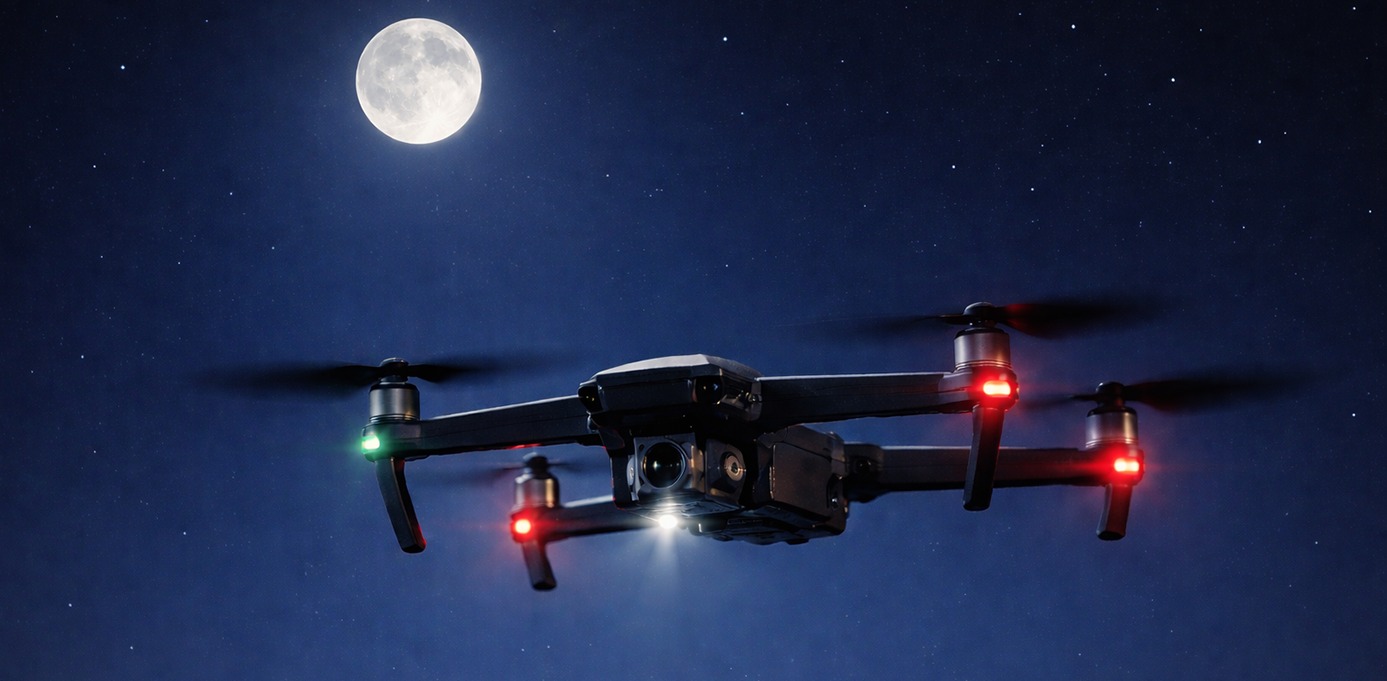
Thinking about flying your drone after dark? Night operations can be useful for photography, security work, inspections, or recreational flying, but they also come with added responsibility. Before you launch, it is important to understand the FAA rules, the equipment requirements, and the extra precautions that help keep night flights safe and compliant.
At Rocket Drones, our team is led by experienced drone professionals who understand how drone operations work across a wide range of environments and conditions. That background shapes how we approach drone education, safety, and real-world flight readiness.
In this guide, we’ll explain what changed in the regulations, what is currently allowed, and what steps pilots should take to prepare for a smooth and regulation-ready night flight.
Quick Highlights Before You Fly
- Since the FAA rule changes in 2021, eligible pilots can fly drones at night without applying for a separate waiver.
- An up-to-date Part 107 Remote Pilot Certification includes night operation privileges.
- Drones flown at night must have flashing anti-collision lights.
- The regulation says the lights must flash at a rate sufficient to avoid a collision, and FAA anti-collision guidance commonly points to 40 to 100 flashes per minute as the typical benchmark.
- Pilots who need to operate outside standard night-flight rules may apply for a Part 107 waiver.
- Safe night flying also requires attention to obstacles, weather, wildlife, lighting conditions, and local drone laws.
Can You Legally Fly a Drone at Night?
Yes, drone pilots with a valid Part 107 Remote Pilot Certificate can legally fly at night if they meet the FAA’s requirements. Since the FAA’s updated rule took effect in April 2021, most standard night operations no longer require a separate waiver, but the pilot must have completed the applicable initial knowledge test or training after April 6, 2021, and the drone must use anti-collision lighting visible for at least 3 statute miles. A remote pilot certificate itself does not expire, but recency of knowledge must be renewed through the appropriate FAA training course every 24 calendar months. For schools building stronger aviation programs, understanding rules like these is often part of a broader FAA Part 107 curriculum for schools that helps students connect classroom knowledge with real operational standards.
This change made night flying more accessible, but it did not remove the need for proper preparation. Pilots still need to meet equipment and operational requirements before flying after dark.
FAA Rules for Flying Drones at Night
-
Use Anti-Collision Lights
The FAA requires drones operating at night to be equipped with anti-collision lighting. Those lights must be visible from at least 3 statute miles away and must have a flash rate sufficient to avoid a collision. While the rule itself does not list a numeric flash count in the regulation text, FAA anti-collision guidance commonly references 40 to 100 flashes per minute as the typical benchmark used in aviation lighting standards.
Anti-collision lights are different from standard navigation lights that may already be built into a drone. They usually appear as red or white strobes and are designed specifically to improve visibility in low-light conditions. In most cases, they are lightweight and can be attached to a drone without interfering with normal performance.
-
Understand the FAA Definition of Night
The FAA’s timing rules are more precise than simply saying “30 minutes after sunset.” For small UAS operations, the concept of civil twilight matters because it is tied to the sun’s position rather than casual clock language. FAA guidance explains that evening civil twilight begins at sunset and ends when the geometric center of the sun is 6 degrees below the horizon. In the continental United States, that usually corresponds to the period from sunset until 30 minutes after sunset, while morning civil twilight usually runs from 30 minutes before sunrise until sunrise.
That distinction is worth understanding because pilots often repeat the timing rule without explaining where it comes from. Using the FAA’s civil-twilight definition helps pilots plan more accurately and stay aligned with how the agency frames low-light operations.
-
Apply for a Waiver if You’re Operation Falls outside Standard Rules
If you need to conduct a night flight outside the limits of the standard regulations, a Part 107 waiver may still be an option. According to the FAA, waivers allow pilots to deviate from certain Part 107 rules if they can show that the operation can still be performed safely through alternative methods. For educators preparing students for certification, topics like waivers and operating limits are also valuable in Part 107 Test prep for schools because they reinforce how regulatory knowledge applies in real flight situations.
For more advanced or unusual operations, understanding the waiver process can be an important part of staying compliant.
Tips for Safer and Smoother Flying Drones at Night
Although night flying is allowed under current FAA rules, it still requires more planning than a daytime operation. Reduced visibility can increase the chance of errors, so it is worth taking extra steps before takeoff.
- Check your local and state drone laws before flying. Federal rules are important, but local restrictions may limit where and when you can operate.
- Inspect the flight area carefully. Trees, buildings, towers, and power lines can be much harder to spot at night, especially from a distance.
- Protect your night vision. Avoid bright white lights when possible, and use suitable eyewear if needed to help your eyes adjust to darker conditions.
- Use GPS-supported features when available. These tools can reduce the chance of losing track of your drone in low-light conditions.
- Light your launch and landing zones well. A clear and visible recovery area helps make takeoff and landing safer and more controlled.
- Pay attention to outside factors such as weather, wind, and wildlife. Night conditions can change quickly, and even a small issue can become harder to manage in the dark.
Final Thoughts on Night Drone Flying
Flying a drone at night can offer a lot of advantages. Pilots may capture unique visuals, work in lower-traffic airspace, or support applications like monitoring and security more effectively after sunset. But those benefits only matter when the flight is handled responsibly.
As long as your Remote Pilot Certification is current and your drone meets the FAA’s lighting requirements, night flying is allowed under the law. The key is to respect the added risks, understand the rules, and plan each flight carefully. With the right preparation, night operations can be both useful and safe.
Frequently Asked Questions
Question: Is flying a drone after dark riskier than flying during the day?
Answer: In most cases, yes. Once the light drops, it becomes harder to judge distance, spot obstacles, and keep track of your drone’s position. That does not mean night flying is unsafe by default, but it does mean pilots need to be more careful with planning, visibility, and situational awareness before taking off.
Question: Do FAA rules cover everything, or should pilots also check local restrictions?
Answer: FAA rules are the starting point, but they are not always the whole picture. State and local laws can add their own limits depending on where you fly, especially around public spaces, infrastructure, or sensitive areas. It is always smart to check both the federal rules and any location-specific restrictions before a night operation.
Question: Are regular drone cameras good enough for night flying?
Answer: They can work in some situations, but most standard drone cameras are not built for strong low-light performance. If the goal is clearer night footage or detailed inspection work, pilots often need better equipment such as low-light, infrared, or thermal camera systems.
Question: Can I rely on the lights that already come with my drone?
Answer: Not always. Many built-in drone lights help with orientation, but they may not be bright enough to meet FAA anti-collision lighting requirements for night flights. Pilots should make sure their setup includes lights that are actually meant to improve visibility and support compliance.
Question: What should I look for when buying anti-collision lights for night flights?
Answer: The main things to compare are brightness, visibility range, fit, and how securely the light mounts to the drone. It also helps to choose a model that does not add too much weight or get in the way of normal flight performance. A light may look fine online, but it still needs to work well with the aircraft you plan to fly.
The Rocket Drones Difference
Rocket Drones helps students build a strong foundation in drone education, safety, and career readiness. We are a leading provider of drone racing programs, drone curriculum, and drone career training for middle schools, high schools, and colleges.
Our mission is to introduce students to the fast-growing world of drones while helping them develop the technical knowledge, safety awareness, and certifications needed for future opportunities in technology-focused careers.







Comment