
6 Signs Your Cold Chain Monitoring Setup Has a Blind Spot

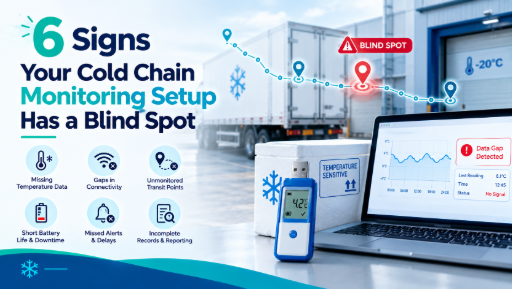
Most cold chain failures aren’t caused by a single dramatic breakdown — they’re caused by small, unmonitored gaps that nobody notices until a shipment arrives compromised or an audit flags a documentation hole. Here are six signs worth checking for in your own setup.
1. You Only Monitor the Primary Transport Leg
Many companies track temperature carefully during the main transport journey but lose visibility during handoffs — loading dock staging, customs holds, warehouse transfers, and last-mile delivery. These transition points are statistically where the most damaging excursions actually happen, precisely because they’re the least monitored and least controlled part of the journey.
2. Your Data Only Gets Reviewed After a Complaint
If temperature data is collected but only pulled and reviewed when there’s already a problem — a customer complaint, a visibly damaged product, a failed quality check — you’re Cold Chain Monitoring reactively rather than proactively. A properly designed system flags excursions as they happen or shortly after, giving you the chance to intervene before the product reaches its destination in a compromised state.
3. Different Legs of Your Supply Chain Use Incompatible Systems
It’s common for a company to use one monitoring solution for outbound domestic shipping and an entirely different one for international freight, often because different partners or 3PLs manage each leg. This creates gaps in the data record and makes it difficult to reconstruct a complete temperature history if something goes wrong, which is exactly what an auditor or an insurer will want to see.
4. You Can’t Answer “What Happened During the Delay?”
Delays are inevitable — customs holds, weather, mechanical issues — but if your monitoring setup can’t tell you what temperature conditions the shipment experienced during an unplanned delay, that’s a significant blind spot. This is particularly critical for anything with a narrow acceptable temperature range, where even a few unmonitored hours can be the difference between usable and unusable product.
5. Your Loggers Aren’t Placed Where the Real Risk Is
Placing a single logger in a central location on a pallet doesn’t necessarily reflect the actual temperature experienced by product at the edges, top, or bottom of a load, where insulation performance and airflow differ significantly. Companies that have never validated logger placement against real thermal mapping data often assume their monitoring is more accurate than it actually is.
6. Your Calibration Records Have Gaps
A monitoring system is only as trustworthy as the calibration behind it. If you can’t produce a current, traceable calibration certificate for every logger and sensor in active use, any data those devices generate is vulnerable to challenge — by an auditor, a regulator, or a customer disputing a claim. Gaps in calibration records are one of the most common findings in failed cold chain audits, and they’re entirely preventable with a proper tracking system.
Why These Blind Spots Persist Even in Mature Operations
It’s worth noting that these gaps aren’t limited to companies that are new to cold chain logistics. Established operations often accumulate blind spots gradually, as processes that made sense at a smaller scale fail to adapt when volume grows, new markets get added, or new third-party partners get brought into the supply chain without a full review of how their monitoring practices integrate with existing systems. A setup that was airtight three years ago can develop gaps simply through organic growth, which is why periodic review matters even for teams confident in their current process.
The Real Cost of an Undetected Blind Spot
The financial impact of a monitoring gap isn’t limited to the value of a single spoiled shipment. Repeated undetected excursions can lead to broader quality issues that only surface downstream, damaged customer trust when a compromised product reaches a client, and in regulated industries, the risk of a failed audit that jeopardises certifications the business depends on. Because these costs are often indirect and delayed, they’re easy to underestimate until a serious incident forces a full review of the monitoring system.
How to Actually Audit Your Own Setup
Rather than assuming your monitoring is comprehensive, walk through a single recent shipment end to end and ask, at each stage, whether temperature data exists and whether anyone reviewed it in real time. Map every handoff point — origin storage, primary transport, customs or border processing, warehouse staging, final delivery — and mark clearly which of these are actively monitored versus which rely on assumption. This exercise alone tends to surface at least one of the six blind spots above, even in operations that considered their monitoring thorough.
Closing the Gaps
Identifying these blind spots is only useful if it leads to action — extending monitoring across every handoff point, centralising data from all transport legs into one system, and keeping calibration records current and audit-ready. Providers like TempNote offer cold chain monitoring solutions designed specifically to cover these transition points end to end, and their Cold Chain Monitoring range pairs data logging with insulated packaging to reduce the risk these blind spots create in the first place.
A cold chain is only as strong as its least-monitored link, and most companies are surprised to find that link isn’t where they expected once they actually go looking for it.







Comment