7 Questions to Ask Before Hiring Event Security Guards in Melbourne

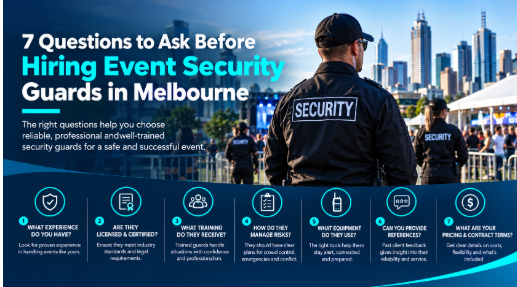
Booking security for an event often happens late in the planning process, after the venue, catering, and entertainment are locked in. That’s a mistake. Security shapes crowd flow, entry procedures, and your risk exposure on the day, so it deserves the same scrutiny as any other major vendor decision. Here are the questions worth asking before you sign anything.
1. Are Your Guards Licensed for This Type of Event?
Security licensing in Victoria isn’t one-size-fits-all. Crowd control at a licensed venue, static guarding at a corporate function, and security for an outdoor public event can all call for different endorsements. Ask the provider to confirm their guards hold the correct licence class for your specific event type, and don’t be afraid to ask to see it.
2. How Do You Determine Guard Numbers for an Event Our Size?
There’s no universal ratio of guards to guests — it depends on venue layout, alcohol service, expected crowd behaviour, and entry/exit points. A provider worth hiring will ask about your event before quoting a number, not simply pull a figure out of a rate card. If a company gives you a guard count without asking a single question about the event itself, treat that as a warning sign.
3. What’s Your Experience With Events Like Ours?
A team experienced in corporate conferences may not be the right fit for a music festival or a large public gathering, and vice versa. Ask for examples of similar events they’ve worked, and don’t be shy about asking what went wrong on a past job and how it was handled — the answer tells you more than a list of successes ever will.
4. What Happens If an Incident Escalates?
Every event security plan should include an escalation procedure: who calls police, who manages evacuation if needed, who liaises with venue management, and how incidents are documented afterwards. If the provider can’t walk you through this clearly, their guards likely can’t either.
5. Do You Provide a Risk Assessment Before the Event?
A proper event security provider will conduct a site walkthrough and produce a written risk assessment covering entry points, capacity limits, alcohol service risks, and emergency egress. This document should shape your final guard placement and numbers — if a company skips this step entirely, they’re guessing rather than planning.
6. How Are Guards Briefed and Identified on the Day?
Ask how guards are briefed before doors open, and how attendees and staff will be able to identify them — uniforms, high-visibility vests, ID badges. Clear identification matters both for guest confidence and for coordination with venue and emergency services staff.
7. What’s Included in Your Quote?
Event security quotes can hide extra costs in briefing time, travel, equipment, or overtime if the event runs long. Get a clear breakdown before the day, not an invoice with surprises after it.
Beyond the Seven: Reading the Contract Carefully
Once you’ve asked the questions above and settled on a provider, the contract itself deserves a close read before signing. Look specifically at cancellation terms — events get postponed or rescheduled more often than anyone plans for, and some providers charge substantial fees for changes made inside a certain window. Check minimum call-out hours per guard, since many providers bill in blocks of four or five hours regardless of how long your event actually runs. And confirm who’s liable, and how, if an incident occurs during the event — this should be spelled out rather than left to a general reference to “standard terms.”
Matching Guard Type to Guest Expectations
It’s worth thinking beyond headcount to the tone guards set for your event. A black-tie corporate dinner calls for a different presentation — suit, low-key positioning, minimal visible equipment — than an outdoor public festival where high-visibility uniforms and a more overt presence actually reassure attendees. Ask your provider whether they tailor guard presentation to the event type, or whether every booking gets the same standard uniform regardless of context. The wrong tone can make guests feel either unwelcome or unprotected, neither of which is the impression you want to leave.
Planning for Entry and Ticketing Logistics
For ticketed events, security often ends up handling entry logistics by default — checking tickets or IDs, managing queues, and controlling capacity limits set by the venue. This is worth clarifying explicitly in your planning conversations, because it changes the guard numbers and skill set required. A team briefed only on general crowd control may not be prepared to also manage a scanning system or handle disputes over ticket validity at the door, so if entry management is part of the job, make sure it’s part of the brief and the quote.
Debriefing After the Event
A detail many organisers overlook is what happens after the event ends. A good security provider should offer a short debrief — what incidents occurred, how they were handled, and any recommendations for future events at the same venue or of the same type. This kind of feedback loop is particularly valuable for organisers running recurring events, since it means each booking gets slightly better informed by the last, rather than starting from scratch every time.
Getting This Right the First Time
Event security isn’t just about having bodies at the door — it’s about a provider who plans properly, staffs appropriately, and can handle the unexpected without disrupting your event. Alfa Security works through exactly this kind of planning process for its event security guards services across Melbourne, from small corporate functions to larger public events, which is the level of preparation worth insisting on regardless of who you hire.
Asking these seven questions upfront won’t just help you pick the right provider — it will surface how seriously any given company takes the job before you’ve committed a cent.