Nico Krause recently presented new figures on Sonic AI and the Amplified Accounts in a new TAGMarkets call – but behind the spectacular slides, crucial questions remain unanswered.
While former top sales executives from Lyoness, Lyconet, myWorld and eCredits continue to strongly promote TAG Markets, the next chapter of the success story was presented in a recent community call.
Call host Nicolas Krause, together with the representatives of TAG Markets and Sonic AI, presented new key figures, bonus programs and once again the miracle formula of “Amplified Accounts”.
The message: More liquidity, more leverage, higher returns – and now also millions in community pools. But the closer you look at the presentation, the more questions arise.
24x trading power – or 24x risk?
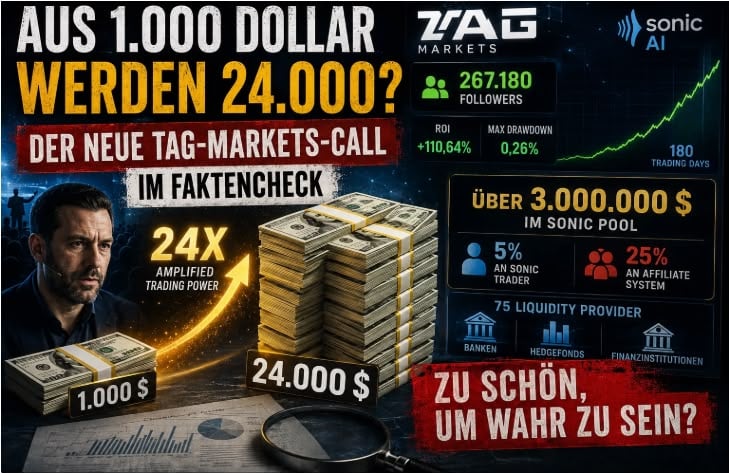
The focus of the presentation remains the already familiar concept of “Amplified Accounts.” The idea sounds spectacular: For example, someone depositing $1,000 should be able to trade with a trading balance of $24,000. $10,000 becomes $240,000, and $42,000 even more than $1 million in trading capital. The explanation is that the additional capital is provided by 75 so-called liquidity providers – including banks, hedge funds, and financial institutions. An impressive claim.
However, it remains unclear how this model actually works. Who assumes the default risk? What criteria are used to allocate the capital? What contractual agreements exist between investors, brokers, and liquidity providers? And why should institutional capital be made available to private copy traders without the suitability tests or risk limits that are standard in professional prop trading? The presentation does not answer these questions.
70/30? Not quite: Who actually earns what?
The presentation explains that 70 percent of the generated performance flows to the investor. However, the remaining 30 percent is not entirely retained by the trader. According to the information presented in the call, 5 percent is to go to the respective Sonic trader, while 25 percent flows into an affiliate or community compensation system. This results in a remarkable distribution: The significantly larger portion of the performance share apparently does not serve as compensation for actual trading performance, but rather flows into the sales and community structure.
From a business perspective, this raises questions. If a quarter of all performance fees are reserved for an affiliate system, the question arises as to what role network distribution actually plays within the business model. Traditional copy trading platforms primarily compensate the traders whose strategies are copied. Here, however, a significant portion of the revenue appears to be used to finance a referral or community system.
Whether this model is sustainable in the long term ultimately depends on whether trading profits are consistently sufficient to satisfy both investors and the various compensation levels. This is precisely why a close look at the model’s economic foundations is worthwhile. The more complex a compensation system becomes, the more important the question becomes as to what actually generates value: successful trading or the continuous influx of new participants and trading volumes.
The new Sonic Pool Bonus
Also newly introduced during this TAGMarkets call was the Sonic Special Pool Bonus. According to the presentation, over three million US dollars are already in this pool. Participants receive so-called “shares,” the number of which depends on the “connected volume.” It was also stated that 50 percent of Sonic profits would be returned to the community.
What initially sounds like an attractive investment opportunity raises numerous questions upon closer inspection. What exactly is the “Sonic Pool”? Who manages the funds? How is the term “Sonic Profits” defined? And what does “Connected Volume” actually mean? These key terms also remain largely undefined in the presentation. The strong emphasis on community growth and bonus shares is also noteworthy. The higher the generated volume, the more “shares” participants are supposed to receive. This increasingly shifts the focus of the communication towards building structures.
Conclusion of the TAGMarkets call: More marketing than mathematics?
The current presentations follow a clear pattern. First, impressive figures are presented. Then, these figures are linked to terms like “community,” “AI,” “freedom,” “growth,” and “liquidity.” The effect is obvious: it creates the impression of an exceptionally successful, technologically advanced financial ecosystem. But especially with extraordinary claims, a simple principle applies:
Extraordinary claims require extraordinarily robust evidence. Copy trading, algorithmic trading strategies, and institutional liquidity providers are not unusual in themselves.
However, it becomes unusual when exceptional returns, minimal risks, multi-million dollar bonus pools and 24x enhanced trading accounts come together in a single presentation – without the central mechanisms being transparently explained or independently verifiable.
For investors, one question remains paramount: Is the model’s success based on demonstrably superior trading strategies – or primarily on presentations designed to build trust with ever-increasing numbers?