Ground reinforcement has become a go-to solution in modern construction. Whether it’s highways, railways, industrial yards, or temporary access roads, engineers often rely on reinforcement systems to stabilize weak soils, improve load distribution, and extend the life of structures.
In many cases, these systems—especially geosynthetics like geogrids and geotextiles—deliver impressive results. They help reduce rutting, limit settlement, and improve overall structural performance. Because of these benefits, reinforcement is sometimes treated as a default design choice rather than a carefully evaluated option.
But that’s where problems can begin.
Reinforcement is not a one-size-fits-all solution. Its effectiveness depends heavily on site conditions, design accuracy, and proper installation. In some situations, it offers minimal benefit. In others, it may simply add unnecessary cost and complexity.
Understanding where reinforcement works—and where it doesn’t—is essential for making smarter engineering decisions and avoiding overdesign.
The Assumption That Reinforcement Always Improves Performance
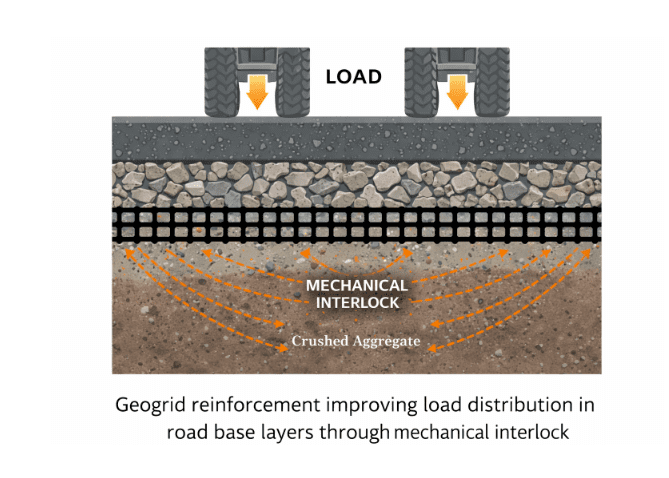
A common belief in construction is that adding reinforcement automatically makes a structure stronger or more durable. While this can be true under certain conditions, it is not a universal rule.
Reinforcement works by improving the interaction between soil and aggregate layers. For example, geogrids create a confinement effect that helps distribute loads more evenly. This is particularly useful in weak or soft subgrades where natural support is limited.
However, in well-prepared subgrades with high bearing capacity, this benefit becomes much less noticeable.
If the underlying soil is already strong and properly compacted, the load distribution is naturally efficient. In such cases, adding reinforcement does not significantly enhance performance. Instead, it may simply act as an extra layer that does little more than increase material and installation costs.
This is why modern engineering practice emphasizes performance-based design. Rather than assuming reinforcement is beneficial, engineers must evaluate whether it actually contributes to measurable improvement under real site conditions.
Situations Where Reinforcement May Be Less Effective
There are several real-world scenarios where reinforcement systems may not deliver the expected value.
One of the most common is when the natural subgrade is already strong. Soils with good bearing capacity and low compressibility can support loads effectively without additional reinforcement. In these cases, the structural benefit of reinforcement is minimal.
Another situation involves low-traffic or temporary roads. For example, construction access roads used for a short duration often do not justify the added cost of reinforcement. A well-compacted granular layer may be sufficient to handle the expected loads.
Installation quality is another critical factor that is often overlooked. Reinforcement systems rely heavily on proper placement, tensioning, and compaction. If the installation is rushed or poorly executed, the system may fail to perform as intended. In some cases, improper installation can even reduce overall stability rather than improve it.
Material compatibility also plays a key role. The interaction between aggregate and reinforcement is essential for performance. If the aggregate size does not match the aperture size of a geogrid, for example, the interlocking mechanism becomes ineffective. Without proper interlock, the reinforcement cannot distribute loads efficiently.
These scenarios highlight an important point: reinforcement is not inherently ineffective—but it is highly context-dependent.
Design and Cost Considerations
From a cost perspective, reinforcement should always be justified by performance benefits.
Adding unnecessary layers or materials can quickly increase project costs. This includes not only material expenses but also transportation, labor, and installation time. In large-scale infrastructure projects, even small inefficiencies can translate into significant financial impact.
Overdesign is a common issue in projects where reinforcement is applied without thorough analysis. Engineers may choose to include reinforcement as a safety measure, even when it is not technically required. While this approach may seem conservative, it is not always economical or efficient.
A better approach is to base design decisions on actual site data. This includes soil testing, load analysis, and performance modeling. By understanding the true conditions of the project, engineers can determine whether reinforcement adds value—or whether it can be safely omitted.
For engineers evaluating both benefits and drawbacks, this overview of limitations of geogrid systems provides a practical understanding of when reinforcement may not be the optimal choice.
The Role of Reinforcement in Suitable Conditions
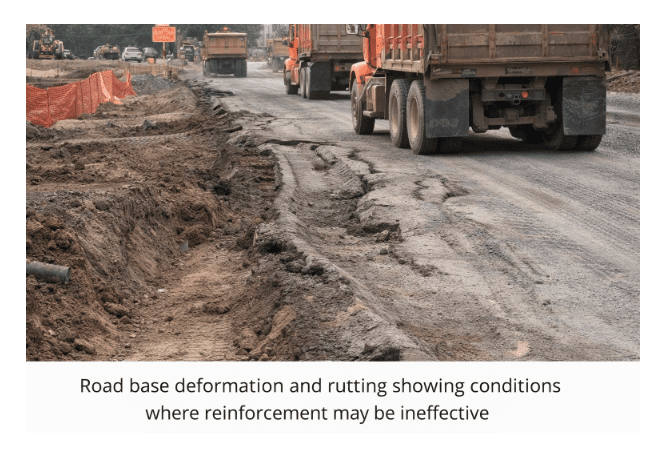
Despite its limitations, ground reinforcement remains an essential tool in modern engineering—when used correctly.
Its value becomes clear in challenging conditions, particularly in weak or variable soils. In such environments, reinforcement can significantly improve load distribution and reduce deformation. This leads to better performance, longer service life, and lower maintenance requirements.
High-load applications are another area where reinforcement proves highly effective. Roads subjected to heavy traffic, industrial platforms supporting large equipment, and railway tracks all benefit from improved structural stability.
When properly designed and installed, reinforcement systems can improve load distribution, reduce deformation, and extend pavement life. A more detailed explanation of geogrid reinforcement in road construction highlights how these systems function effectively under the right conditions.
Final Thoughts
Ground reinforcement should not be treated as a default solution, but as a strategic engineering tool.
Its effectiveness depends on multiple factors, including soil conditions, load requirements, material compatibility, and installation quality. When these elements are properly aligned, reinforcement can deliver significant performance improvements.
However, when applied without careful evaluation, it may offer little benefit while increasing costs and complexity.
The key is balance. By understanding both the strengths and limitations of reinforcement systems, engineers can make more informed decisions. This leads to designs that are not only structurally sound but also cost-effective and efficient over the long term.