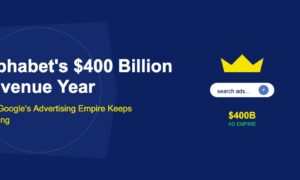
Search advertising revenue in the United States surpassed 102 billion dollars in 2025, making it the largest single category within the digital advertising ecosystem. Google commands approximately 83 percent of this market through its dominant search engine and associated advertising products, while Microsoft’s Bing platform captures roughly 9 percent and Amazon’s product search advertising accounts for an increasingly significant share of search-intent advertising dollars.
The hundred-billion-dollar search advertising market represents two decades of compounding growth since Google introduced its AdWords platform in 2000. What began as simple text ads displayed alongside search results has evolved into a sophisticated ecosystem of advertising formats, bidding strategies and targeting capabilities that touches virtually every industry in the American economy. Search advertising works because it captures consumers at the moment they express intent, creating an advertising environment where relevance is inherently high and measurable outcomes are the norm.
Despite its maturity, the search advertising market continues to grow at approximately 8 percent annually, adding roughly 7.5 billion dollars in new revenue each year. This growth rate is impressive for a market of this scale and reflects both the increasing digitization of consumer research behavior and the expansion of search advertising into new formats including shopping ads, local services ads, video search results and AI-enhanced search experiences.
The economics of keyword advertising
The keyword advertising model operates through real-time auction systems that process billions of queries daily. When a consumer searches for a term like “best running shoes” or “plumber near me,” an auction occurs in milliseconds among advertisers who have bid on relevant keywords. The winner’s ad appears prominently in search results, and the advertiser pays only when the consumer clicks on the ad. This pay-per-click model ensures that advertisers pay for actual engagement rather than estimated exposure.
Keyword costs vary enormously by industry, competition level and commercial intent. Legal keywords represent the most expensive category, with terms like “mesothelioma lawyer” commanding costs per click exceeding 200 dollars. Insurance, financial services and medical keywords also carry premium prices, with average costs per click ranging from 20 to 80 dollars. Conversely, less competitive categories like local services, specialty retail and educational content typically see costs per click between 1 and 10 dollars.
Quality Score, Google’s rating of an advertiser’s relevance and landing page experience, plays a critical role in search advertising economics. Advertisers with high Quality Scores pay lower costs per click and receive more favorable ad positions than competitors with lower scores. This system incentivizes advertisers to create relevant, high-quality landing pages and ad copy, improving the consumer experience while rewarding advertisers who invest in relevance rather than simply outbidding competitors.
The return on investment for search advertising varies by industry and campaign type but generally compares favorably to other advertising channels. Google internal data shows that search advertising generates an average return of approximately 8 dollars for every dollar spent, though this figure ranges from 3 dollars in highly competitive categories to more than 15 dollars in categories with lower competition and higher customer lifetime values. These returns explain why search advertising continues to capture the largest share of digital advertising budgets despite the availability of newer and more visually engaging alternatives.
Google’s dominance and competitive pressures
Google’s 83 percent share of US search advertising revenue reflects its overwhelming dominance in consumer search behavior. Google processes approximately 8.5 billion searches per day globally, with the United States accounting for roughly 27 percent of that volume. The company’s search advertising business benefits from decades of accumulated behavioral data, sophisticated machine learning algorithms and a global advertiser base that provides deep liquidity for its auction systems.
Google’s advertising product suite has expanded well beyond traditional text ads. Google Shopping ads, which display product images, prices and merchant information directly in search results, have become a major revenue driver for e-commerce advertisers. Performance Max campaigns, which use AI to optimize advertising across Google’s entire inventory including Search, YouTube, Display, Gmail and Maps, represent Google’s vision for the future of automated advertising. Local Services Ads connect service providers with nearby consumers through a pay-per-lead model that has proven particularly effective for home services businesses.
Microsoft’s Bing platform has maintained a stable position as the second-largest search advertising platform, benefiting from its integration with Windows devices, Microsoft Edge browser and the LinkedIn professional network. Microsoft Advertising reaches approximately 38 percent of US desktop searches through Bing and partner networks. The company’s integration of AI capabilities through its partnership with OpenAI has generated renewed interest in Bing, though its impact on advertising market share has been gradual rather than dramatic.
Amazon’s role in search advertising continues to expand as consumers increasingly begin product searches on the Amazon platform rather than Google. An estimated 56 percent of US consumers start their product searches on Amazon, bypassing traditional search engines entirely for commercial queries. This behavioral shift has directed significant search advertising budgets toward Amazon Sponsored Products and Sponsored Brands, which collectively generate approximately 38 billion dollars in US advertising revenue annually.
The AI transformation of search advertising
Artificial intelligence is fundamentally changing how search advertising operates at every level, from query understanding to ad creation to bidding optimization. Google’s implementation of AI-powered search experiences, including AI Overviews that provide synthesized answers at the top of search results, is reshaping the advertising landscape by changing how consumers interact with search results and where advertising placements appear.
The introduction of conversational AI search experiences by Google, Microsoft and emerging competitors like Perplexity raises important questions about the future of traditional keyword advertising. When an AI assistant provides a comprehensive answer to a query within the search interface, users may have less reason to click on either organic or paid results. The advertising industry is closely monitoring how AI search adoption affects click-through rates and conversion patterns for search advertising campaigns.
AI-powered bidding systems have become essential for competitive search advertising performance. Google’s Smart Bidding strategies, including Target CPA, Target ROAS and Maximize Conversions, use machine learning to optimize bids for each individual auction based on hundreds of contextual signals. These automated bidding systems have largely replaced manual bid management for sophisticated advertisers, though they require careful configuration and monitoring to ensure alignment with business objectives.
Generative AI is also transforming search advertising creative development. Google’s automatically created assets feature uses AI to generate ad headlines and descriptions based on landing page content and historical performance data. While many advertisers still prefer to craft their own ad copy, AI-generated creative is improving rapidly and becoming increasingly competitive with human-written advertisements in performance metrics.
The road ahead for search advertising
Voice search advertising represents an emerging opportunity as smart speaker and voice assistant usage continues to grow. An estimated 42 percent of US adults use voice search at least once daily, creating advertising inventory in conversational search environments. Monetizing voice search presents unique challenges because the audio format limits the number of advertising placements that can be delivered without degrading the user experience, but platforms are experimenting with sponsored voice responses and related formats.
Visual search advertising is another growing category, with consumers increasingly using camera-based search to identify products, compare prices and find purchase options. Google Lens processes billions of visual searches annually, and Pinterest’s visual search capabilities drive significant commercial activity. As visual search technology improves and adoption increases, advertising formats that capitalize on image-based search intent will become more important components of the search advertising ecosystem.
The regulatory environment for search advertising is becoming more complex, with antitrust scrutiny of Google’s market position intensifying in both the United States and European Union. The US Department of Justice’s antitrust case against Google, which resulted in a ruling that Google maintains an illegal monopoly in search, could lead to structural remedies that reshape the competitive dynamics of search advertising. Potential remedies being discussed include restrictions on default search agreements and requirements to share search data with competitors.
Despite the uncertainties created by AI transformation, regulatory risk and competitive dynamics, search advertising is projected to grow to approximately 135 billion dollars in the United States by 2029. The channel’s fundamental advantage of capturing consumers at moments of expressed intent ensures its continued relevance, even as the specific formats, platforms and technologies through which search advertising is delivered evolve. For advertisers, the keyword market remains the most reliable and measurable channel for connecting with consumers who are actively seeking products and services.
Data from Statista’s digital market outlook shows that global digital spending continues to grow at double-digit rates, with mobile channels accounting for an increasingly dominant share of total transactions.
PwC’s analysis of financial services trends through 2025 highlights the convergence of technology and media as a defining dynamic, with data-driven personalisation becoming the primary competitive differentiator.