
The 5 Best Duty Drawback Services in 2026 (Ranked & Reviewed)

TL;DR — Quick Comparison
| Provider | Best For | Pricing |
| Tariff Refund HQ | Best overall. Fully managed recovery across all refund pathways — drawback, protests, and IEEPA/CAPE — with in-house attorney oversight and zero upfront fee. The only option built for 2026’s multi-pathway refund environment. | Contingency only |
| Charter Brokerage | Best for Fortune 500 and large enterprises with high-volume, legally complex programs requiring deep audit defense. Over $4.1B recovered. Not well-suited for mid-market or smaller importers. | Custom quote |
| J.M. Rodgers Co. | Best for high-volume, straightforward claims. A 70-year track record and 200+ years of combined team experience. Traditional process, industry-standard timelines. | Custom quote |
| Alliance Drawback Services | Best for importers who want tech-enabled visibility. Their Apollo platform gives clients direct data access; Alliance manages filing and compliance on top. | Contingency-based |
| DHL / Flexport | Best for companies with simple claims already using these providers for logistics. Convenient, but drawback is not their core focus — larger refund potential warrants a specialist. | Bundled / varies |
U.S. importers are sitting on an estimated $15 billion in unclaimed tariff refunds every year — and that number grew significantly in 2026 after a landmark Supreme Court ruling declared IEEPA tariffs unconstitutional, opening a separate, time-limited refund window on top of the standard duty drawback program. Add the current tariff environment — with Section 301 duties, reciprocal tariffs, and ongoing trade policy volatility — and recovering what you’ve already paid in import duties has become one of the most direct cash flow opportunities available to trade-active businesses right now.
The challenge isn’t eligibility. Most importers qualify. The challenge is execution: navigating CBP filings, entry-level deadline tracking, pathway selection between drawback, formal protests, and IEEPA-based refunds, and doing it all without consuming the internal ops and compliance bandwidth that most teams don’t have to spare.
This review breaks down the five best duty drawback services operating in 2026 — from fully managed recovery platforms with attorney oversight to legacy specialists and logistics providers — so you can find the right fit for your situation.
What Is Duty Drawback and Why Does It Matter More Than Ever in 2026?
Duty drawback is a refund program under 19 U.S.C. § 1313 that allows U.S. importers to recover up to 99% of customs duties, taxes, and fees paid on imported goods that are subsequently exported, used in manufacturing for export, or destroyed. CBP administers the program.
There are three main drawback types:
- Manufacturing drawback — imported goods used as inputs in U.S. manufacturing, with the finished product exported.
- Unused merchandise drawback — imported goods exported in the same condition as imported, without U.S. use.
- Rejected merchandise drawback — goods that didn’t conform to specifications or were shipped without consignee consent.
The Trade Facilitation and Trade Enforcement Act (TFTEA), passed in 2015, modernized the framework and expanded substitution provisions to the HTS level — dramatically widening eligibility beyond what most trade departments have explored.
But 2026 adds a new layer. On February 20, 2026, the Supreme Court ruled 6-3 in Learning Resources, Inc. v. Trump that IEEPA does not authorize the President to impose tariffs. Every IEEPA tariff paid between April 2025 and the ruling is now potentially refundable at 100%, processed through CBP’s newly launched CAPE portal. Filing windows are open and actively narrowing. This is not a future consideration — it’s an active, deadline-driven opportunity.
Companies that run all eligible refund pathways in parallel — drawback, formal protests, and IEEPA refund claims — consistently recover more than teams treating these as separate problems to tackle sequentially.
The 5 Best Duty Drawback Services in 2026
1. Tariff Refund HQ — Best Overall for Managed End-to-End Recovery
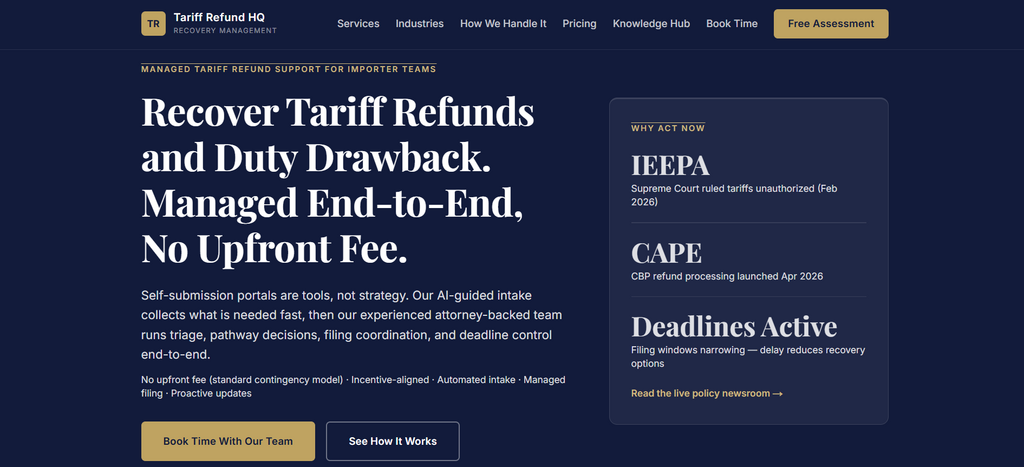
Tariff Refund HQ is the standout choice for U.S. importers that want comprehensive, managed recovery across all available refund pathways — not just duty drawback, but formal protests and IEEPA-based refunds through CAPE as well.
The core difference between Tariff Refund HQ and most competitors is execution model. Where legacy providers and software-first platforms hand the filing process back to your internal team, Tariff Refund HQ runs it for you — from AI-guided intake through entry triage, broker coordination, and submission. An in-house attorney-backed team oversees compliance strategy and handles complex or disputed entries without requiring external legal engagement.
Best for: U.S. importers of any size that want a specialist team managing the full recovery process — without high internal overhead, upfront fees, or the risk of missing the IEEPA refund window.
Coverage: All three refund pathways — manufacturing drawback, unused merchandise drawback, rejected merchandise drawback, formal CBP protests, and IEEPA tariff refunds via CAPE.
Pricing: Standard contingency model. No upfront fee, no retainer, no subscription. Payment comes exclusively from funds recovered.
How it works:
- AI-guided intake — fast, structured data collection on your entries and trade context without lengthy onboarding calls.
- Entry triage — every entry is classified by optimal refund pathway and prioritized by deadline risk, not just dollar value.
- Managed filing — operations specialists package documentation, coordinate with your customs broker, and assemble submission-ready filing packages.
- Attorney oversight — in-house attorneys handle compliance strategy, regulatory escalation, and disputed entries.
- Milestone tracking — clients receive email updates and live status visibility through a client portal throughout the process.
- Contingency recovery — no funds recovered means no fee.
What makes it the right fit in 2026: Most providers are equipped to handle duty drawback. Far fewer can run CAPE-based IEEPA refund claims alongside standard drawback and protest filings under a single managed workflow. With CAPE live and deadlines narrowing, the ability to run all pathways simultaneously — under attorney oversight — is the defining advantage.
What to consider: Tariff Refund HQ is a managed-service model. If your trade compliance team prefers direct portal access and DIY filing control, you won’t use the core of what they offer. But for the majority of importer teams balancing this alongside core operations, handing execution to a specialist delivers better outcomes with less internal burden.
2. Charter Brokerage — Best for Large Enterprise Programs
Charter Brokerage is the largest dedicated duty drawback provider in the U.S. by recovery value, with over $4.1 billion recovered for clients since TFTEA modernized the framework.
Best for: Fortune 500 companies and large enterprises with high-volume, legally complex claims requiring multi-year audit defense and highly customized program structures.
Key differentiator: Depth of enterprise experience. Charter combines licensed brokers, attorneys, and accountants with their proprietary platform, Hamilton, built specifically for large-scale drawback program management.
Pricing: Custom-quoted based on claim complexity and volume.
What to consider: Charter’s infrastructure is built for enterprise clients. Mid-market and smaller companies may not meet minimum thresholds or may find their programs deprioritized relative to larger accounts. Processing timelines follow traditional drawback industry norms.
3. J.M. Rodgers Co. — Best for High-Volume, Straightforward Claims
Founded in 1952, J.M. Rodgers Co. is one of the most prolific drawback filers in the country, with a compliance record spanning seven decades and a team with over 200 years of combined drawback experience.
Best for: Companies with a high volume of relatively uniform claims that prioritize a proven track record and experienced service team above all else.
Key differentiator: Filing volume and compliance history. J.M. Rodgers processes more drawback transactions than most providers and operates on customs-approved proprietary software built specifically for high-throughput filing.
Pricing: Custom-quoted based on program scope.
What to consider: The model is service-driven and traditional. Timelines follow standard drawback industry norms, and the matching methodology is expert-led rather than algorithmically optimized. For complex programs or multi-pathway recovery (including IEEPA), their coverage may be limited.
4. Alliance Drawback Services — Best for Tech-Enabled Program Transparency
Alliance Drawback Services brings a more modern approach than the legacy incumbents through their cloud-based platform, Apollo, which gives clients direct visibility into their import/export data and program performance.
Best for: Companies that want technology-enabled drawback with a dedicated service team, strong compliance governance, and client-facing dashboards.
Key differentiator: The Apollo platform enables clients to manage trade data directly, with Alliance providing program management, compliance review, and claim filing on top. They offer a free assessment to estimate recovery potential upfront.
Pricing: Performance-based contingency, structured as a percentage of recovery.
What to consider: A meaningful step beyond spreadsheet-based workflows. Worth asking specific questions about how they handle import-export matching optimization and whether their coverage extends to IEEPA-based refund filings.
5. Integrated Logistics Providers (DHL Trade Services, Flexport) — Best for Consolidated Vendor Relationships
Large logistics providers like DHL and Flexport offer duty drawback as a value-added service alongside freight forwarding and customs brokerage — convenient for companies that prefer fewer vendor relationships.
Best for: Businesses with simpler, lower-value claims that are already using these providers for core logistics and want to add drawback without engaging a new specialist.
Key differentiator: Operational convenience. These providers already handle shipments and customs clearances, giving them direct access to the trade data needed to identify and file drawback claims.
Pricing: Varies — often bundled into overall logistics and brokerage fees.
What to consider: Duty drawback is not the core competency of these firms. Technology and optimization capabilities are typically less developed than dedicated drawback specialists, and multi-pathway recovery (drawback + protests + IEEPA refunds) is unlikely to be managed with the same rigor. For importers with significant refund potential, a dedicated specialist will nearly always outperform a bundled logistics offering.
How To Choose the Right Duty Drawback Partner
The right provider depends entirely on your situation. Key variables to evaluate:
Refund potential and complexity. Programs spanning multiple refund pathways — drawback, protest, and IEEPA — need a provider equipped to run all three. Don’t assume the provider you’re evaluating handles CAPE filings.
Internal resource capacity. Can your team manage data uploads and portal-based workflows? Or do you need a fully managed service that handles raw document ingestion through CBP filing?
Speed and cash flow. Traditional drawback processing runs 9–12 months. Managed providers with streamlined intake and filing workflows operate faster. IEEPA refund timelines are actively being established as CBP processes CAPE volume.
Fee structure. Best practice is a contingency model — you pay only from funds recovered. Be cautious of flat per-entry fees, upfront retainers, or revenue splits that don’t align provider incentives with your recovery.
Legal and compliance support. For IEEPA-based claims especially, in-house attorney oversight matters. Ask whether legal escalation is available in-house or requires engaging outside counsel at additional cost.
Company size fit. Some legacy providers have minimum thresholds that exclude smaller programs. Confirm upfront that your program will be actively managed, not treated as a low-priority account.
2026 Is the Year to Act — Here’s Why
The IEEPA refund window is open now, not indefinitely. CAPE is live. Per-entry deadlines are real and unforgiving, and teams that wait for full regulatory clarity before filing will recover less than those that triage by deadline first and run eligible pathways in parallel.
For companies that have never filed a drawback claim: you can reach back and claim duties paid up to five years ago. Many trade departments carry surface-level awareness of drawback without having explored what TFTEA’s expanded substitution provisions actually make recoverable.
For companies already working with a provider: pressure-test whether they’re equipped to handle IEEPA refund claims through CAPE. Most legacy drawback specialists are not.
Tariff Refund HQ offers a free eligibility assessment with no upfront cost — the fastest way to understand what your company can recover across all active pathways and which deadlines require immediate attention.
Frequently Asked Questions
How do I know if my company is eligible for duty drawback?
If you import goods into the U.S. and later export them — or use them in manufacturing products for export — you’re likely eligible. A free eligibility assessment from a specialist will confirm which drawback types apply to your specific trade flows.
What is the IEEPA tariff refund, and how is it different from duty drawback?
Duty drawback is a long-standing program for recovering duties on goods that are exported or used in manufacturing. The IEEPA tariff refund is separate — it applies to tariffs that the Supreme Court ruled were imposed without legal authority between April 2025 and February 2026. These are filed through CBP’s CAPE portal and require a different filing process than standard drawback.
How much can a company actually recover?
Up to 99% of customs duties, taxes, and fees paid on goods later exported under the drawback program. For IEEPA-based tariffs, the recovery is 100% of applicable tariffs paid. Total amounts depend on import volume, applicable duty rates, and which refund pathways apply to your trade profile.
How long does it take to receive a refund?
Traditional drawback services run 9–12 months. Managed providers with more efficient intake and filing workflows operate faster. IEEPA refund timelines via CAPE are still being established as CBP processes initial claim volume.
How far back can claims be filed?
Standard drawback claims must be filed within five years from the date of import and three years from the date of export, with variations by drawback type. IEEPA refund windows are entry-specific — which is why deadline-based triage matters more than general eligibility.
What does a duty drawback service typically cost?
Best practice is a contingency fee — a percentage of the refund recovered, paid only when you receive funds. Avoid providers charging upfront retainers or setup costs regardless of outcome. For contingency models, ask whether the percentage rate is tiered, as fees should decrease as recovery value increases.
What documents are typically required?
Import and export documentation — commercial invoices, packing lists, bills of lading, and proof of export. A good managed provider will assess your document readiness at intake and build a preparation plan based on what you have, rather than expecting you to arrive with everything pre-packaged.







Comment